December 14, 2021; revised August 27, 2022; November 24, 2022; March 17, 2023; rewritten April 2, 2023
Ngày 14/12/2021; sửa đổi ngày 27/08/2022; ngày 24/11/2022; ngày 17/03/2023; viết lại ngày 02/04/2023.
Cetanā expresses the “intention” via a set of cetasika. Saṅkhāra leads to action with that intention. Kamma is the deed done with that intention.
Cetanā thể hiện “ý định” thông qua một nhóm cetasika. Saṅkhāra dẫn đến hành động theo ý định ấy. Kamma chính là hành động được thực hiện với ý định đó.
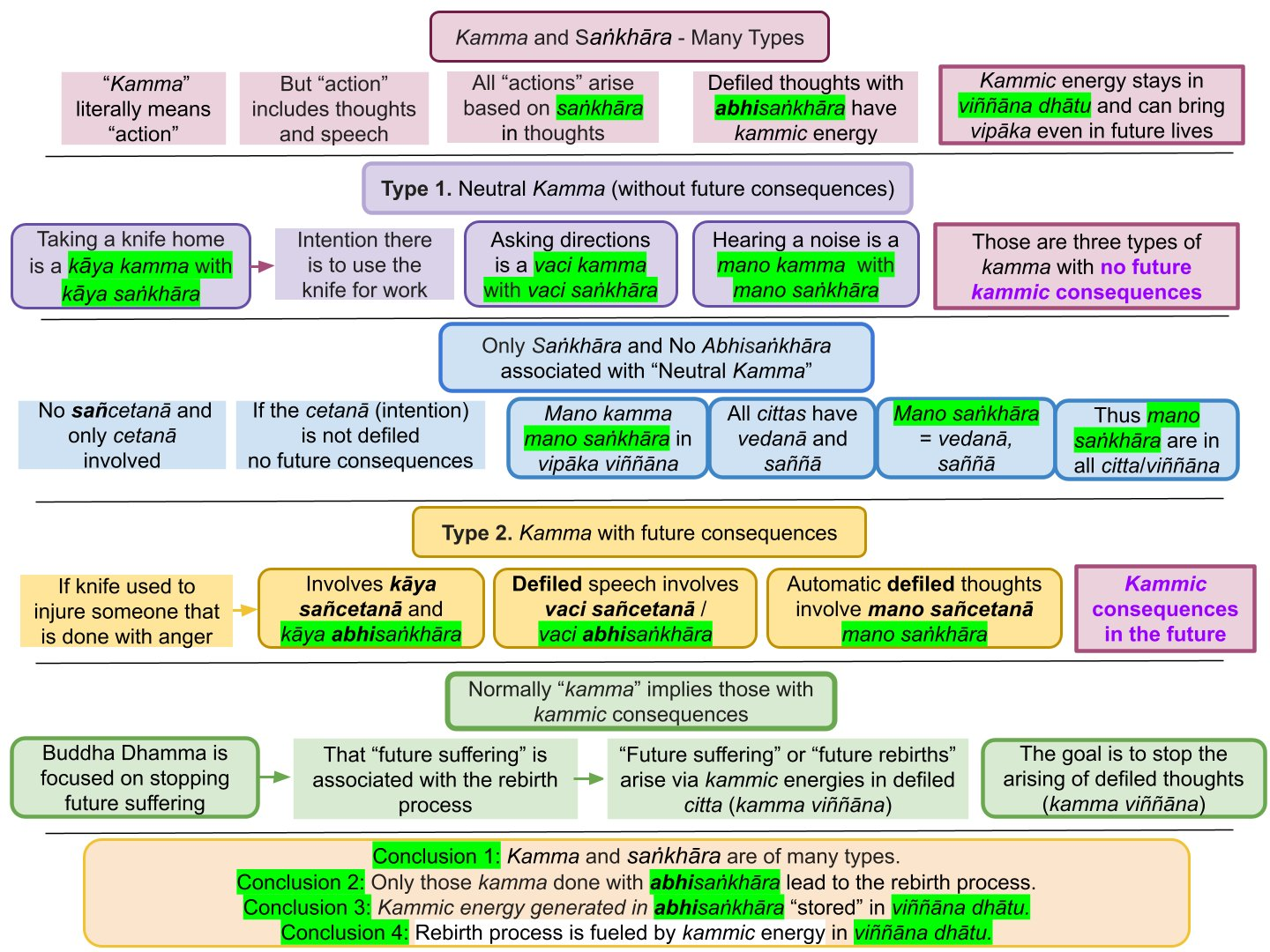
Buddhism – In Charts: 8. Kamma and Saṅkhāra
Phật giáo – Qua các sơ đồ: 8. Kamma và Saṅkhāra
Download/Print: “WebLink: suttacentral: 8. Kamma and Saṅkhāra”
Tải xuống/In: “WebLink: suttacentral: 8. Kamma and Saṅkhāra”
Introduction
Giới thiệu
- Most people use the word “kamma” to indicate “bad deeds” or even “results of past bad deeds” (which are really “kamma vipāka.”) When something terrible happens, they say, “Oh, this is my kamma.”
Phần lớn mọi người dùng từ “kamma” để chỉ “việc xấu”, thậm chí là “quả của những việc xấu trong quá khứ” (thực ra đó là “kamma vipāka”). Khi gặp chuyện tồi tệ, họ nói: “Ôi, đây là kamma của tôi”.
- But kamma is a generic word that means “action.” That could mean moving the body, speaking, or thinking (kāya, vaci, and mano kamma.) Kamma can be of mainly three types:
Nhưng kamma là một từ mang nghĩa chung là “hành động”. Đó có thể là cử động thân thể, nói năng hoặc suy nghĩ (kāya, vaci và mano kamma). Có thể chia kamma thành ba loại chính:
- Neutral kamma: like using a knife to cut vegetables or asking directions from someone.
Kamma trung tính: chẳng hạn dùng dao cắt rau hoặc hỏi đường một người nào đó.
- Akusala (or pāpa/apuñña) kamma: e.g., stabbing someone with a knife or telling a lie to make money.
Akusala (hoặc pāpa/apuñña) kamma: chẳng hạn dùng dao đâm người khác hoặc nói dối để kiếm tiền.
- Puñña kamma: e.g., using a knife to cut loose a trapped animal or explaining Dhamma to others. A kusala kamma is a puñña kamma done with the comprehension of the Four Noble Truths, i.e., by a Noble Person. Of course, all puñña kamma become kusala kamma only for an Arahant.
Puñña kamma: chẳng hạn dùng dao cắt dây giải thoát một con vật mắc bẫy hoặc giải thích Dhamma cho người khác. Kusala kamma là puñña kamma được thực hiện với sự thấu hiểu Tứ Thánh đế, tức bởi một bậc Thánh. Dĩ nhiên, chỉ đối với một vị Arahant thì tất cả puñña kamma mới trở thành kusala kamma.
- All three types are done with a specific intention. We must engage in various kinds of kamma of the first type in our daily lives to get things done. The “intention” in the second type is evil or immoral, while that in the third type is good or moral.
Cả ba loại đều được thực hiện với một ý định nhất định. Trong đời sống hằng ngày, chúng ta cần thực hiện nhiều loại kamma thuộc nhóm thứ nhất để hoàn thành công việc. “Ý định” ở loại thứ hai là xấu hoặc bất thiện, còn ở loại thứ ba là tốt hoặc thiện.
- The first type of kamma yields results at that time only; they do not lead to “kammic consequences” in the future. Those actions do not have morally good or bad intentions.
Loại kamma thứ nhất chỉ mang lại kết quả ngay lúc thực hiện; chúng không dẫn đến “hệ quả của kamma” trong tương lai. Những hành động ấy không xuất phát từ ý định thiện hay bất thiện.
- The second/third type can bring “bad/good results” at that time or in the future. Moral or immoral “intentions” that arise lead to the creation of an unseen “kammic energy” that remains in “viññāṇa dhātu” and can bring vipāka in the future. See below.
Loại thứ hai và thứ ba có thể mang lại “quả xấu/quả tốt” ngay lúc ấy hoặc trong tương lai. Những “ý định” thiện hay bất thiện phát sinh sẽ tạo ra một dạng “năng lượng kamma” không nhìn thấy được, tồn tại trong “viññāṇa dhātu” và có thể mang lại vipāka trong tương lai. Xem phần dưới.
- That “intention” is not in the cetanā cetasika (mental factor), per se, but is incorporated via a set of other “moral/immoral” cetasika, as explained below. [per se: [adverb] with respect to its inherent nature.]
“Ý định” ấy không nằm sẵn trong bản thân cetanā cetasika (tâm sở), mà được hình thành thông qua một nhóm cetasika “thiện/bất thiện” khác, như sẽ giải thích dưới đây. [per se: trạng từ, nghĩa là xét theo bản chất vốn có của chính nó.]
- Cetanā cetasika only incorporates appropriate cetasikas into a citta; “cetanā” means to “assemble a citta (with appropriate) cetasika.”
Cetanā cetasika chỉ tập hợp những cetasika thích hợp vào một citta; “cetanā” có nghĩa là “kết hợp các cetasika (thích hợp) để hình thành một citta”.
- With intention, one generates three types of saṅkhāra to “take action.” Kamma is the deed done with saṅkhāra. Kāya, vacī, and mano saṅkhāra lead to kāya, vacī, and mano kamma. A kamma becomes immoral or moral with the incorporation of immoral or moral (sobhana/asobhana) cetasika, as explained below.
Khi có ý định, chúng ta tạo ra ba loại saṅkhāra để “hành động”. Kamma là hành vi được thực hiện thông qua saṅkhāra. Kāya, vacī và mano saṅkhāra lần lượt dẫn đến kāya, vacī và mano kamma. Một kamma trở thành bất thiện hay thiện tùy theo những cetasika bất thiện hoặc thiện (sobhana/asobhana) được đưa vào, như sẽ giải thích dưới đây.
Cetanā Is In Every Citta!
Cetanā Có Trong Mọi Citta!
- “Nibbedhika Sutta (AN 6.63)” is a vital sutta that explains many keywords in Buddha Dhamma. Toward the end, it defines kamma: “Cetanā, I tell you, is kamma. With intention, one does kamma through body, speech, and mind.” See Ref. 1.
“Nibbedhika Sutta (AN 6.63)” là một sutta quan trọng, giải thích nhiều thuật ngữ then chốt trong Dhamma của Đức Phật. Gần cuối sutta, kamma được định nghĩa: “Này các Tỳ-kheo, Ta nói cetanā là kamma. Có ý định rồi, người ta thực hiện kamma qua thân, lời nói và tâm.” Xem Tài liệu tham khảo 1.
- Now, cetanā is a “universal cetasika,” meaning it is in every citta. This is a CRITICAL observation. We don’t do good or bad kamma at all times. Thus, kamma means any bodily activity, speech, or even thoughts. For example, we saw that even breathing happens with cittās.
Cetanā là một “cetasika phổ biến”, nghĩa là nó có trong mọi citta. Đây là điểm CỰC KỲ QUAN TRỌNG. Không phải lúc nào chúng ta cũng thực hiện kamma thiện hay bất thiện. Vì thế, kamma có thể chỉ bất kỳ hoạt động nào của thân, lời nói hoặc ngay cả suy nghĩ. Chẳng hạn, chúng ta đã thấy rằng ngay cả việc hít thở cũng diễn ra với các citta.
- Therefore, even any action, like lifting an arm, is a kamma. One may also speak and think about getting some task done that would NOT have morally good or bad intentions. Those would NOT belong to akusala, pāpa, puñña, or kusala kamma. They are just kamma. Such “neutral kamma” would not have sobhana (moral) or asobhana (immoral) cetasika. However, cetanā cetasika is still there since it is a universal cetasika.
Do đó, ngay cả một hành động như giơ cánh tay cũng là kamma. Người ta cũng có thể nói hoặc suy nghĩ để hoàn thành một công việc mà KHÔNG mang ý định thiện hay bất thiện về mặt đạo đức. Những hoạt động ấy KHÔNG thuộc akusala, pāpa, puñña hay kusala kamma; chúng đơn thuần là kamma. “Kamma trung tính” như vậy không có các cetasika sobhana (thiện) hoặc asobhana (bất thiện). Tuy nhiên, cetanā cetasika vẫn hiện diện vì đó là một cetasika phổ biến.
- There are seven such “universal cetasika” in every citta: Phassa (contact with an ārammaṇa); vedanā (feeling); saññā (perception); cetanā (putting together all relevant mental factors); Ekaggatā (One-pointedness); jīvitindriya (life faculty); manasikāra (memory). See Ref. 2.
Có bảy “cetasika phổ biến” hiện diện trong mỗi citta: phassa (sự tiếp xúc với một ārammaṇa); vedanā (cảm thọ); saññā (sự nhận biết); cetanā (kết hợp tất cả tâm sở liên quan); ekaggatā (nhất tâm); jīvitindriya (mạng căn); manasikāra (khả năng nhớ lại). Xem Tài liệu tham khảo 2.
- Mano saṅkhāra are defined as “vedanā and saññā;” see “Saṅkhāra – Should Not be Translated as a Single Word.” Since vedanā and saññā are universal cetasika, mano saṅkhāra arise in every citta. Thus, a “neutral kamma” is done with only mano saṅkhāra.
Mano saṅkhāra được định nghĩa là “vedanā và saññā”; xem “Saṅkhāra – Should Not be Translated as a Single Word.” Vì vedanā và saññā là những cetasika phổ biến, mano saṅkhāra phát sinh trong mọi citta. Do đó, một “kamma trung tính” được thực hiện chỉ với mano saṅkhāra.
- A new citta vīthi arises when a new ārammaṇa comes in. That contact with the new ārammaṇa is phassa. The mind “feels” that (vedanā) and recognizes it (saññā) with the help of the manasikāra cetasika that can recall similar past events. Ekaggatā helps keep the mind focused on that ārammaṇa. See “Citta and Cetasika – How Viññāṇa (Consciousness) Arises.”
Một citta vīthi mới sinh khởi khi có một ārammaṇa mới đến. Sự tiếp xúc với ārammaṇa mới ấy là phassa. Tâm “cảm nhận” đối tượng đó (vedanā) và nhận ra nó (saññā), nhờ sự hỗ trợ của manasikāra cetasika, vốn có thể nhớ lại những sự việc tương tự trong quá khứ. Ekaggatā giúp tâm tập trung vào ārammaṇa ấy. Xem “Citta and Cetasika – How Viññāṇa (Consciousness) Arises.”
- That complex process occurs within a billionth of a second (lifetime of a citta). See “Amazingly Fast Time Evolution of a Thought (Citta).” It is critical to read that post to understand this primary process.
Tiến trình phức tạp ấy diễn ra trong khoảng một phần tỷ giây (thời gian tồn tại của một citta). Xem “Amazingly Fast Time Evolution of a Thought (Citta).” Việc đọc bài này rất quan trọng để hiểu tiến trình căn bản ấy.
- When cetanā starts incorporating “defiled intentions,” it becomes sañcetanā, and saṅkhāra becomes abhisaṅkhāra.
Khi cetanā bắt đầu kết hợp những “ý định bị ô nhiễm”, nó trở thành sañcetanā, và saṅkhāra trở thành abhisaṅkhāra.
Cetanā Becomes Sañcetanā
Cetanā Trở Thành Sañcetanā
- The word “sañcetanā” comes from “saŋ” + “cetanā.” Thus, it means cetanā cetasika has incorporated “saṅ” that can contribute to generating kammic energy for future rebirths. I have discussed the importance of “saṅ” in many posts. See “Saŋ – A Critical Pāli Root.”
Từ “sañcetanā” bắt nguồn từ “saŋ” + “cetanā”. Như vậy, nó có nghĩa là cetanā cetasika đã kết hợp thêm “saṅ”, yếu tố có thể góp phần tạo ra năng lượng kamma cho những lần tái sinh trong tương lai. Tôi đã bàn về tầm quan trọng của “saṅ” trong nhiều bài viết. Xem “Saŋ – A Critical Pāli Root.”
- Therefore, saṅkhāra are associated with cetanā, and abhisaṅkhāra (those that contribute to the rebirth process) involve sañcetanā.
Do đó, saṅkhāra gắn liền với cetanā, còn abhisaṅkhāra (những saṅkhāra góp phần duy trì tiến trình tái sinh) thì có sañcetanā.
- The intention becomes “defiled” when certain types of cetasika arise. For example, an “angry state of mind” is expressed by incorporating dosa and moha cetasika into the citta. When becoming greedy, lobha, moha, and even jealousy (issā) cetasika may arise in citta.
Ý định trở nên “ô nhiễm” khi một số loại cetasika nhất định sinh khởi. Chẳng hạn, “trạng thái tâm sân giận” được biểu hiện khi dosa và moha cetasika được kết hợp vào citta. Khi tâm tham khởi lên, lobha, moha và thậm chí cả cetasika ganh tỵ (issā) có thể sinh khởi trong citta.
- When cetanā incorporates types of cetasika responsible for future vipāka, it becomes sañcetanā. Then saṅkhāra become abhisaṅkhāra.
Khi cetanā kết hợp những loại cetasika có thể đưa đến vipāka trong tương lai, nó trở thành sañcetanā. Khi đó, saṅkhāra trở thành abhisaṅkhāra.
- Only abhisaṅkhāra with sañcetanā are responsible for the rebirth process or saṁsāra.
Chỉ những abhisaṅkhāra có sañcetanā mới là yếu tố dẫn đến tiến trình tái sinh hay saṁsāra.
- The word “saṁsāra” comes from “saŋ” + “sāra” where “sāra” means “good” or “beneficial.” Thus, one is trapped in the rebirth process because of the wrong view that “living in this world is beneficial.”
Từ “saṁsāra” bắt nguồn từ “saŋ” + “sāra”, trong đó “sāra” có nghĩa là “tốt” hoặc “có lợi”. Vì vậy, một người bị mắc kẹt trong tiến trình tái sinh do tà kiến cho rằng “sống trong thế gian này là có lợi”.
- This is why the types of saṅkhāra that arise due to the ignorance of the Four Noble Truths (i.e., “avijjā paccayā saṅkhārā”) are kāya saṅkhāra, vacī saṅkhāra, and citta (mano) saṅkhāra that involve kāya sañcetanā, vacī sañcetanā, and mano (or citta) sañcetanā.
Đó là lý do những saṅkhāra sinh khởi do không hiểu Tứ Thánh Đế (tức “avijjā paccayā saṅkhārā”) là kāya saṅkhāra, vacī saṅkhāra và citta (mano) saṅkhāra có liên quan đến kāya sañcetanā, vacī sañcetanā và mano (hoặc citta) sañcetanā.
- “WebLink: suttacentral: Paṭiccasamuppāda Vibhaṅga (Abhidhamma Vb 6)” states: “Kāyasañcetanā kāya saṅkhāro, vacīsañcetanā vacī saṅkhāro, manosañcetanā citta saṅkhāro. Ime vuccanti ‘avijjā paccayā saṅkhārā’.” Therefore, saṅkhāra in Uppatti Paṭicca Samuppāda always involve abhisaṅkhāra with sañcetanā.
“WebLink: suttacentral: Paṭiccasamuppāda Vibhaṅga (Abhidhamma Vb 6)” nêu: “Kāyasañcetanā kāya saṅkhāro, vacīsañcetanā vacī saṅkhāro, manosañcetanā citta saṅkhāro. Ime vuccanti ‘avijjā paccayā saṅkhārā’.” Do đó, saṅkhāra trong Uppatti Paṭicca Samuppāda luôn liên quan đến abhisaṅkhāra có sañcetanā.
- However, only kāya abhisaṅkhāra and vacī abhisaṅkhāra directly lead to the rebirth process. Mano (or citta) sañcetanā do not become abhisaṅkhāra. That is a subtle point we will address in the future.
Tuy nhiên, chỉ kāya abhisaṅkhāra và vacī abhisaṅkhāra trực tiếp dẫn đến tiến trình tái sinh. Mano (hoặc citta) sañcetanā không trở thành abhisaṅkhāra. Đây là một điểm vi tế sẽ được bàn đến sau.
- A Buddha or an Arahant would not generate abhisaṅkhāra or sañcetanā, but they do generate saṅkhāra with cetanā until Parinibbāna. Their actions, speech, or thoughts would have kammically-neutral kāya, vacī, and mano saṅkhāra associated with them.
Một vị Phật hoặc một vị Arahant không tạo ra abhisaṅkhāra hay sañcetanā, nhưng các Ngài vẫn tạo ra saṅkhāra với cetanā cho đến khi Parinibbāna. Những hành động, lời nói và suy nghĩ của các Ngài gắn với kāya, vacī và mano saṅkhāra trung tính về phương diện kamma.
“Intention” Comes from Cetasikas Added Based on the Ārammaṇa and One’s Gati
“Ý Định” Phát Sinh Từ Những Cetasika Được Kết Hợp Theo Ārammaṇa và Gati Của Mỗi Người
- If the ārammaṇa is mind-pleasing, lobha (greed) can arise in the mind. When the lobha cetasika is incorporated into the citta, it becomes a “lobha citta.” On the other hand, seeing an enemy would generate dosa (anger), and the corresponding citta would be angry because cetanā would incorporate the dosa cetasika into it. Thus, cetanā is like a supervisor/administrator who adds other relevant cetasika (good or bad) based on the “state of mind.”
Nếu ārammaṇa làm tâm ưa thích, lobha (tham) có thể sinh khởi. Khi lobha cetasika được đưa vào citta, nó trở thành một “lobha citta”. Ngược lại, việc nhìn thấy kẻ thù có thể làm phát sinh dosa (sân), khiến citta tương ứng trở nên sân giận vì cetanā đưa dosa cetasika vào đó. Như vậy, cetanā giống như một người giám sát hoặc điều phối, kết hợp các cetasika liên quan khác (thiện hoặc bất thiện) tùy theo “trạng thái tâm”.
- Returning to the types of kamma in #1 above, we can now make sense of the role of the cetanā cetasika. The “intention” comes from the types of cetasika that arise in the mind based on the ārammaṇa and one’s gati. For example, someone with “angry gati” is more likely to be angered by even a mild accusation. For an introduction to gati: “The Law of Attraction, Habits, Character (Gati), and Cravings (Āsava).”
Trở lại các loại kamma ở mục số 1 phía trên, giờ đây chúng ta có thể hiểu vai trò của cetanā cetasika. “Ý định” xuất phát từ các loại cetasika sinh khởi trong tâm tùy theo ārammaṇa và gati của mỗi người. Chẳng hạn, người có “gati dễ sân” có thể nổi giận ngay cả khi bị trách móc nhẹ. Để tìm hiểu về gati, xem “The Law of Attraction, Habits, Character (Gati), and Cravings (Āsava).”
- The cetanā cetasika “constructs” a citta by incorporating appropriate cetasika based on one’s gati and the type of ārammaṇa. Thus, gati and the ārammaṇa will dictate the “intention.” This is a CRITICAL point to understand.
Cetanā cetasika “cấu thành” một citta bằng cách kết hợp những cetasika thích hợp dựa trên gati của người ấy và loại ārammaṇa đang có. Vì vậy, gati và ārammaṇa quyết định “ý định”. Đây là điểm CỰC KỲ QUAN TRỌNG cần hiểu.
- If one does a task with lobha, dosa, moha, then it is an akusala (or pāpa) kamma. Another subtle way to say that is any action done with chandarāga (with a mindset that says worldly pleasures are worthwhile pursuing) has at least a trace of akusala nature.
Nếu một người làm việc gì với lobha, dosa, moha, thì đó là akusala (hoặc pāpa) kamma. Có thể diễn đạt tinh tế hơn rằng bất kỳ hành động nào được thực hiện với chandarāga (tâm cho rằng những lạc thú thế gian đáng để theo đuổi) đều mang ít nhất một chút tính chất akusala.
- A particular activity involving generosity, compassion, etc., is a puñña kamma. Here, alobha and adosa cetasika are incorporated into cittā. Cetanā here is still “sañcetanā” IF one has not comprehended the dangers of the rebirth process, i.e., since one still has avijjā (not comprehending the Noble Truths).
Một hoạt động xuất phát từ bố thí, lòng bi mẫn, v.v. là puñña kamma. Khi ấy, các cetasika alobha và adosa được kết hợp vào cittā. Cetanā trong trường hợp này VẪN là “sañcetanā” NẾU người ấy chưa hiểu những hiểm họa của tiến trình tái sinh, nghĩa là vẫn còn avijjā (chưa thấu hiểu các Thánh Đế).
- That is because those “good kamma” are done with the expectation of “better rebirths/good vipāka” in the higher realms of the kāma loka (human and Deva realms).
Bởi vì những “kamma tốt” ấy được thực hiện với mong muốn được “tái sinh tốt hơn/nhận vipāka tốt” trong các cảnh giới cao hơn của kāma loka (cảnh giới người và Deva).
- A kusala kamma is a “better version” of a puñña kamma done with an understanding of the Noble Truths/Paṭicca Samuppāda/Tilakkhaṇa.
Một kusala kamma là “phiên bản cao hơn” của puñña kamma, được thực hiện với sự hiểu biết về các Thánh Đế/Paṭicca Samuppāda/Tilakkhaṇa.
- If the same puñña kamma is done by someone who comprehends the Four Noble Truths/Paṭicca Samuppāda/Tilakkhaṇa, it would automatically be a kusala kamma. Such kusala are done WITHOUT expectations for worldly benefits, but ONLY with the expectation of attaining Nibbāna and, thus, stopping the suffering-filled rebirth process.
Nếu cùng một puñña kamma ấy được thực hiện bởi người đã thấu hiểu Tứ Thánh Đế/Paṭicca Samuppāda/Tilakkhaṇa, thì nó tự động trở thành kusala kamma. Những kusala ấy được thực hiện KHÔNG nhằm mong cầu lợi ích thế gian, mà CHỈ hướng đến việc chứng đạt Nibbāna và qua đó chấm dứt tiến trình tái sinh đầy khổ đau.
- Details in “Six Root Causes – Loka Samudaya (Arising of Suffering) and Loka Nirodhaya (Nibbāna)” and “Kilesa – Relationship to Akusala, Kusala, and Puñña Kamma.”
Xem chi tiết trong “Six Root Causes – Loka Samudaya (Arising of Suffering) and Loka Nirodhaya (Nibbāna)” và “Kilesa – Relationship to Akusala, Kusala, and Puñña Kamma.”
Kammic Energy Arises In the Mind
Năng Lượng Kamma Phát Sinh Trong Tâm
- The three types of kamma are kāya, vacī, and mano kamma. They are done based on kāya, vacī, and mano saṅkhāra.
Ba loại kamma là kāya, vacī và mano kamma. Chúng được thực hiện dựa trên kāya, vacī và mano saṅkhāra.
- When a “neutral kamma” is done with saṅkhāra (that are not abhisaṅkhāra), the kammic energy generated is only enough to get the task done. There is no “residual kammic energy” deposited in the viññāṇa dhātu that can bring vipāka in the future.
Khi một “kamma trung tính” được thực hiện với saṅkhāra (không phải abhisaṅkhāra), năng lượng kamma được tạo ra chỉ đủ để hoàn thành công việc. Không có “năng lượng kamma còn dư” nào được lưu lại trong viññāṇa dhātu để đưa đến vipāka trong tương lai.
- However, when a kamma is done with abhisaṅkhāra (with sañcetanā), part of the kammic energy generated is deposited in the viññāṇa dhātu. Those can bring vipāka in the future, including rebirths.
Tuy nhiên, khi một kamma được thực hiện với abhisaṅkhāra (có sañcetanā), một phần năng lượng kamma được tạo ra sẽ được lưu lại trong viññāṇa dhātu. Năng lượng ấy có thể đưa đến vipāka trong tương lai, kể cả tái sinh.
Kammic Energy Remains in Viññāṇa Dhātu to Bring Vipāka
Năng Lượng Kamma Tồn Tại Trong Viññāṇa Dhātu Để Đưa Đến Vipāka
- It is difficult for those in the Western world to wrap their minds around the concepts relating to kamma. That is mainly because the focus is primarily on the material world. Ancient Greeks tried to describe the world only in terms of matter, a tradition that has continued with modern science. Modern science investigates material phenomena involving material objects located in space. With the terminology of Buddha Dhamma, that description restricts the “world” to just five “dhātus”: pathavi, āpo, tejo, vāyo, and ākāsa. All material objects are made of pathavi, āpo, tejo, and vāyo and located in ākāsa dhātu.
Người phương Tây thường khó nắm bắt các khái niệm liên quan đến kamma, chủ yếu vì họ tập trung vào thế giới vật chất. Người Hy Lạp cổ đại đã cố giải thích thế giới chỉ bằng vật chất, và truyền thống ấy tiếp tục trong khoa học hiện đại. Khoa học hiện đại nghiên cứu các hiện tượng vật chất liên quan đến những đối tượng vật chất tồn tại trong không gian. Theo thuật ngữ của Dhamma của Đức Phật, cách mô tả ấy giới hạn “thế giới” vào năm “dhātu”: pathavi, āpo, tejo, vāyo và ākāsa. Mọi vật thể đều được cấu tạo từ pathavi, āpo, tejo và vāyo, và tồn tại trong ākāsa dhātu.
- However, in Buddha Dhamma, there is a sixth dhātu, viññāṇa dhātu, and that is the most important. Viññāṇa – arising in mind (mano) – is the precursor to the material world. See “Manopubbangamā Dhammā.”
Tuy nhiên, trong Dhamma của Đức Phật còn có dhātu thứ sáu, viññāṇa dhātu, và đây là dhātu quan trọng nhất. Viññāṇa, phát sinh trong tâm (mano), là yếu tố đi trước thế giới vật chất. Xem “Manopubbangamā Dhammā.”
- Kammic energies generated in defiled cittas (as well as all memories or namagotta) are “stored” in the viññāṇa dhātu. See “Where Are Memories Stored? – Viññāṇa Dhātu.”
Những năng lượng kamma được tạo ra trong các citta ô nhiễm (cùng với mọi ký ức, hay namagotta) đều được “lưu giữ” trong viññāṇa dhātu. Xem “Where Are Memories Stored? – Viññāṇa Dhātu.”
- It may not be easy to understand that post without understanding Paṭicca Samuppāda (PS). I plan to direct this series of posts to clarify all the terms in PS to complete that picture.
Có thể khó hiểu bài viết đó nếu chưa hiểu Paṭicca Samuppāda (PS). Tôi dự định dùng loạt bài này để làm rõ tất cả thuật ngữ trong PS, qua đó hoàn thiện bức tranh tổng thể.
All posts in the new series: “Buddhism – In Charts”
Tất cả bài viết trong loạt bài mới: “Buddhism – In Charts”.
Tài Liệu Tham Khảo
- From “WebLink: suttacentral: Nibbedhika Sutta (AN 6.63)”: “Kammaṁ, bhikkhave, veditabbaṁ … pe… kammanirodhagāminī paṭipadā veditabbāti, iti kho panetaṁ vuttaṁ. Variant: kammanirodhagāminī → sabbatthapi evamevaKiñcetaṁ paṭicca vuttaṁ? Cetanāhaṁ, bhikkhave, kammaṁ vadāmi. Cetayitvā kammaṁ karoti—kāyena vācāya manasā.”
Trích “WebLink: suttacentral: Nibbedhika Sutta (AN 6.63)”: “Kammaṁ, bhikkhave, veditabbaṁ … pe… kammanirodhagāminī paṭipadā veditabbāti, iti kho panetaṁ vuttaṁ. Variant: kammanirodhagāminī → sabbatthapi evamevaKiñcetaṁ paṭicca vuttaṁ? Cetanāhaṁ, bhikkhave, kammaṁ vadāmi. Cetayitvā kammaṁ karoti—kāyena vācāya manasā.”
- The “WebLink: suttacentral: Sammādiṭṭhi Sutta (MN 9)” defines nāma (mentality) as, “Vedanā, saññā, cetanā, phasso, manasikāro—idaṁ vuccatāvuso, nāmaṁ.” In Abhidhamma, two more cetasika of jīvitindriya and ekaggatā are listed together with the above five cetasika. Thus, there are seven cetasika in every citta. The point is that “intention” is not a good translation for cetanā. One’s “intention” comes through the types of other good or bad cetasika (such as lobha or alobha) included in the citta. The cetanā cetasika “puts together appropriate cetasikā and builds the citta.” See “What is a Thought?”
“WebLink: suttacentral: Sammādiṭṭhi Sutta (MN 9)” định nghĩa nāma (danh, phương diện tâm) là: “Vedanā, saññā, cetanā, phasso, manasikāro—idaṁ vuccatāvuso, nāmaṁ.” Trong Abhidhamma, hai cetasika nữa là jīvitindriya và ekaggatā được liệt kê cùng với năm cetasika trên. Như vậy, mỗi citta đều có bảy cetasika. Điểm cần lưu ý là dịch cetanā thành “ý định” không thật chính xác. “Ý định” của một người xuất hiện thông qua các cetasika thiện hoặc bất thiện khác (như lobha hoặc alobha) được đưa vào citta. Cetanā cetasika “kết hợp những cetasikā thích hợp và hình thành citta”. Xem “What is a Thought?”