February 16, 2025
Ngày 16/02/2025
The path to Nibbāna can be divided into four main parts. First, one must get rid of the ten types of wrong views. This allows the mind to grasp the essence of Buddha’s worldview and become a Sotāpanna. Then, one must overcome the “built-in distorted saññā” to dissociate from kāma loka first and then from rūpa and arūpa loka.
Con đường đến Nibbāna có thể được chia thành bốn phần chính. Trước hết, cần loại bỏ mười loại tà kiến. Điều này giúp tâm nắm bắt được cốt lõi của thế giới quan Đức Phật và trở thành Sotāpanna. Sau đó, cần vượt qua “saññā bị méo mó sẵn có” để tách khỏi kāma loka trước, rồi đến rūpa và arūpa loka.
Path to Nibbāna
Con đường đến Nibbāna
- The path to Nibbāna can be separated into four steps or sequential achievements.
Con đường đến Nibbāna có thể được chia thành bốn bước hay các thành tựu tuần tự.
- Removing the ten types of wrong views (micchā diṭṭhi): Buddha’s worldview vastly differs from any other religious or scientific/philosophical worldview. The cornerstones of Buddha’s worldview are that one’s actions (with greed, anger, or ignorance of the “Worldview of the Buddha”) will have consequences in future rebirths. Thus, the first part of the process is to understand the validity of the laws of kamma and the rebirth process. Those are the foundations of Buddha’s teachings. See “Moral Living and Fundamentals.”
Loại bỏ mười loại tà kiến (micchā diṭṭhi): Thế giới quan của Đức Phật khác biệt rất lớn so với bất kỳ thế giới quan tôn giáo hay khoa học/triết học nào khác. Nền tảng của thế giới quan này là các hành động của một người (với tham, sân hoặc vô minh đối với “Thế giới quan của Đức Phật”) sẽ mang lại hậu quả trong các lần tái sinh trong tương lai. Do đó, phần đầu của tiến trình là hiểu được tính đúng đắn của định luật kamma và tiến trình tái sinh. Đây là nền tảng của giáo pháp Đức Phật. Xem “Moral Living and Fundamentals.”
- Removal of sakkāya diṭṭhi: Once those foundational aspects are understood, one has the background to understand the meaning of the first Noble Truth of Suffering: that there is unimaginable suffering in the rebirth process, but it can be overcome. Here, one will comprehend that the cause of future suffering is the attachment to “sensory pleasures.” When that sinks into the mind, one attains the first stage of Nibbāna, i.e., one becomes a Sotāpanna. At this point, the possibility of rebirth in the lowest four realms will be nullified by breaking three mental bonds (saṁyojana) to the rebirth process. This is where “Sammā Sati” (or the “Satipaṭṭhāna Bhumi” in the following chart) is accessed for the first time. Then, one can start on the last two steps by accessing the Satipaṭṭhāna Bhumi and engaging in Vipassanā meditation or Satipaṭṭhāna.
Loại bỏ sakkāya diṭṭhi: Khi các nền tảng đó được hiểu rõ, người ta có cơ sở để hiểu ý nghĩa của Chân lý Cao quý Thứ nhất về Khổ: rằng có khổ đau không thể tưởng tượng trong vòng tái sinh, nhưng có thể vượt qua. Ở đây, người ta sẽ hiểu rằng nguyên nhân của khổ trong tương lai là sự dính mắc vào “khoái lạc giác quan”. Khi điều đó thấm sâu vào tâm, người đó đạt giai đoạn đầu của Nibbāna, tức là trở thành Sotāpanna. Tại thời điểm này, khả năng tái sinh vào bốn cõi thấp nhất bị loại bỏ bằng cách phá vỡ ba ràng buộc tâm (saṁyojana) với tiến trình tái sinh. Đây là lúc “Sammā Sati” (hay “Satipaṭṭhāna Bhumi” trong sơ đồ sau) được tiếp cận lần đầu. Sau đó, có thể bắt đầu hai bước cuối bằng cách tiếp cận Satipaṭṭhāna Bhumi và thực hành thiền Vipassanā hoặc Satipaṭṭhāna.
- Overcome “distorted saññā” for kāma rāga: This requires comprehending that “sensory pleasures” are an illusion arising via Paṭicca Samuppāda. That allows a mind to become free of the kāma loka (including the human and six Deva realms.) By this time, one would have attained the Sakadāgāmi and Anāgāmi stages of Nibbāna.
Vượt qua “saññā bị méo mó” đối với kāma rāga: Điều này đòi hỏi phải hiểu rằng “khoái lạc giác quan” là ảo ảnh phát sinh qua Paṭicca Samuppāda. Điều đó cho phép tâm thoát khỏi kāma loka (bao gồm cõi người và sáu cõi Deva). Đến giai đoạn này, người đó đã đạt các mức Sakadāgāmi và Anāgāmi của Nibbāna.
- Overcome “distorted saññā” for rūpa and arūpa rāga: The fourth step is to comprehend that “jhānic pleasures” in rūpa loka and the “samāpatti pleasures” in arūpa loka are also illusions; once that is done, one completely separates from the “world of 31 realms” (kāma, rūpa, and arūpa loka) at the Arahant stage of Nibbāna. All future suffering will end at the death of the Arahant.
Vượt qua “saññā bị méo mó” đối với rūpa và arūpa rāga: Bước thứ tư là hiểu rằng “hỷ lạc của jhāna” trong rūpa loka và “lạc của samāpatti” trong arūpa loka cũng là ảo ảnh; khi làm được điều này, người đó hoàn toàn tách khỏi “thế giới 31 cõi” (kāma, rūpa và arūpa loka) ở giai đoạn Arahant của Nibbāna. Mọi khổ trong tương lai sẽ chấm dứt khi Arahant qua đời.
- The following chart (which we derived in previous posts in “Worldview of the Buddha”), will be a useful guide.
Sơ đồ sau (được xây dựng từ các bài trước trong “Worldview of the Buddha”) sẽ là một hướng dẫn hữu ích.
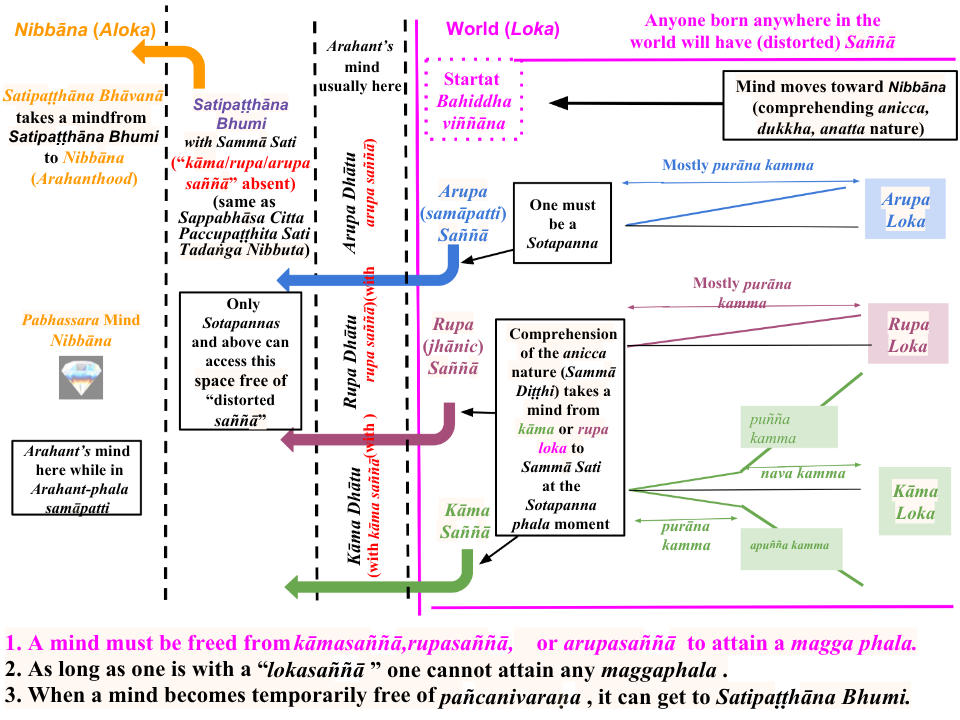 Distorted Sañña, Loka, and Nibbāna
Saññā Bị méo mó, Loka và Nibbāna
Download/Print: “WebLink: PDF file Download: Distorted Saññā, Loka, and Nibbāna”
Tải xuống/In: “WebLink: PDF file Download: Distorted Saññā, Loka, and Nibbāna”
- Let us go through an overview to connect to the summary in #1 above.
Hãy đi qua phần tổng quan để kết nối với phần tóm tắt ở mục #1 ở trên.
Removing Ten Types of Wrong Views (Micchā Diṭṭhi)
Loại Bỏ Mười Loại Tà Kiến (Micchā Diṭṭhi)
- As we can see from the chart, Nibbāna is about stopping the rebirth process. Thus, if someone believes that life ends with the death of the current physical body we have, then there is nothing else to do to “pursue Nibbāna.” Those with that belief (“uccheda diṭṭhi”), in essence, are saying that one will attain Nibbāna upon the death of the physical body, i.e., all suffering will end.
Như có thể thấy từ sơ đồ, Nibbāna là việc chấm dứt tiến trình tái sinh. Do đó, nếu ai đó tin rằng cuộc sống chấm dứt khi thân xác hiện tại chết đi, thì không còn gì cần làm để “hướng đến Nibbāna”. Những người có niềm tin đó (“uccheda diṭṭhi”), về bản chất, đang nói rằng một người sẽ đạt Nibbāna khi thân xác chết đi, tức là mọi khổ sẽ chấm dứt.
- With that “wrong worldview,” one could be tempted to engage in immoral actions to fulfill one’s cravings/desires. If one’s immoral actions do not lead to consequences in future lives (and one can avoid the law enforcement), why not do “whatever it takes” to fulfill one’s cravings?
Với “thế giới quan sai lầm” đó, người ta có thể bị cám dỗ thực hiện các hành vi bất thiện để thỏa mãn ham muốn của mình. Nếu các hành vi bất thiện không dẫn đến hậu quả trong đời sau (và có thể tránh được pháp luật), thì tại sao không làm “bất cứ điều gì cần thiết” để thỏa mãn ham muốn?
- Under normal conditions, such temptations are restrained by an innate sense of morality common to all humans. A human birth is rare and comes with a “built-in” set of restraints. In particular, “hiri” (shame of immoral deeds) and otappa (fear of the consequences of immoral deeds) are built into human consciousness.
Trong điều kiện bình thường, những cám dỗ như vậy được kiềm chế bởi ý thức đạo đức bẩm sinh chung của con người. Một thân người là hiếm và đi kèm với một hệ thống “kiềm chế” sẵn có. Đặc biệt, “hiri” (xấu hổ với hành vi bất thiện) và otappa (sợ hậu quả của hành vi bất thiện) đã được tích hợp trong ý thức con người.
- The problem is that a human mind can overcome those “moral qualities” if the temptations become too strong. Thus, a “tipping over” event can happen, and any puthujjana (no matter how moral life he/she lives) is capable of doing an apāyagāmi deed.
Vấn đề là tâm con người có thể vượt qua những “phẩm chất đạo đức” đó nếu cám dỗ trở nên quá mạnh. Do đó, một “sự vượt ngưỡng” có thể xảy ra, và bất kỳ puthujjana nào (dù sống đạo đức đến đâu) cũng có thể thực hiện một hành động dẫn đến apāya.
- This is why having the ten types of micchā diṭṭhi is dangerous, according to Buddha’s teachings.
Đó là lý do tại sao việc có mười loại micchā diṭṭhi là nguy hiểm, theo giáo lý của Đức Phật.
- The other extreme view (compared to the uccheda diṭṭhi) is sassata diṭṭhi. This is the view of a “permanent existence” in a Deva or a Brahma realm.
Quan điểm cực đoan còn lại (so với uccheda diṭṭhi) là sassata diṭṭhi. Đây là quan điểm về “sự tồn tại vĩnh viễn” trong một cõi Deva hoặc cõi Brahma.
- Sassata diṭṭhi is a better than uccheda diṭṭhi because it requires understanding that one’s actions will have consequences, i.e., one believes in the laws of kamma.
Sassata diṭṭhi tốt hơn uccheda diṭṭhi vì nó đòi hỏi hiểu rằng hành động của một người sẽ có hậu quả, tức là tin vào định luật kamma.
- However, as we can see from the above chart, that view also keeps one trapped in the rebirth process.
Tuy nhiên, như có thể thấy từ sơ đồ trên, quan điểm đó vẫn khiến một người bị mắc kẹt trong vòng tái sinh.
Sekha Bala – Five Powers of a Trainee
Sekha Bala – Năm Sức Mạnh Của Người Đang Tu Tập
- In the “Sekhabalavagga” of Aṅguttara Nikāya, a series of ten suttās discuss the “five powers” of a trainee or sekha (striving to attain Nibbāna.) These five, when cultivated simultaneously, can make permanent change in morality.
Trong “Sekhabalavagga” của Aṅguttara Nikāya, một loạt mười sutta bàn về “năm sức mạnh” của người đang tu tập hay sekha (đang nỗ lực đạt Nibbāna). Năm yếu tố này, khi được tu tập đồng thời, có thể tạo ra sự thay đổi lâu dài về đạo đức.
- In the first sutta, “WebLink: suttacentral: Saṅkhitta Sutta (AN 5.1)” they are listed: Saddhā bala, hirī bala, ottappa bala, vīriya bala, paññā bala.
Trong sutta đầu tiên, “WebLink: suttacentral: Saṅkhitta Sutta (AN 5.1)”, chúng được liệt kê: Saddhā bala, hirī bala, ottappa bala, vīriya bala, paññā bala.
- The second sutta in the series, “WebLink: suttacentral: Vitthata Sutta (AN 5.2),” discusses them in some detail: Saddhā means to have faith in Buddha’s teachings (‘itipi so bhagavā arahaṁ sammāsambuddho vijjācaraṇasampanno sugato lokavidū anuttaro purisadammasārathi satthā devamanussānaṁ buddho bhagavā’ti.”) Hiri means to have a sense of moral shame, i.e., to be ashamed of bodily, verbal, and mental misconduct (“Idha, bhikkhave, ariyasāvako hirīmā hoti, hirīyati kāyaduccaritena vacīduccaritena manoduccaritena, hirīyati pāpakānaṁ akusalānaṁ dhammānaṁ samāpattiyā.”) Ottappa means to have fear/dread of such immoral deeds (“Idha, bhikkhave, ariyasāvako ottappī hoti, ottappati kāyaduccaritena vacīduccaritena manoduccaritena, ottappati pāpakānaṁ akusalānaṁ dhammānaṁ samāpattiyā.”) Vīriya means to be energetic to sustain hiri and otappa and avoid such immoral deeds (“Idha, bhikkhave, ariyasāvako āraddhavīriyo viharati akusalānaṁ dhammānaṁ pahānāya, kusalānaṁ dhammānaṁ upasampadāya, thāmavā daḷhaparakkamo anikkhittadhuro kusalesu dhammesu.”). Paññā is to cultivate wisdom by learning Buddha’s teachings (“Idha, bhikkhave, ariyasāvako paññavā hoti udayatthagāminiyā paññāya samannāgato ariyāya nibbedhikāya sammā dukkhakkhayagāminiyā.”).
Sutta thứ hai trong loạt này, “WebLink: suttacentral: Vitthata Sutta (AN 5.2),” trình bày chi tiết hơn: Saddhā nghĩa là có niềm tin vào giáo pháp của Đức Phật (“itipi so bhagavā arahaṁ sammāsambuddho vijjācaraṇasampanno sugato lokavidū anuttaro purisadammasārathi satthā devamanussānaṁ buddho bhagavā’ti.”) Hiri là cảm giác xấu hổ đạo đức, tức là xấu hổ với hành vi sai trái về thân, khẩu và ý (“Idha, bhikkhave, ariyasāvako hirīmā hoti, hirīyati kāyaduccaritena vacīduccaritena manoduccaritena, hirīyati pāpakānaṁ akusalānaṁ dhammānaṁ samāpattiyā.”) Ottappa là sợ hãi hoặc e ngại các hành vi bất thiện như vậy (“Idha, bhikkhave, ariyasāvako ottappī hoti, ottappati kāyaduccaritena vacīduccaritena manoduccaritena, ottappati pāpakānaṁ akusalānaṁ dhammānaṁ samāpattiyā.”) Vīriya là sự tinh tấn để duy trì hiri và otappa và tránh các hành vi bất thiện (“Idha, bhikkhave, ariyasāvako āraddhavīriyo viharati akusalānaṁ dhammānaṁ pahānāya, kusalānaṁ dhammānaṁ upasampadāya, thāmavā daḷhaparakkamo anikkhittadhuro kusalesu dhammesu.”). Paññā là phát triển trí tuệ bằng cách học giáo pháp của Đức Phật (“Idha, bhikkhave, ariyasāvako paññavā hoti udayatthagāminiyā paññāya samannāgato ariyāya nibbedhikāya sammā dukkhakkhayagāminiyā.”).
- The concepts are better explained in the following translation: “WebLink: suttacentral: AN 5.2. In Detail.”
Các khái niệm này được giải thích rõ hơn trong bản dịch sau: “WebLink: suttacentral: AN 5.2. In Detail.”
- In the “WebLink: suttacentral: Yathābhata Sutta (AN 5.4)” it is stated that one without those powers is likely to be reborn in an apāya/niraya: “Imehi kho, bhikkhave, pañcahi dhammehi samannāgato bhikkhu yathābhataṁ nikkhitto evaṁ niraye.” One could lose the naturally built-in hiri and otappa by associating with immoral people (asappurisa).
Trong “WebLink: suttacentral: Yathābhata Sutta (AN 5.4)”, có nói rằng người không có các sức mạnh đó có khả năng tái sinh vào apāya/niraya: “Imehi kho, bhikkhave, pañcahi dhammehi samannāgato bhikkhu yathābhataṁ nikkhitto evaṁ niraye.” Một người có thể mất đi hiri và otappa vốn có sẵn khi giao du với những người bất thiện (asappurisa).
- On the other hand, someone with those five powers is likely to be reborn in a “good realm”: “Pañcahi, bhikkhave, dhammehi samannāgato bhikkhu yathābhataṁ nikkhitto evaṁ sagge..”
Ngược lại, người có đủ năm sức mạnh đó có khả năng tái sinh vào “cõi tốt”: “Pañcahi, bhikkhave, dhammehi samannāgato bhikkhu yathābhataṁ nikkhitto evaṁ sagge..”
- In the “WebLink: suttacentral: Ananussuta Sutta (AN 5.11),” the Buddha says he discovered those “previously unknown” five powers that helped him attain the Buddhahood and those are powers of a Buddha: “Pubbāhaṁ, bhikkhave, ananussutesu dhammesu abhiññāvosānapāramippatto paṭijānāmi. Pañcimāni, bhikkhave, tathāgatassa tathāgatabalāni, yehi balehi samannāgato tathāgato āsabhaṁ ṭhānaṁ paṭijānāti, parisāsu sīhanādaṁ nadati, brahmacakkaṁ pavatteti.”
Trong “WebLink: suttacentral: Ananussuta Sutta (AN 5.11),” Đức Phật nói rằng Ngài đã khám phá ra năm sức mạnh “chưa từng được biết đến trước đây” giúp Ngài đạt giác ngộ, và đó là các năng lực của một vị Phật: “Pubbāhaṁ, bhikkhave, ananussutesu dhammesu abhiññāvosānapāramippatto paṭijānāmi. Pañcimāni, bhikkhave, tathāgatassa tathāgatabalāni, yehi balehi samannāgato tathāgato āsabhaṁ ṭhānaṁ paṭijānāti, parisāsu sīhanādaṁ nadati, brahmacakkaṁ pavatteti.”
- A good translation: “WebLink: suttacentral: AN 5.11. Not Heard Before.”
Một bản dịch tốt: “WebLink: suttacentral: AN 5.11. Not Heard Before.”
Hiri and Otappa Turn to Sati and Samādhi at Sotāpanna Stage
Hiri và Otappa Chuyển thành Sati và Samādhi ở Bậc Sotāpanna
- A puthujjana cultivates those “five powers of a trainee” (sekha bala) while eliminating the ten types of micchā diṭṭhi. That will help removing both uccheda and sassata diṭṭhis.
Một puthujjana tu tập “năm sức mạnh của người đang tu” (sekha bala) trong khi loại bỏ mười loại micchā diṭṭhi. Điều đó giúp loại bỏ cả uccheda diṭṭhi và sassata diṭṭhi.
- Getting rid of all those diṭṭhis (wrong views) makes a mind conducive to grasp the teachings of a Buddha. Of course, one must be exposed to the true teachings of the Buddha by a sappurisa (Noble Person or Ariya.)
Việc loại bỏ tất cả các diṭṭhi (tà kiến) đó khiến tâm trở nên phù hợp để tiếp nhận giáo pháp của Đức Phật. Dĩ nhiên, cần được tiếp xúc với giáo pháp chân chính của Đức Phật thông qua một sappurisa (Bậc Thiện Trí hay Ariya).
- Then, one attains a “trace of sati and (corresponding) samādhi” at the Sotāpanna phala moment.
Sau đó, một người đạt được “dấu vết của sati và (tương ứng) samādhi” tại khoảnh khắc Sotāpanna phala.
- At that point, the transition from saddhā bala, hirī bala, ottappa bala, vīriya bala, paññā bala to saddhā bala, vīriya bala, sati bala, samādhi bala, paññā bala (listed in “WebLink: suttacentral: Saṅkhitta Sutta (AN 5.13)” and explained in “WebLink: suttacentral: Vitthata Sutta (AN 5.14)”) is initiated.
Tại thời điểm đó, sự chuyển đổi từ saddhā bala, hirī bala, ottappa bala, vīriya bala, paññā bala sang saddhā bala, vīriya bala, sati bala, samādhi bala, paññā bala (được liệt kê trong “WebLink: suttacentral: Saṅkhitta Sutta (AN 5.13)” và giải thích trong “WebLink: suttacentral: Vitthata Sutta (AN 5.14)”) được khởi đầu.
- The transition is finalized at the Arahant stage when a sekha becomes an Arahant with complete five powers of saddhā bala, vīriya bala, sati bala, samādhi bala, paññā bala.
Sự chuyển đổi này được hoàn tất ở giai đoạn Arahant khi một sekha trở thành Arahant với đầy đủ năm sức mạnh: saddhā bala, vīriya bala, sati bala, samādhi bala, paññā bala.
- That requires the cultivation of Satipaṭṭhāna to overcome the “distorted saññā of worldly pleasures.”
Điều đó đòi hỏi tu tập Satipaṭṭhāna để vượt qua “saññā bị méo mó của các khoái lạc thế gian.”
One Definite Way to Nibbāna – Satipaṭṭhāna
Một Con Đường Chắc Chắn Đến Nibbāna – Satipaṭṭhāna
- The Buddha described the same concepts in many different ways. The Four Noble Truths and the Noble Eightfold Path are automatically fulfilled with the cultivation of Satipaṭṭhāna. In the current series of posts on the “Worldview of the Buddha” we will focus on Satipaṭṭhāna.
Đức Phật đã trình bày cùng một nội dung theo nhiều cách khác nhau. Tứ Diệu Đế và Bát Chánh Đạo được tự động hoàn thành khi tu tập Satipaṭṭhāna. Trong loạt bài hiện tại về “Thế giới quan của Đức Phật”, chúng ta sẽ tập trung vào Satipaṭṭhāna.
- As the “WebLink: suttacentral: Mahāsatipaṭṭhāna Sutta (DN 28)” the Buddha stated, “Ekāyano ayaṁ, bhikkhave, maggo sattānaṁ visuddhiyā, sokaparidevānaṁ samatikkamāya dukkhadomanassānaṁ atthaṅgamāya ñāyassa adhigamāya nibbānassa sacchikiriyāya, yadidaṁ cattāro satipaṭṭhānā” OR “cultivation of satipaṭṭhāna is a one definite way to attain Nibbāna. ”
Như trong “WebLink: suttacentral: Mahāsatipaṭṭhāna Sutta (DN 28)”, Đức Phật dạy: “Ekāyano ayaṁ, bhikkhave, maggo sattānaṁ visuddhiyā, sokaparidevānaṁ samatikkamāya dukkhadomanassānaṁ atthaṅgamāya ñāyassa adhigamāya nibbānassa sacchikiriyāya, yadidaṁ cattāro satipaṭṭhānā” HOẶC “tu tập satipaṭṭhāna là con đường chắc chắn duy nhất để đạt Nibbāna.”
- As summarized above, the cultivation of Satipaṭṭhāna requires a basic background in #1 (i) above. The next step of removing sakkāya diṭṭhi requires learning the “worldview of the Buddha.” The last two steps require understanding that “distorted saññā” is the root cause of attachments (taṇhā/upādāna) for worldly pleasures. All three steps can be covered by fully understanding the “big picture” in the chart above.
Như đã tóm tắt ở trên, việc tu tập Satipaṭṭhāna đòi hỏi nền tảng cơ bản ở mục #1 (i). Bước tiếp theo là loại bỏ sakkāya diṭṭhi, cần học “thế giới quan của Đức Phật”. Hai bước cuối đòi hỏi hiểu rằng “saññā bị méo mó” là nguyên nhân gốc của sự dính mắc (taṇhā/upādāna) vào các khoái lạc thế gian. Cả ba bước này có thể được bao quát bằng cách hiểu đầy đủ “bức tranh tổng thể” trong sơ đồ trên.
- I compiled that chart based on my efforts over the past two to three years based on what I learned from Waharaka Thero and others; I am grateful to all of them. Even though I may have to make some minor revisions (our understanding grows with time), I am fairly confident it captures the essential elements. As we proceed, I will use this chart repeatedly.
Tôi đã tổng hợp sơ đồ đó dựa trên nỗ lực trong hai đến ba năm qua dựa trên những gì học được từ Waharaka Thero và những người khác; tôi rất biết ơn họ. Mặc dù có thể cần chỉnh sửa nhỏ (hiểu biết của chúng ta phát triển theo thời gian), tôi khá tin rằng nó đã nắm bắt được các yếu tố cốt lõi. Khi tiếp tục, tôi sẽ sử dụng sơ đồ này nhiều lần.
Setting the Background
Thiết Lập Nền Tảng
- The above worldview of the Buddha can be explained in simple terms as follows.
Thế giới quan của Đức Phật ở trên có thể được giải thích đơn giản như sau.
- The common name for any living being who is not a Noble Person (i.e., one with a magga phala at or above the Sotāpanna stage) is “sattā.” Thus, an animal, a human, a Deva, or a Brahma (who has not attained a magga phala) is a sattā. The word “puthujjana” (“general population in the world, a country, or a given region”) is used for sattās in the human realm.
Tên gọi chung cho bất kỳ chúng sinh nào chưa phải là bậc Thánh (tức là chưa đạt magga phala từ Sotāpanna trở lên) là “sattā”. Do đó, một con vật, một con người, một Deva hoặc một Brahma (chưa đạt magga phala) đều là sattā. Từ “puthujjana” (“đại đa số quần chúng trong thế giới, một quốc gia hoặc một khu vực”) được dùng cho các sattā trong cõi người.
- A sattā is born in a given realm because it had craved “sensory pleasures” valued in that realm as a human in a previous existence.
Một sattā sinh vào một cõi nhất định vì trước đó, khi còn là con người, đã khao khát “các khoái lạc giác quan” được coi trọng trong cõi đó.
- That last statement requires some explanation. Two specific points need to be discussed: (i) In most cases, kammic energies to “power” any existence (i.e., rebirth in any realm) are acquired while in the human realm. However, sattās in Deva and Brahma realms can attain magga phala. (ii) Sattās in different realms have different cravings based on the types of “distorted saññā” associated with them; see “Sotāpanna Stage via Understanding Perception (Saññā).” A human would not crave eating grass (like a cow) or eating feces (like a pig), but that “craving” is manifested via specific types of “immoral actions” (kamma) done by humans.
Phát biểu trên cần được giải thích thêm. Có hai điểm cụ thể cần bàn: (i) Trong hầu hết các trường hợp, năng lượng kamma để “duy trì” một sự tồn tại (tức là tái sinh vào bất kỳ cõi nào) được tích lũy khi ở trong cõi người. Tuy nhiên, các sattā trong cõi Deva và Brahma vẫn có thể đạt magga phala. (ii) Các sattā ở những cõi khác nhau có những khao khát khác nhau dựa trên các loại “saññā bị méo mó” tương ứng; xem “Sotāpanna Stage via Understanding Perception (Saññā).” Một con người sẽ không khao khát ăn cỏ (như bò) hay ăn phân (như heo), nhưng “sự khao khát” đó được biểu hiện thông qua những loại “hành động bất thiện” (kamma) cụ thể do con người thực hiện.
- Let us discuss those two issues.
Hãy cùng thảo luận hai vấn đề đó.
Most Kammic Energies Acquired While in the Human Realm
Phần Lớn Năng Lượng Kamma Được Tích Lũy Khi Ở Trong Cõi Người
- As discussed in the Aggañña Sutta, most of the sattās in our world system based on the Earth will be in the human realm at the beginning of a “world cycle.” See “Aggañña Sutta Discussion – Introduction” and “Buddhism and Evolution – Aggañña Sutta (DN 27).”
Như đã thảo luận trong Aggañña Sutta, phần lớn các sattā trong hệ thế giới của chúng ta (liên quan đến Trái Đất) sẽ ở trong cõi người vào lúc bắt đầu một “chu kỳ thế giới”. Xem “Aggañña Sutta Discussion – Introduction” và “Buddhism and Evolution – Aggañña Sutta (DN 27).”
- Those “early humans” did not have dense physical bodies like ours; they were called “Brahma-kāyika humans” because they had “invisible bodies” (manomaya kāya or gandhabba kāya). They also had relatively undefiled minds (like those of Brahmās).
Những “con người sơ khai” đó không có thân vật lý đặc như chúng ta; họ được gọi là “người Brahma-kāyika” vì có “thân vô hình” (manomaya kāya hoặc gandhabba kāya). Họ cũng có tâm tương đối ít ô nhiễm (giống như các Brahmā).
- With time, after many millions of years, their “human gati” started emerging, and many started generating defiled thoughts and engaging in immoral activities. Then, their bodies get denser, and they require physical food to eat. Vegetation appears, and some of those humans start getting animal births. As immorality grows, even lower realms (apāyās) are populated. Those reborn in lower realms have very little chance of “coming out” and being reborn in a “good realm” until the end of that Mahā Kappa (“world cycle”)
Theo thời gian, sau hàng triệu năm, “gati người” của họ bắt đầu xuất hiện, và nhiều người bắt đầu phát sinh các suy nghĩ ô nhiễm và tham gia vào các hành vi bất thiện. Khi đó, thân của họ trở nên đặc hơn và cần thức ăn vật lý. Thực vật xuất hiện, và một số người bắt đầu tái sinh vào cõi động vật. Khi sự bất thiện gia tăng, các cõi thấp (apāyā) cũng được hình thành. Những người tái sinh vào các cõi thấp có rất ít cơ hội “thoát ra” để tái sinh vào “cõi tốt” cho đến khi kết thúc Mahā Kappa (“chu kỳ thế giới”).
- Of course, some with “better gati” cultivate puñña kamma and are reborn in Deva realms. Some cultivate jhāna and are reborn in Brahma realms. Thus, the initial population of “Brahma-kāyika humans” spread out among the other realms. These days, we have only a minute fraction of humans compared to sattās in other realms.
Dĩ nhiên, một số người có “gati tốt hơn” tu tập puñña kamma và tái sinh vào các cõi Deva. Một số tu tập jhāna và tái sinh vào các cõi Brahma. Do đó, quần thể ban đầu của “người Brahma-kāyika” đã phân tán vào các cõi khác. Ngày nay, số lượng con người chỉ là một phần rất nhỏ so với các sattā ở các cõi khác.
- Thus, a given sattā (living being) accumulates significant kammic energies mostly when born in the human realm.
Do đó, một sattā (chúng sinh) tích lũy phần lớn năng lượng kamma khi sinh vào cõi người.
Sattās in different realms have different Types of “Distorted Saññā”
Các Sattā Ở Các Cõi Khác Nhau Có Các Loại “Saññā Bị Méo Mó” Khác Nhau
- The same living being (sattā) has different types of cravings (i.e., “upādāna”) because, while in the human realm, they had generated corresponding (abhi) saṅkhāra. Another way to say that is to say they had done corresponding types of kamma. It is easier to explain this with some examples.
Cùng một chúng sinh (sattā) có các loại khao khát khác nhau (tức là “upādāna”) vì khi ở trong cõi người, họ đã tạo ra các (abhi) saṅkhāra tương ứng. Nói cách khác, họ đã thực hiện các loại kamma tương ứng. Điều này dễ hiểu hơn qua một số ví dụ.
- One’s future births are primarily due to one’s gati, which one cultivates while in the human realm.
Các lần tái sinh trong tương lai chủ yếu phụ thuộc vào gati mà một người đã phát triển khi ở trong cõi người.
- The “WebLink: suttacentral: Gati Sutta (AN 9.68)” lists five main categories: hell (niraya), the animal realm (tiracchāna), the hungry ghost realm (peta), humans (manussa), and Deva. Many suttās (including the Dhammacakkappavattana Sutta) sometimes lump the Devās in the six Deva realms and Brahmās in the 20 Brahma realms into one category as Devās. For details, see “Gati to Bhava to Jāti – Ours to Control” and “Gati (Habits/Character) Determine Births – Saṁsappanīya Sutta.”
“WebLink: suttacentral: Gati Sutta (AN 9.68)” liệt kê năm loại chính: địa ngục (niraya), cõi động vật (tiracchāna), cõi ngạ quỷ (peta), con người (manussa) và Deva. Nhiều sutta (bao gồm Dhammacakkappavattana Sutta) đôi khi gộp Devā trong sáu cõi Deva và Brahmā trong 20 cõi Brahma thành một nhóm gọi chung là Devā. Để biết chi tiết, xem “Gati to Bhava to Jāti – Ours to Control” và “Gati (Habits/Character) Determine Births – Saṁsappanīya Sutta.”
- Once born in other realms, a given sattā lives that life without generating significant kammic energies. Beings in higher realms are prevented from engaging in kāya kamma (because they don’t have dense bodies and thus cannot engage in stealing, killing, etc. Furthermore, there is no need to steal or kill to acquire “sensory pleasures” because they don’t need to. In the four lower realms, it can be explained differently. For example, while some animals need to kill to survive (lions, tigers, etc.), they don’t generate strong javana citta; this is explained in Abhidhamma.
Khi sinh vào các cõi khác, một sattā sống đời đó mà không tạo ra năng lượng kamma đáng kể. Các chúng sinh ở cõi cao không thực hiện kāya kamma (vì không có thân đặc nên không thể trộm cắp, giết hại, v.v.). Hơn nữa, họ không cần phải trộm hay giết để có “khoái lạc giác quan”. Ở bốn cõi thấp, điều này được giải thích khác. Ví dụ, một số động vật cần giết để sinh tồn (sư tử, hổ, v.v.), nhưng chúng không tạo ra javana citta mạnh; điều này được giải thích trong Abhidhamma.
- Further details in “Cuti and Maraṇa – Related to Bhava and Jāti.”
Chi tiết thêm xem “Cuti and Maraṇa – Related to Bhava and Jāti.”
Separating from the World of 31 Realms – Importance of “Distorted Saññā”
Tách Khỏi Thế Giới 31 Cõi – Tầm Quan Trọng Của “Saññā Bị Méo Mó”
- The Buddha divided the world into three lokās: kāma, rūpa, and arūpa loka. A Sotāpanna separates from the kāma loka via the Sakadāgāmi and Anāgāmi stages. Then, an Anāgāmi dissociates from the rūpa and arūpa lokās at the Arahant stage.
Đức Phật chia thế giới thành ba lokā: kāma, rūpa và arūpa loka. Một Sotāpanna tách khỏi kāma loka thông qua các giai đoạn Sakadāgāmi và Anāgāmi. Sau đó, một Anāgāmi tách khỏi rūpa và arūpa loka ở giai đoạn Arahant.
- We have discussed the material needed to understand the above in the previous posts in the “Worldview of the Buddha” section.
Chúng ta đã thảo luận các nội dung cần thiết để hiểu điều trên trong các bài trước thuộc phần “Thế giới quan của Đức Phật”.
- The main conclusion is as follows. Any living being (sattā) is trapped in the rebirth process among the 31 realms (distributed among the kāma, rūpa, and arūpa lokās) because of their attachment to sensory inputs (ārammaṇa) with rāga, dosa, and moha.
Kết luận chính như sau. Bất kỳ chúng sinh nào (sattā) đều bị mắc kẹt trong tiến trình tái sinh giữa 31 cõi (phân bố trong kāma, rūpa và arūpa lokā) do sự dính mắc vào các đối tượng cảm giác (ārammaṇa) với rāga, dosa và moha.
- Such automatic attachments are triggered by “mind-made pleasure sensation/perception” (“distorted saññā”) present in each realm, but they can be put in three broad categories: kāma saññā, rūpa saññā, and arūpa saññā associated with the kāma, rūpa, and arūpa lokās.
Những sự dính mắc tự động này được kích hoạt bởi “cảm giác/nhận thức khoái lạc do tâm tạo ra” (“saññā bị méo mó”) tồn tại trong mỗi cõi, nhưng có thể được chia thành ba nhóm chính: kāma saññā, rūpa saññā và arūpa saññā tương ứng với kāma, rūpa và arūpa lokā.
- It is beneficial to learn about the “distorted saññā” even to attain the Sotāpanna stage. We will discuss that in the next post (i.e., removal of sakkāya diṭṭhi in #1(ii) above).
Việc tìm hiểu về “saññā bị méo mó” là rất hữu ích ngay cả để đạt đến giai đoạn Sotāpanna. Chúng ta sẽ thảo luận điều đó trong bài tiếp theo (tức là việc loại bỏ sakkāya diṭṭhi ở mục #1(ii) ở trên).