August 20, 2023; revised August 21, 2023 (#4, #13)
20/8/2023; chỉnh sửa ngày 21/8/2023 (#4, #13)
Contamination of the human mind can happen quickly. The “extent of contamination” depends on the sensory input and one’s gati at that moment.
Tâm người có thể nhiễm ô rất nhanh. “Mức độ nhiễm ô” tùy thuộc dữ liệu giác quan và gati của mỗi người ngay tại thời điểm ấy.
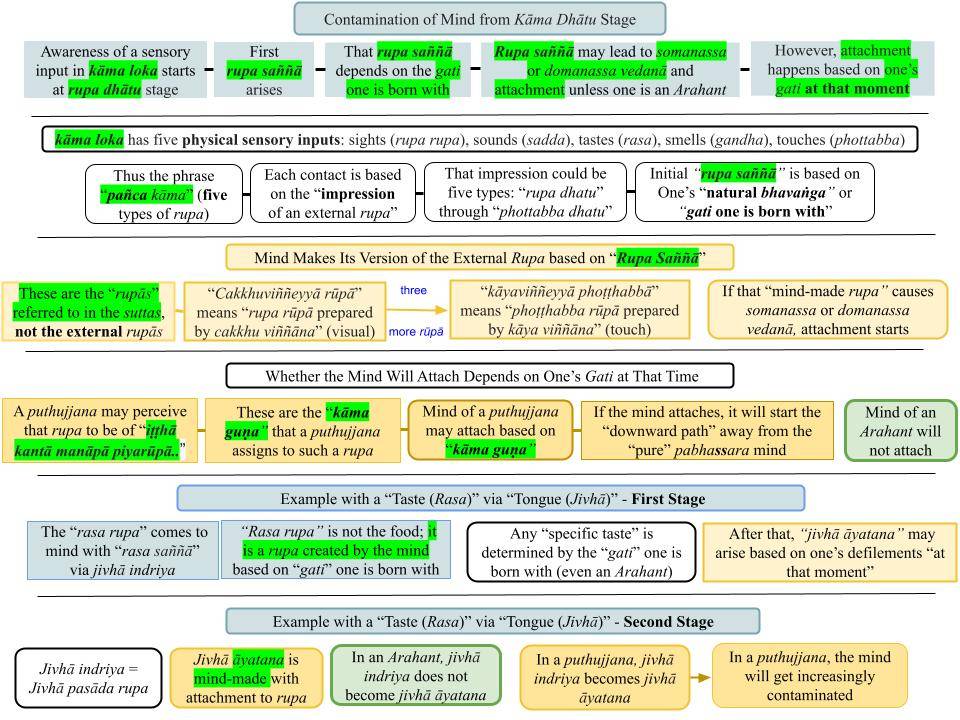
Buddhism – In Charts: B3. Contamination of Mind from Kama Dhatu Stage
Phật Giáo – Dưới dạng Sơ đồ: B3. Sự nhiễm ô của Tâm từ Giai đoạn Kama Dhatu
Download/Print: “WebLink: suttacentral: B3. Contamination of Mind from Kāma Dhātu Stage.”
Tải xuống/In: “WebLink: suttacentral: B3. Contamination of Mind from Kāma Dhātu Stage.”
Background
Bối cảnh
- Mind is not active all the time. When we sleep, we don’t have “thoughts.” For the mind to be active/busy, it must receive sensory input from one of the five physical senses (eyes, ears, tongue, nose, body); or the mind itself must receive a dhammā. In our waking hours, we are bombarded with numerous sensory inputs, and that is why it feels like the mind is fully occupied in our waking hours.
Tâm không hoạt động mọi lúc. Khi ngủ, ta không có “ý niệm”. Muốn tâm vận hành, nó phải tiếp nhận một dữ liệu giác quan từ năm giác quan vật lý (mắt, tai, lưỡi, mũi, và thân); hoặc tự tâm tiếp nhận một dhammā. Khi thức, ta liên tục bị dội bom bởi vô số tín hiệu giác quan, nên có cảm giác như tâm luôn bận rộn.
- Even though it feels like we experience multiple sensory inputs simultaneously, the mind can process only one input at a time. Sensory inputs come to the mind in “packets,” each packet processed by the brain. The brain can process the five sensory inputs in parallel, but the mind processes only one “packet” at a time. Yet, since they happen very fast, we feel they happen simultaneously.
Dù có vẻ như các giác quan hoạt động đồng thời, thật ra tâm chỉ xử lý một tín hiệu tại một thời điểm. Các tín hiệu giác quan đến thành từng “gói”, não chuyển tiếp chúng theo cơ chế riêng. Não có thể xử lý song song năm kênh giác quan, nhưng tâm thì chỉ nhận một gói mỗi lần; Tuy nhiên, do tốc độ cực nhanh, ta tưởng như các cảm nhận xảy ra cùng lúc.
- Each “packet” gives rise to a citta vīthi which lasts only a billionth of a second. The mind can alternate among different types (for the six senses) and sort them out and very fast. It is a good idea to read “Amazingly Fast Time Evolution of a Thought (Citta),” “Vision Is a Series of “Snapshots” – Movie Analogy,” and the references therein.
Mỗi “gói” này khởi một citta vīthi, kéo dài chỉ khoảng một phần tỉ giây. Tâm luân phiên xử lý các loại này (tương ứng lục căn) và phân loại chớp nhoáng. Có thể xem thêm: “Amazingly Fast Time Evolution of a Thought (Citta),” “Vision Is a Series of ‘Snapshots’ – Movie Analogy,” và các tham chiếu liên quan.
- The brain is much slower than the mind. The brain takes at least a hundredth of a second to process a “data packet,” which is processed by the “seat of the mind” (hadaya vatthu) in a billionth of a second. Thus, the mind is roughly a million times faster than the brain. See “Vision Is a Series of “Snapshots” – Movie Analogy.”
Não chậm hơn tâm rất nhiều: não cần ít nhất một phần trăm của giây để xử lý một “gói dữ liệu”, trong khi “chỗ nương của tâm” (hadaya vatthu) xử lý trong một phần tỷ của giây. Tức tâm nhanh hơn não khoảng một triệu lần. Xem “Vision Is a Series of ‘Snapshots’ – Movie Analogy.”
The “Natural Bhavaṅga State”
“Trạng thái Bhavaṅga Tự nhiên”
- The “natural bhavaṅga state” is the bhavaṅga that one is born with. Even after attaining Arahanthood, that does not change.
“Trạng thái bhavaṅga tự nhiên” là bhavaṅga ta sinh ra đã có; dù có chứng đắc Arahanthood, trạng thái này không thay đổi.
- At the very beginning of the first citta vīthi focusing on new sensory input, the mind switches from the “natural bhavaṅga state” to focus on the incoming sensory input.
Ngay lúc khởi lên citta vīthi đầu tiên hướng về một dữ liệu giác quan mới, tâm rời “trạng thái bhavaṅga tự nhiên” để tập trung vào dữ liệu giác quan đang đến đó.
- However, the “base level” or “initial” rūpa saññā is based on the “natural bhavaṅga”
Tuy vậy, rūpa saññā “nền tảng” hay “sơ khởi” vẫn dựa trên “trạng thái bhavaṅga tự nhiên” này.
Connection Between “Gati” and the “Natural Bhavaṅga State”
Mối liên Hệ Giữa “Gati” và “Bhavaṅga Tự Nhiên”
- Births in different realms are according to the gati at the moment of grasping a new bhava. The Buddha pointed out five major gati in the “WebLink: suttacentral: Gati Sutta (AN 9.68).” The first three (niraya, tiracchāna meaning animal, pettivisaya) lead to births in the apāyās; the fourth (manussa) refers to the human realm, and the fifth (deva) lead to births in the six Deva realms and the 20 Brahma In many suttas, the Buddha referred to all Devas and Brahmas as just “Devas.” (Note: In the English translation of the sutta, “gati” is translated as “place of rebirth”; but gati is a more general term that does not have a corresponding word in English, with only “strong gati” leading rebirth. If you search with the word “gati” using the “Search box” on the top right, you will see many posts.)
Việc sinh vào cõi nào tùy theo gati tại khoảnh khắc chấp nhận một bhava mới. Đức Phật nêu ra năm loại gati chính trong “Weblink: suttacentral: Gati Sutta (AN 9.68).” Ba gati đầu (niraya, tiracchāna: thú, pettivisaya) đưa đến apāyās; gati thứ tư (manussa) là cõi người; gati thứ năm (deva) dẫn đến sáu cõi Deva và 20 cõi Brahma (nhiều sutta gom Deva và Brahma chung là “Deva”). (Lưu ý: Bản tiếng Anh dịch “gati” là “nơi tái sinh”, nhưng thực ra gati rộng hơn thế; chỉ gati mạnh mới quyết định tái sinh. Tìm từ “gati” trong “Search box” sẽ thấy nhiều bài.)
- The five primary “gati” listed above are drastically different.
Năm loại “gati” liệt kê ở trên khác nhau rất xa.
- Even within each major category of “gati,” there can be variations. Humans have a wide variety and overlapping of gati, and the gati of each person can and will change too. Within animals, there are numerous variations.
Trong mỗi loại “gati”, vẫn có sự biến thiên. Con người có phổ gati rất rộng và thay đổi theo thời gian; loài vật cũng đa dạng tương tự.
- Since we are familiar with only the human and animal realms, let us take those two for comparison.
Vì ta quen thuộc với người và thú nhất, nên có thể so sánh hai loại này để hiểu sự khác biệt.
Initial “Rūpa Sannā” of a Sensory Input Depends on “Natural Bhavaṅga”
“Rūpa Saññā” Khởi điểm” của một Dữ liệu giác quan Tùy thuộc “Bhavaṅga Tự nhiên”
- Since both humans and animals are in “kāma bhava,” the mind of a human or an animal (or any living being in kāma loka) will start at the “kāma dhātu” stage with an “initial rūpa sannā” based on the “natural bhavaṅga state” that it was in.
Vì cả con người và loài vật đều ở trong “kāma bhava”, nên tâm của con người hay loài vật (và mọi chúng sinh trong cõi kāma loka) sẽ khởi lên ở giai đoạn kāma dhātu với một “rūpa saññā khởi điểm” dựa trên bhavaṅga tự nhiên của chính mình.
- However, since they have different gati, the “natural bhavaṅga state” of an animal is very different from that of a human.
Tuy nhiên, do gati khác nhau, “trạng thái bhavaṅga tự nhiên” của loài vật rất khác con người.
- Therefore, the same sensory input will give rise to very different types of “initial rūpa saññā” in a human compared to an animal.
Vì thế, cùng một dữ liệu giác quan nhưng “rūpa saññā khởi điểm” của con người và loài vật sẽ rất khác.
- They are common only in the sense that both belong to “kāma bhava” based on the five physical senses. But within the “kāma bhava,” the “initial rūpa saññā” experienced among different realms will differ.
Chúng chỉ giống ở điểm đều thuộc “kāma bhava”, nương vào năm giác quan vật lý; nhưng ngay trong kāma bhava, “rūpa saññā khởi điểm” vẫn khác giữa các cõi.
- To clarify, let us consider a human and a tiger. A human is born with “human gati,” and a tiger is born with the “gati of a tiger.” Gati, in turn, is based on the types of kamma responsible for that birth. To be born a tiger, the kamma responsible must have involved the tendency engage in “violent deeds.” A tiger tends to try to kill and eat other animals. On the other hand, human birth is due to “good kamma.”
Để làm rõ, hãy xét một con người và một con hổ. Con người sinh ra với “gati con người”, còn hổ sinh ra với “gati của hổ.” Gati lại nương vào loại kamma chịu trách nhiệm cho lần sinh ấy. Sinh làm hổ do kamma thiên về “hành vi bạo lực”. Một con hổ có xu hướng muốn sát hại và ăn thịt các loài vật khác. Trái lại, sinh làm người nhờ “kamma thiện”.
- Thus, the base level of “initial rūpa saññā” for humans is thus very different from that of a tiger; the gati of a tiger is also different from that of a pig, even though both are in the same animal realm.
Bởi vậy, mức nền của “rūpa saññā khởi điểm” nơi con người khác xa con hổ; và gati của hổ cũng khác gati của heo, dù ở trong cùng cõi loài vật.
- These differences in “initial rūpa saññā” show up in the types of “base level saññā” associated with all five senses. Thus, species with different types of gati have very different “initial rūpa saññā” for sights, sounds, smells, tastes, and touches.
Sự khác biệt này ở “rūpa saññā khởi điểm” thể hiện rõ nơi “saññā mức nền” gắn với năm giác quan vật lý. Do đó, mỗi loài với gati khác nhau sẽ có “rūpa saññā khởi điểm” rất khác cho mắt, tai, mũi, lưỡi, và thân.
- When a mind receives a new sensory input, it “breaks away” from the “natural bhavaṅga state” and goes to the beginning stage (“dhātu stage”) of analyzing that sensory input. See the previous post, “Each Citta Starts with Distorted Sannā.”
Khi tâm tiếp xúc với một dữ liệu giác quan mới, nó “tách khỏi” “trạng thái bhavaṅga tự nhiên” và tiến vào giai đoạn sơ khởi (“giai đoạn dhātu”) để phân tích đối tượng. Xem bài trước “Each Citta Starts with Distorted Saññā.”
- However, at that early stage, the mind still has the gati it was born in (corresponding to the “natural bhavaṅga”) Thus, it perceives the world with those earlier gati, not the gati that one currently has.
Tuy vậy, ở giai đoạn ban đầu ấy, tâm vẫn mang gati mà nó sinh ra (tương ứng “trạng thái bhavaṅga tự nhiên”). Do đó, nó nhận biết theo gati cũ, không theo gati hiện tại (đang được tu sửa).
- That is why the initial level of saññā is roughly common to all humans, whether a puthujjana or an Arahant.
Vì thế, mức saññā khởi điểm đại thể giống nhau giữa những con người, dù là puthujjana hay một Arahant.
- They all will experience the sweetness of sugar or the foul smell of feces.
Ai cũng nếm được vị ngọt của đường hay ngửi thấy mùi hôi của phân như nhau.
Sweetness, Saltiness, etc. are not Vedanā; They are Saññā!
Vị Ngọt, Vị Mặn, v.v. không phải là Vedanā; Chúng là Saññā!
- Vedanā are normally five main types: sukha/somanassa, dukkha/domanassa, and adukkhamasukha (neutral). Those under various situations may fall under sāmisa, nirāmisa, or nirāmisatara categories too.
Vedanā thông thường có năm loại chính: sukha/somanassa, dukha/domanassa, và adukkhamasukha (trung tính). Tùy cảnh huống, các vedanā ấy còn có thể xếp vào nhóm sāmisa, nirāmisa, hoặc nirāmisatara.
- However, sweetness, saltiness, odors, etc., are saññā based on the “base level or initial rūpa saññā.”
Tuy nhiên, vị ngọt, vị mặn, mùi, v.v. là saññā dựa trên “rūpa saññā nền/khởi điểm”.
- As discussed above, “initial rūpa saññā” for animals can be very different from those for humans. For example, when a pig sees a pile of foul-smelling feces, a “mind-pleasing rūpa saññā” arises in the pig. When a human sees the same, a “repulsive rūpa saññā” arises.
Như đã nói, “rūpa saññā khởi điểm” ở loài vật có thể khác rất xa so với con người. Ví dụ, một con heo thấy đống phân hôi thì khởi một “rūpa saññā vừa ý”; còn con người thấy cùng cảnh ấy lại khởi “rūpa saññā ghê tởm.”
- Within the human realm, too, there can be minor divisions. Different males are attracted to different females, and vice versa. All those variations can be ultimately tied to one’s gati. Since gati can change, one’s preferences can change too.
Ngay trong cõi người cũng có khác biệt nhỏ. Những nam giới khác nhau bị hấp dẫn bởi nữ giới khác nhau, và ngược lại. Rốt cuộc, các dị biệt ấy quy về gati của từng người. Vì gati có thể chuyển, nên thì sở thích cũng đổi theo.
Initial “Rūpa Sannā” Does Not Have “Kāma Rāga”
“Rūpa Saññā” Khởi Điểm Không mang theo “Kāma Rāga”
- It is critical to understand that this “initial rūpa sannā” does not have any “kāma rāga” associated.
Cần hiểu thật rõ: “rūpa saññā khởi điểm” không mang theo “kāma rāga.”
- This “initial rūpa/kāma saññā” is merely a “characteristic” of the particular realm. Humans perceive the world differently from animals. We can speculate that our physical bodies are made to be compatible with that “initial rūpa saññā.”
“Rūpa/kāma saññā khởi điểm” này chỉ là “đặc trưng tự nhiên” của mỗi cõi. Con người nhận biết thế giới khác loài vật. Có thể suy rằng thân thể chúng ta được hình thành sao cho tương ứng với “rūpa saññā khởi điểm” ấy.
- For example, cows have an innate liking for grass. No one has to teach them that they need to eat grass and not fruits; their digestive system can handle grass and not fruits. On the other hand, humans don’t like to eat grass; their digestive systems can’t handle grass, either.
Ví dụ, bò sinh ra đã thích ăn cỏ. Chẳng ai phải dạy nó ăn cỏ thay vì trái cây; hệ tiêu hóa của bò xử lý được cỏ chứ không xử lý được trái cây. Ngược lại, con người thì không thích ăn cỏ, và hệ tiêu hóa của người cũng không thích hợp với cỏ.
- However, it is only at this very early stage that one’s “rūpa sannā” is not defiled.
Tuy nhiên, chỉ ở giai đoạn rất sớm này, “rūpa saññā” của mỗi người mới chưa bị nhiễm ô.
- We must also note that only a Buddha could “see” these rapid processes; we can only see that it makes sense after being explained.
Cũng cần lưu ý rằng chỉ một Vị Phật mới có thể “thấy” được các tiến trình cực nhanh này; chúng ta chỉ có thể thấy điều đó hợp lý sau khi được khai thị.
After the “Initial Rūpa Saññā” Stage, Current Gati Takes Over
Sau giai đoạn “Rūpa Saññā Ban Đầu”, Gati Hiện hành Chi phối
- As the mind evolves, kāma rāga starts to take effect based on one’s current gati.
Khi tâm phát triển, kāma rāga bắt đầu phát huy tác dụng dựa trên gati hiện hành của mỗi người.
- As the processing of the sensory input evolves, the mind starts “preparing its own version of the “external rūpa based on one’s current gati.”
Khi quá trình xử lý dữ liệu giác quan tiến triển, tâm bắt đầu “tự chuẩn bị phiên bản riêng của “rūpa bên ngoài trên cơ sở gati hiện hành.”
- All types of “defiled gati” would have gradually disappeared as one progressed on the Noble Path.
Mọi dạng “gati nhiễm ô” sẽ dần dần biến mất khi người hành tiến bước trên Thánh đạo.
An Arahant has no “defiled gati” left.
Một Arahant không còn “gati nhiễm ô”.
- The “mind-made impression of the external rūpa” (“cakkhuviññeyyā rūpā,” “sotaviññeyyā saddā,” through “kāyaviññeyyā phoṭṭhabbā”) that finally emerges (within a split second) depends on the current gati.
“Ấn tượng do tâm tạo về rūpa bên ngoài” (“cakkhuviññeyyā rūpā,” “sotaviññeyyā saddā,” thông qua “kāyaviññeyyā phoṭṭhabbā”) rốt cuộc hiển lộ (trong tích tắc) tùy thuộc vào gati hiện hành.
The “Mind-Made Rūpa” (Cakkhuviññeyyā Rūpā)
“Rūpa Do Tâm tạo” (Cakkhuviññeyyā Rūpā)
- Therefore, each person’s mind will make its own version of the “mind-made impression of the external rūpa” based on the “level of value” (or kāma guṇa) its mind places on the sensory input. That will be based on one’s current gati.
Do đó, tâm của mỗi người sẽ tạo ra phiên bản riêng của “ấn tượng do tâm tạo về rūpa bên ngoài” dựa trên “mức độ giá trị” (hay kāma guṇa) mà tâm gán cho dữ liệu giác quan đó. Điều này tùy thuộc vào gati hiện hành.
- This is succinctly stated in the “WebLink: suttacentral: Kāmaguṇa Sutta (AN 9.65).”
Điều này được trình bày ngắn gọn trong “WebLink: suttacentral: Kāmaguṇa Sutta (AN 9.65).”
- Depending on the five sensual sensory inputs (pañca kāma), the mind prepares its own version of the external sensory input: “cakkhuviññeyyā rūpā,” “sotaviññeyyā saddā,” through “kāyaviññeyyā phoṭṭhabbā.”
Tùy theo năm loại dữ liệu giác quan khả ái (pañca kāma), tâm chuẩn bị phiên bản riêng của dữ liệu giác quan bên ngoài: “cakkhuviññeyyā rūpā,” “sotaviññeyyā saddā,” thông qua “kāyaviññeyyā phoṭṭhabbā.”
- Thus, a puthujjana may attach to the sensory input with kāma guṇa and start generating a mind-made somanassa and domanassa vedanā.
Như vậy, một puthujjana có thể chấp thủ vào dữ liệu giác quan với kāma guṇa và bắt đầu tạo ra somanassa và domanassa vedanā do tâm tạo.
- However, an Arahant “who sees the world in its real nature” does not have kāma guṇa; thus, such somanassa or domanassa vedanā will not arise.
Tuy nhiên, một Arahant, “người thấy thế gian đúng như bản chất thật”, không có kāma guṇa; vì vậy, những somanassa hay domanassa vedanā như thế sẽ không sinh khởi.
Somanassa/Domanassa Vedanā Are Mind-Made
Somanassa/Domanassa Vedanā Là Do Tâm Tạo
- Sukha, dukkha, and adukkhamasukha (neutral) vedanā are real in the sense that they are bodily (sārīrika) vedanā (like those due to injuries) arising due to kamma vipāka; they arise in Arahants as well.
Sukha, dukkha và adukkhamasukha (trung tính) vedanā là “thực” theo nghĩa chúng là vedanā thuộc thân (sārīrika) (như những cảm thọ do chấn thương) sinh khởi do kamma vipāka; chúng cũng sinh khởi nơi Arahant.
- On the other hand, somanassa and domanassa vedanā are “mind-made” and do not arise in Arahants. They arise when one becomes joyful or depressed due to sukha, dukkha vedanā. In addition, they can also arise due to the “initial rūpa saññā” that arises in the “kāma dhātu” stage of the mind.
Ngược lại, somanassa và domanassa vedanā là “do tâm tạo” và không sinh khởi nơi Arahant. Chúng sinh khởi khi một người trở nên hoan hỷ hoặc sầu uất do sukha, dukkha vedanā. Ngoài ra, chúng cũng có thể sinh khởi do “rūpa saññā ban đầu” sinh khởi ở giai đoạn tâm thuộc kāma dhātu.
- Such “somanassa/domanassa vedanā” (mind-made vedanā) will increase rapidly if one attaches to the “initial rūpa saññā” coming with the sensory input. That happens in a split second!
Những “somanassa/domanassa vedanā” như vậy (vedanā do tâm tạo) sẽ tăng nhanh chóng nếu chấp thủ vào “rūpa saññā ban đầu” đi kèm với dữ liệu giác quan. Điều đó xảy ra trong tích tắc!
- For example, somanassa vedanā can arise in a pig seeing a pile of feces; the same sight would lead to a domanassa vedanā in a puthujjana (average human.) Both may attach to it differently: a pig will pursue it with somanassa vedanā, and a human may act on it (try to get rid of it or move away from it) with a domanassa vedanā.
Ví dụ, somanassa vedanā có thể sinh khởi nơi một con heo khi thấy một đống phân; cùng cảnh ấy sẽ dẫn đến domanassa vedanā nơi một puthujjana (người phàm). Cả hai có thể chấp thủ theo những cách khác nhau: con heo sẽ tìm đến nó với somanassa vedanā, còn con người có thể hành động (cố loại bỏ hoặc tránh xa) với domanassa vedanā.
- It is possible for anyone below the Arahant stage to attach to such somanassa and domanassa vedanā with kāma rāga. It happens often in a puthujjana and much less in a Sotāpanna.
Bất kỳ ai dưới bậc Arahant đều có thể chấp thủ những somanassa và domanassa vedanā như vậy cùng với kāma rāga. Điều này xảy ra thường xuyên nơi puthujjana và ít hơn rất nhiều nơi Sotāpanna.
- Progressive defilement of the mind starts with that attachment to the “kāma saññā” (based on one’s kāma guṇa), as we will discuss.
Sự nhiễm ô tăng dần của tâm sơ khởi từ sự chấp thủ ấy đối với “kāma saññā” (dựa trên kāma guṇa của mỗi người), như chúng ta sẽ bàn tiếp.
Somanassa/Domanassa Vedanā Arise Based on the “Initial Kāma Saññā”
Somanassa/Domanassa Vedanā Sinh khởi Dựa trên “Kāma Saññā Sơ khởi”
- The first step is to stop cultivating existing “defiled gati.” To do that, one must understand how a thought process (via citta vīthi) gets progressively contaminated when the mind gets “attached” to an ārammaṇa. Of course, one can get attached via a liking, dislike, or ignorance. It is easier to start with the first two since it is easy to see the contamination process.
Bước đầu tiên là dừng nuôi dưỡng những “gati nhiễm ô” đã có. Để làm điều đó, cần hiểu cách một tiến trình tâm (qua citta vīthi) dần dần bị nhiễm ô khi tâm “chấp thủ” vào một ārammaṇa. Dĩ nhiên, sự chấp thủ có thể xảy ra qua tham thích, sân ghét, hoặc si mê. Sẽ dễ bắt đầu với hai loại đầu tiên, vì quá trình ô nhiễm dễ thấy hơn.
- For example, suppose you see your worse enemy. That starts a series of thoughts (citta vīthi) which leads to an increasingly agitated/angry mind. The opposite happens when seeing a delicious meal or an attractive person. The mind attaches with a “pleasurable feeling” but that can also lead to an agitated mind and unwise actions.
Ví dụ, giả sử bạn thấy kẻ thù lớn nhất của mình. Điều đó khởi động một chuỗi tiến trình tâm (citta vīthi) dẫn đến tâm ngày càng bị kích động/sân hận. Ngược lại, khi thấy một bữa ăn ngon hoặc một người hấp dẫn, tâm chấp thủ với một “cảm thọ lạc” nhưng điều đó cũng có thể dẫn đến tâm bị kích động và hành động bất thiện.
- If neither of those is stopped, one’s tendency to do the same again will only increase, i.e., gati will be strengthened.
Nếu không ngăn chặn, khuynh hướng lặp lại hành vi ấy sẽ chỉ tăng thêm, tức là gati sẽ được củng cố.
Anusotagāmī (Puthujjana) and Paṭisotagāmī (Noble Persons)
Anusotagāmī (Puthujjana: người phàm) và Paṭisotagāmī (Bậc Thánh)
- The “WebLink: suttacentral: Anusota Sutta (AN 4.5)” explains four types of people in the world.
“WebLink: suttacentral: Anusota Sutta (AN 4.5)” giải thích có bốn hạng người trong thế gian.
- Those who “go with the flow” (i.e., pursue sensual pleasures) and let the viññāṇa get defiled are called “anusotagāmi,” taking one away from Nibbāna.
Những người “thuận dòng” (tức là chạy theo dục lạc) và để viññāṇa bị ô nhiễm được gọi là anusotagāmī, đưa họ xa rời Nibbāna.
- Next are two types: Those who have started on the journey “against the tide” or “paṭisotagāmī” (i.e., on the Noble Path) who have made it halfway through the Path.
Kế đó là hai hạng người: những người đã bắt đầu con đường “ngược dòng” hay paṭisotagāmī (tức là trên Thánh Đạo), đã đi được nửa chặng Đường.
- The last category is those who have completed the journey (Arahants.)
Hạng cuối cùng là những người đã hoàn tất hành trình (Arahant).
- We must resist the tendency to “go with the flow” and “go against the flow/tide.” Thus, to overcome suffering, we must become paṭisotagāmī (“paṭisota” means “against the flow,” and “gāmī” refers to one who does it.)
Chúng ta phải chống lại khuynh hướng “thuận dòng” và đi theo “ngược dòng.” Như vậy, để vượt qua khổ đau, ta phải trở thành paṭisotagāmī (“paṭisota” nghĩa là “ngược dòng,” và “gāmī” là người thực hành điều đó.)
- Initially, it seems to be a not-so-easy process since one must start abstaining from sensual pleasures. However, this must be done gradually: “Is It Necessary for a Buddhist to Eliminate Sensual Desires?”
Ban đầu, điều này dường như không dễ dàng, vì cần bắt đầu kiêng tránh dục lạc. Tuy nhiên, điều này phải được thực hiện dần dần, xem “Is It Necessary for a Buddhist to Eliminate Sensual Desires?”
- Alcoholics/drug addicts must first understand the consequences of seeking “pleasure” in drinking or drugs. That there is a better way to overcome distress and depression. Seeking “stronger doses of sensual pleasures” makes one “go with the flow” away from the “hidden suffering-free pabhassara citta”; there is no easy way out!
Người nghiện rượu/ma túy trước hết phải hiểu hậu quả của việc tìm “khoái lạc” trong rượu hoặc ma túy, rằng có một cách tốt hơn để vượt qua khổ đau và trầm uất. Tìm kiếm những “liều dục lạc mạnh hơn” khiến người ta “thuận dòng,” rời xa “tâm sáng suốt vắng khổ ẩn tàng (pabhassara citta).” Không có con đường tắt!
- “Giving up sensual pleasures” becomes easy when one starts comprehending that one will be mired in suffering for perpetuity otherwise. Furthermore, one will start experiencing relief from at least “mental suffering” in the initial stages. Then one would start seeing that “sensual pleasures are suffering.” That “seeing” is not with the eyes but with wisdom (paññā.)
“Từ bỏ dục lạc” trở nên dễ dàng hơn khi bắt đầu thấy rõ rằng nếu không, mình sẽ bị trói buộc trong khổ đau vô tận. Hơn nữa, ngay trong giai đoạn đầu, người ấy sẽ bắt đầu cảm nhận được sự nhẹ nhõm ít nhất từ “sự khổ tâm.” Rồi dần dần thấy rằng “dục lạc chính là khổ.” Sự “thấy” đó không phải bằng mắt, mà bằng trí tuệ (paññā).
The Path of a Paṭisotagāmī
Con Đường của một Paṭisotagāmī
- That journey towards “less contaminated” states of mind (i.e., uncovering the hidden “pabhassara citta”) is the basis of Ānāpānasati/Satipaṭṭhāna.
Hành trình hướng đến các trạng thái tâm “ít ô nhiễm hơn” (tức là khai mở “pabhassara citta” bị che khuất) chính là nền tảng của Ānāpānasati/Satipaṭṭhāna.
- It will be tremendously informative to understand the steps involved in “progressive contamination of the mind” via “chasing an ārammaṇa” (a sensory input.) A rough outline will be discussed in the next post.
Sẽ vô cùng hữu ích khi hiểu các bước “ô nhiễm tiến dần của tâm” qua việc “đuổi theo một ārammaṇa” (một dữ liệu giác quan). Bài kế tiếp sẽ trình bày một phác thảo tổng quát.
- Those who are interested need to keep their own notes so that they make the connections. I have rewritten this post several times, trying to make it as clear as possible. It is impossible to review the complete background material necessary in a post like this one. Feel free to ask questions at the forum: “WebLink: puredhamma.net: Forums.”
Những ai quan tâm nên tự ghi chú để nối kết các điểm lại với nhau. Bài viết này đã được viết lại nhiều lần nhằm làm cho rõ ràng hơn. Không thể ôn lại toàn bộ nền tảng cần thiết trong một bài như thế này. Bạn cứ thoải mái đặt câu hỏi trong diễn đàn: “WebLink: puredhamma.net: Forums.”
- All posts in this section: “Recovering the Suffering-Free Pure Mind.”
Tất cả các bài trong mục này: “Recovering the Suffering-Free Pure Mind.”
Contamination of a Human Mind – Detailed Analysis
Sự nhiễm ô Nơi tâm Người – Phân tích Chi tiết
August 26, 2023; revised November 11, 2023 (#1); January 30, 2025
Ngày 26/8/2023; sửa đổi ngày 11/11/2023 (#1); ngày 30/1/2025
Contamination of the human mind can happen within a split second. Buddha’s description is discussed in detail.
Sự ô nhiễm của tâm người có thể xảy ra chỉ trong tích tắc. Lời giải thích của Đức Phật sẽ được bàn chi tiết.
Buddhism – In Charts: B3. Contamination of Mind from Kama Dhatu Stage
Phật Giáo – Dưới dạng Sơ đồ: B3. Sự nhiễm ô của Tâm từ Giai đoạn Kama Dhatu
Download/Print: “WebLink: suttacentral: B3. Contamination of Mind from Kāma Dhātu Stage.”
Tải xuống/In: “WebLink: suttacentral: B3. Contamination of Mind from Kāma Dhātu Stage.”
Summary of the Previous Post
Tóm lược Bài Trước
- The mind of an average human (puthujjana) can become defiled within a split second of receiving sensory input (ārammaṇa.) In the previous post, “Contamination of the Human Mind Based on a Sensory Input,” we discussed the basic framework of the rapid contamination of the mind. We will use the same chart to continue with that discussion. The following are the essential concepts.
Tâm của một người phàm (puthujjana) có thể bị nhiễm ô chỉ trong tích tắc sau khi nhận một dữ liệu giác quan (ārammaṇa). Trong bài trước, “Contamination of the Human Mind Based on a Sensory Input,” chúng ta đã bàn khung cơ bản của sự ô nhiễm tâm nhanh chóng. Ở đây, ta sẽ tiếp tục thảo luận dựa trên cùng sơ đồ đó. Dưới đây là các khái niệm then chốt.
- The “default state” of a human mind is its “natural bhavaṅga state,” which automatically leads to a characteristic “initial rūpa saññā” arising in a human mind. Humans have certain types of “rūpa saññā” associated with external sensory inputs. “Rūpa saññā” of humans are drastically different from those in other realms of kāma loka, for example, animals.
“Trạng thái mặc định” của tâm người là “trạng thái bhavaṅga tự nhiên,” vốn tự động dẫn đến sự sinh khởi “rūpa saññā sơ khởi” đặc trưng trong tâm con người. Con người có những loại “rūpa saññā” gắn liền với dữ liệu giác quan bên ngoài. “Rūpa saññā” của loài người khác hẳn so với chúng sinh trong các cảnh giới khác thuộc kāma loka, ví dụ như loài vật.
- We are focusing on the five physical senses. They come through the five “sense doors” of eyes, ears, nose, tongue, and the physical body (touch.) The brain processes such signals in discrete “data packets” of roughly a hundredth of a second and sends them to the hadaya vatthu (“seat of the mind”) via one of the five pasāda rūpa.
Chúng ta tập trung vào năm giác quan vật lý. Chúng đi qua năm “cửa giác quan”: mắt, tai, mũi, lưỡi, và thân (xúc chạm). Não xử lý các tín hiệu này thành những “gói dữ liệu” riêng biệt, mỗi gói khoảng một phần trăm giây, rồi gửi chúng đến hadaya vatthu (“chỗ ngụ/sở y của tâm”) qua một trong năm pasāda rūpa.
- As the mind receives the few initial “data packets,” a vague impression of the incoming signal starts to form in the mind, and the corresponding “rūpa saññā” about the ārammaṇa grows, too.
Khi tâm nhận được vài “gói dữ liệu” ban đầu, một ấn tượng mơ hồ về tín hiệu đang đến bắt đầu hình thành, và “rūpa saññā” tương ứng về ārammaṇa cũng dần phát triển.
- The mind will start making its own impression of the “external rūpa” based on the gati associated with the “natural bhavaṅga state.” Since all humans are born with associated common “rūpa saññā” for sensory inputs, they tend to like/dislike certain types: we all perceive “sugar to be sweet” and “feces to be bad smelling.” Such “rūpa saññā” are common to all humans, including Arahants. They can be collectively called “kāma saññā” too.
Tâm sẽ bắt đầu tạo ra ấn tượng riêng về “rūpa bên ngoài” dựa trên gati gắn liền với “trạng thái bhavaṅga tự nhiên.” Vì tất cả con người đều sinh ra với những “rūpa saññā” chung cho các dữ liệu giác quan, nên ai cũng có xu hướng ưa/ghét những loại nhất định: chúng ta đều nhận thấy “đường thì ngọt” và “phân thì hôi.” Những “rūpa saññā” như vậy là chung cho tất cả loài người, kể cả các Arahant. Chúng cũng có thể được gọi chung là “kāma saññā.”
- If the “initial rūpa saññā” is “mind-grabbing,” the mind will keep monitoring it. Thus, the “external rūpa” leads to “rūpa āyatana,” which is the “mind’s version” of the external rūpa. For example, the “visual rūpa” of a woman may become an “āyatana” (specifically an external āyatana.) Accordingly, the mind will start using the cakkhu indriya as “cakkhu āyatana” (an internal āyatana.) That is the origin of the 12 types of āyatana, six external and six internal. They are all “mental;” Arahants do not have āyatana.
Nếu “rūpa saññā sơ khởi” mang tính “lôi cuốn tâm,” thì tâm sẽ tiếp tục theo dõi nó. Như vậy, “rūpa bên ngoài” dẫn đến “rūpa āyatana,” tức “phiên bản do tâm tạo ra” của rūpa bên ngoài. Ví dụ, “rūpa thị giác” của một người phụ nữ có thể trở thành một “āyatana” (cụ thể là āyatana bên ngoài). Theo đó, tâm sẽ bắt đầu dùng cakkhu indriya như “cakkhu āyatana” (āyatana nội tại). Đây chính là nguồn gốc của 12 loại āyatana: sáu ngoại và sáu nội. Tất cả đều là “tâm tạo;” Arahant không có āyatana.
- That “mind-made rūpa” (“mind’s impression of the external rūpa”) prepared by the mind can be of six types based on the sensory inputs: “cakkhu viññeyyā rūpa” through “manoviññeyyā dhammā.” The mind attaches NOT to the external rūpa but the “mind-made versions” or “cakkhu viññeyyā rūpa” through “manoviññeyyā dhammā.”
“Rūpa do tâm tạo” (“ấn tượng của tâm về rūpa bên ngoài”) mà tâm hình thành có thể thuộc sáu loại, dựa trên các giác quan: từ “cakkhu viññeyyā rūpa” cho đến “manoviññeyyā dhammā.” Tâm KHÔNG chấp thủ vào rūpa bên ngoài, mà là vào “các phiên bản do tâm tạo”, tức “cakkhu viññeyyā rūpa” cho đến “manoviññeyyā dhammā.”
- In the suttas, unless specifically stated, “rūpa” means this “mind-made rūpa,” which arises based on the mind’s attachment to that initial “rūpa saññā.” For example, when you see the verse “rūpaṁ aniccaṁ” that refers to “mind-made rūpa” and NOT to the external rūpa.
Trong các bản kinh, trừ khi có chỉ rõ, “rūpa” ám chỉ “rūpa do tâm tạo,” vốn sinh khởi dựa trên sự chấp thủ của tâm vào “rūpa saññā sơ khởi.” Ví dụ, khi thấy câu “rūpaṁ aniccaṁ,” điều đó ám chỉ “rūpa do tâm tạo,” chứ không phải rūpa bên ngoài.
- That “mind-made rūpa” gives rise to an “initial rūpa saññā” characteristic of the human realm for ANY human.
“Rūpa do tâm tạo” ấy tạo ra “rūpa saññā sơ khởi” đặc trưng của cảnh giới loài người, cho BẤT KỲ ai.
“Initial Rūpa Saññā” Arises Without Kāma Rāga
“Rūpa Saññā Sơ khởi” Sinh khởi Không có Kāma Rāga
- Thus, it is critical to note that there is no “kāma rāga” involved in the initial step of generating the “rūpa saññā.”
Do vậy, cần lưu ý rằng không có “kāma rāga” nào tham dự vào bước sơ khởi trong việc hình thành “rūpa saññā.”
- That “initial rūpa saññā” (the sweetness of sugar, say) can trigger kāma rāga in a puthujjana, and they may attach to it. That leads to the arising of rasa āyatana and jivhā āyatana based on the “mind-made taste” (rasa.)
“Rūpa saññā sơ khởi” ấy (ví dụ vị ngọt của đường) có thể kích hoạt kāma rāga nơi một puthujjana, và họ có thể chấp thủ vào đó. Điều này dẫn đến sự sinh khởi rasa āyatana và jivhā āyatana dựa trên “vị do tâm tạo” (rasa).
- If the ārammaṇa was a visual rūpa (attractive sight), that leads to the arising of rūpa āyatana and cakkhu āyatana based on the “mind-made visual” (rūpa.) Ditto for the other types of ārammaṇa.
Nếu ārammaṇa là một rūpa thị giác (hình ảnh hấp dẫn), điều đó dẫn đến sự sinh khởi rūpa āyatana và cakkhu āyatana dựa trên “hình ảnh do tâm tạo” (rūpa). Các loại ārammaṇa khác cũng vậy.
- In addition to such “initial rūpa saññā” associated with sights, sounds, smells, and tastes (which lead only to neutral vedanā), contacts with the physical body can generate “sukha vedanā” or “dukkha vedanā.” Thus, bodily contact (phoṭṭhabba) can trigger attachment via vedanā, as discussed in #6 below.
Ngoài những “rūpa saññā sơ khởi” liên quan đến sắc, thanh, hương, vị (chỉ dẫn đến vedanā trung tính), tiếp xúc với thân thể có thể sinh khởi “sukha vedanā” hoặc “dukkha vedanā.” Do đó, xúc chạm thân thể (phoṭṭhabba) có thể kích hoạt sự chấp thủ qua vedanā, như đã bàn ở mục #6 bên dưới.
- An Arahant’s mind will stop at the initial “rūpa saññā” (or the sukha/dukkha bodily vedanā) stage and will not lead to “āyatana formation” since there is no kāma rāga left in that mind.
Tâm của một Arahant sẽ dừng lại ở giai đoạn “rūpa saññā sơ khởi” (hoặc sukha/dukkha vedanā nơi thân) và sẽ không dẫn đến sự “hình thành āyatana,” vì trong tâm ấy không còn kāma rāga.
- For an Arahant, even the sight of the most beautiful person or the most delicious meal will not lead to an attachment to it since “kāma rāga anusaya” is non-existent. That is expressed as “diṭṭhe diṭṭhamattaṁ bhavissati” in the “WebLink: suttacentral: Bāhiya Sutta (Ud 1.10).” [see ‘Diṭṭhe Diṭṭhamattaṁ Bhavissati’ – Connection to Sannā]
Đối với một Arahant, ngay cả khi thấy người đẹp nhất hay món ăn ngon nhất cũng sẽ không dẫn đến sự chấp thủ, bởi “kāma rāga anusaya” không còn tồn tại. Điều này được diễn tả là “diṭṭhe diṭṭhamattaṁ bhavissati” trong “WebLink: suttacentral: Bāhiya Sutta (Ud 1.10).” [xem ‘Diṭṭhe Diṭṭhamattaṁ Bhavissati’ – Connection to Sannā]
Brain Is What Makes Human Life Unique and Precious
Bộ não Khiến Đời Người Trở nên Độc đáo và Quý giá
- The “seat of the mind” (hadaya vatthu) receives all sensory inputs via the brain. The brain is the intermediary between the external rūpa and the mind. The brain is much slower than the mind. The brain takes at least a hundredth of a second to process a “data packet,” which is processed by the “seat of the mind” (hadaya vatthu) in a billionth of a second. Thus, the mind is roughly a million times faster than the brain. See “Vision Is a Series of ‘Snapshots’ – Movie Analogy.”
“Chỗ ngụ/sở y của tâm” (hadaya vatthu) nhận mọi dữ liệu giác quan thông qua não.
Não là trung gian giữa rūpa bên ngoài và tâm. Não chậm hơn tâm rất nhiều. Não cần ít nhất một phần trăm giây để xử lý một “gói dữ liệu,” trong khi “chỗ ngụ/sở y của tâm” (hadaya vatthu) xử lý nó chỉ trong một phần tỉ giây. Vì thế, tốc độ của tâm nhanh hơn não xấp xỉ một triệu lần. Xem “Vision Is a Series of ‘Snapshots’ – Movie Analogy.”
- Therefore, the mind can be inactive while it waits for “more data from the brain” to analyze. In between processing “data packets,” the mind may fall back to “bhavaṅga” See “State of Mind in the Absence of Citta Vīthi – Bhavaṅga.”
Do đó, tâm có thể tạm “không hoạt động” trong lúc chờ “thêm dữ liệu từ não” để phân tích. Giữa các lần xử lý “gói dữ liệu,” tâm có thể rơi về “trạng thái bhavaṅga.” Xem “State of Mind in the Absence of Citta Vīthi – Bhavaṅga.”
- However, for those who have learned to be mindful, this gives them an opportunity/time to reason about the sensory input being processed.
Tuy nhiên, với những ai đã rèn luyện chánh niệm, khoảng dừng này cho họ cơ hội/thời gian để suy xét về dữ liệu giác quan đang được xử lý.
- Others (average humans or puthujjana) just “go with the flow” and don’t take advantage of “being human” with a fully functional brain. See “Triune Brain: How the Mind Rewires the Brain via Meditation/Habits.”
Những người khác (người phàm hay puthujjana) thì chỉ “thuận dòng,” không tận dụng được lợi thế “làm người” với một bộ não vận hành đầy đủ. Xem “Triune Brain: How the Mind Rewires the Brain via Meditation/Habits.”
Further Details
Các chi tiết Khác
- Basic Abhidhamma makes it appear that all those things take place in a single citta vīthi. At some point, we will discuss that issue. It is sufficient to say that it will take numerous citta vīthi (within a split second) for a mind to be contaminated.
Căn bản Abhidhamma khiến dường như mọi việc trên xảy ra trong một citta vīthi duy nhất. Ở một thời điểm thích hợp, chúng ta sẽ bàn sâu về điểm này. Ở đây chỉ cần nói rằng tâm bị ô nhiễm phải trải qua vô số citta vīthi (chỉ trong tích tắc).
- It will be worthwhile to review the analysis in “Vision Is a Series of “Snapshots” – Movie Analogy” using vision as an example. The identification of an external rūpa will take several “data packets” coming through the eyes and processed by the brain.
Sẽ đáng để ôn lại phần phân tích trong mục “Vision Is a Series of ‘Snapshots’ – Movie Analogy,” lấy thị giác làm ví dụ. Việc nhận dạng một rūpa bên ngoài cần qua vài “gói dữ liệu” đi vào qua mắt và được não xử lý.
- As discussed in that post, the brain processes “data packets” of roughly a hundredth of a second in duration (according to modern science.) As it processes the data packets, the brain keeps sending them to the seat of the mind (hadaya vatthu) in the gandhabba. For example, let us consider a “taste input” coming through the tongue. It comes to the mind via the “jivhā pasāda rūpa” (jivhā indriya) and is passed over to the hadaya vatthu. The mind itself processes the data, but since it comes through the jivhā pasāda, it is called a “rasa rūpa” processed by the jivhā indriya.
Như đã nêu trong bài đó, não xử lý các “gói dữ liệu” có độ dài chừng một phần trăm giây (theo khoa học hiện đại). Trong khi xử lý, não liên tục gửi các gói dữ liệu ấy đến “chỗ ngụ/sở y của tâm” (hadaya vatthu) nơi gandhabba. Chẳng hạn, xét một “tín hiệu vị” đi qua lưỡi: nó đến tâm qua “jivhā pasāda rūpa” (jivhā indriya) và được chuyển tiếp đến hadaya vatthu. Chính tâm xử lý dữ liệu đó, nhưng vì nó đi qua jivhā pasāda, nên được gọi là “rasa rūpa” do jivhā indriya xử lý.
- It may take a few such “data packets” for the mind to start to identify what that rūpa is: in this case, whether it is tasty or distasteful. Thus, the “initial rūpa saññā” about the “rasa rūpa” develops as data packets come in, and accordingly, the “rasa rūpa” starts to transform into “rasa āyatana” or “rasāyatana” The internal jivhā indriya also gradually transforms into “jivhā āyatana” or “jivhāyatana.”
Có thể cần vài “gói dữ liệu” như vậy để tâm bắt đầu nhận diện rūpa đó là gì: trong trường hợp này là ngon hay dở. Do đó, “rūpa saññā sơ khởi” về “rasa rūpa” sẽ phát triển khi các gói dữ liệu lần lượt đến; tương ứng, “rasa rūpa” dần chuyển thành “rasa āyatana” hay “rasāyatana.” Đồng thời, jivhā indriya nội tại cũng dần chuyển thành “jivhā āyatana” hay “jivhāyatana.”
- We discussed that in the previous post, “Contamination of the Human Mind Based on a Sensory Input.”
Điều này đã được bàn trong bài trước, “Contamination of the Human Mind Based on a Sensory Input.”
- While the external rūpa (taste or rasa) and internal indriya (jivhā) transform into rasāyatana and jivhāyatana, the cittās gradually transform into “jivhā viññāṇa.” In the “visual input” example analyzed in “Vision Is a Series of “Snapshots” – Movie Analogy,” the corresponding entities are rūpāyatana, cakkhāyatana, and cakkhu viññāṇa.
Trong khi rūpa bên ngoài (vị hay rasa) và indriya nội tại (jivhā) chuyển thành rasāyatana và jivhāyatana, các cittā cũng dần chuyển thành “jivhā viññāṇa.” Ở ví dụ “tín hiệu thị giác” trong “Vision Is a Series of “Snapshots” – Movie Analogy,” các thực thể tương ứng là rūpāyatana, cakkhāyatana và cakkhu viññāṇa.
- It is critically important to realize that the “external āyatana” (rūpa, sadda, rasa, gandha, phoṭṭhabba) are NOT the corresponding external rūpa (object, sound, food, odor, touch); the “external āyatana” are mind-made impressions of the external rūpa. In the same way, the “internal āyatana” is NOT the corresponding pasāda rūpa (a set of suddhaṭṭhaka.) Furthermore, the cittās (just experiencing) transform into viññāṇa (experience with expectations.)
Điều tối quan trọng là hiểu rằng “āyatana bên ngoài” (rūpa, sadda, rasa, gandha, phoṭṭhabba) KHÔNG phải là các rūpa bên ngoài tương ứng (vật thể, âm thanh, thực phẩm, mùi, xúc chạm); “āyatana bên ngoài” là các ấn tượng do tâm tạo về rūpa bên ngoài. Tương tự, “āyatana bên trong” KHÔNG phải là pasāda rūpa tương ứng (một tập hợp suddhaṭṭhaka). Hơn nữa, các cittā (chỉ kinh nghiệm thuần) chuyển thành viññāṇa (kinh nghiệm kèm kỳ vọng).
- What we discussed in the above steps happens in a split second, and we are not aware of it. Only a Buddha can “see” such fast processes.
Những gì vừa bàn ở các bước trên diễn ra trong tích tắc và ta không hề hay biết. Chỉ một vị Phật mới có thể “thấy” các tiến trình nhanh như vậy.
Sārīrika Vedanā Can Also Trigger “Attachment”
Sārīrika Vedanā cũng có thể kích hoạt “Chấp thủ”
- In the above, we discussed the role of the “initial rūpa saññā” (like the “sweetness of sugar” or the “foul odor of rotten meat”) giving rise to attachment in a puthujjana.
Ở phần trên, chúng ta đã bàn vai trò của “rūpa saññā sơ khởi” (như “vị ngọt của đường” hoặc “mùi hôi của thịt thối”) trong việc làm khởi lên chấp thủ nơi một puthujjana.
- In general, the sensory inputs via four of the five types of physical sensory contacts only lead to “adukkhamasukha vedanā” or “neutral vedanā.” Thus, any attachment to such sensory events is based on the “initial rūpa saññā” (for example, attractive sights, pleasing music, tasty foods, and perfumes on one side and repulsive versions of those on the other side.)
Nói chung, các dữ liệu giác quan đi qua bốn trong năm loại tiếp xúc giác quan vật lý chỉ dẫn đến “adukkhamasukha vedanā” hay “vedanā trung tính.” Vì vậy, mọi sự chấp thủ vào các sự kiện giác quan như thế đều dựa trên “rūpa saññā sơ khởi” (ví dụ: cảnh khả ái, âm nhạc êm tai, món ăn ngon, hương thơm—và những phiên bản đáng chán tương ứng ở phía đối nghịch).
- In contrast, bodily feelings (sārīrika vedanā) like the comfort of a cushioned seat or the pain associated with an injury are two types of vedanā that can lead to attachment via like/dislike. Just like “initial rūpa saññā” for the other four physical sensory inputs, Arahants also experience these sārīrika vedanā but don’t attach to them. See “Vipāka Vedanā and “Samphassa jā Vedanā” in a Sensory Event” and specifically #11 onward.
Trái lại, cảm thọ nơi thân (sārīrika vedanā), như sự dễ chịu của ghế nệm hoặc cơn đau do chấn thương, là hai dạng vedanā có thể dẫn đến chấp thủ qua ưa/ghét. Tương tự “rūpa saññā sơ khởi” ở bốn dữ liệu giác quan vật lý kia, các bậc Arahant cũng trải nghiệm những sārīrika vedanā này nhưng không chấp thủ vào chúng. Xem “Vipāka Vedanā and “Samphassa jā Vedanā” in a Sensory Event” đặc biệt từ mục #11 trở đi.
- As pointed out in that post, the following sutta specifically used sārīrika vedanā to describe the physical pain felt by the Buddha with an injury: “WebLink: suttacentral: Sakalika Sutta (SN 1.38).” The point is that a puthujjana (or even a Sotāpanna) is likely to generate mind-made domanassa vedanā, but the Buddha (or an Arahant) will not.
Như bài viết đó đã nêu, bài kinh sau đây dùng chính sārīrika vedanā để mô tả cơn đau thân xác mà Đức Phật trải qua khi bị thương: : “WebLink: suttacentral: Sakalika Sutta (SN 1.38).” Ý chính là: một puthujjana (thậm chí cả Sotāpanna) có khuynh hướng tạo ra domanassa vedanā do tâm tạo, còn Đức Phật (hay một Arahant) thì không.
Sutta References on the Contamination of the Mind
Các tham khảo về Sutta nói về Sự nhiễm ô của Tâm
- The progression of “mind contamination” based on the six types of rūpa is discussed in many suttas in SN 14. It is succinctly stated in the “WebLink: suttacentral: Saññānānatta Sutta (SN 14.7).”
Tiến trình “nhiễm ô của tâm” dựa trên sáu dạng rūpa được bàn trong nhiều suttas thuộc SN 14. Điều này được trình bày ngắn gọn trong “WebLink: suttacentral: Saññānānatta Sutta (SN 14.7).”
It says: “Rūpa dhātuṁ, bhikkhave, paṭicca uppajjati rūpa saññā, rūpa saññaṁ paṭicca uppajjati rūpa saṅkappo, rūpa saṅkappaṁ paṭicca uppajjati rūpacchando, rūpacchandaṁ paṭicca uppajjati rūpapariḷāho, rūpapariḷāhaṁ paṭicca uppajjati rūpapariyesanā” OR “Rūpa dhātu gives rise to the perception of that sight (rūpa saññā.) That perception (if mind-attaching) gives rise to thoughts about it (rūpa saṅkappa.) Thoughts give rise to the desire for such sights (rūpacchanda.) The desire for sights gives rise to the passion for sights (rūpa pariḷāha.) The passion for sights gives rise to pursuing/investigating sights (rūpa pariyesanā.) In the last one, “pariyesanā” means “investigations;” when one becomes interested in something, one investigates how to use it optimally.
Sutta ấy nói rằng: “Rūpa dhātuṁ, bhikkhave, paṭicca uppajjati rūpa saññā, rūpa saññaṁ paṭicca uppajjati rūpa saṅkappo, rūpa saṅkappaṁ paṭicca uppajjati rūpacchando, rūpacchandaṁ paṭicca uppajjati rūpapariḷāho, rūpapariḷāhaṁ paṭicca uppajjati rūpapariyesanā”; NGHĨA LÀ “Rūpa dhātu làm sinh khởi tri nhận về cảnh sắc ấy (rūpa saññā). Tri nhận ấy (nếu tâm chấp thủ) làm sinh khởi tư tưởng về nó (rūpa saṅkappa). Tư tưởng làm sinh khởi ưa muốn đối với các cảnh như thế (rūpacchanda). Sự ưa muốn cảnh sắc làm sinh khởi say đắm đối với cảnh sắc (rūpa pariḷāha). Sự say đắm cảnh sắc làm sinh khởi việc theo đuổi/tìm hiểu về cảnh sắc (rūpa pariyesanā).” Ở bước cuối, “pariyesanā” nghĩa là “tìm hiểu/điều tra;” khi hứng thú với điều gì, người ta sẽ tìm cách sử dụng nó một cách tối ưu.
- Then the verse is repeated for all SIX senses ending with “dhamma dhātuṁ paṭicca uppajjati dhamma saññā, dhamma saññaṁ paṭicca uppajjati dhamma saṅkappo, dhamma saṅkappaṁ paṭicca uppajjati dhammacchando, dhammacchandaṁ paṭicca uppajjati dhamma pariḷāho, dhammapariḷāhaṁ paṭicca uppajjati dhamma pariyesanā.”
Rồi bài kệ được lặp lại cho đủ SÁU căn, kết thúc bằng “dhamma dhātuṁ paṭicca uppajjati dhamma saññā, dhamma saññaṁ paṭicca uppajjati dhamma saṅkappo, dhamma saṅkappaṁ paṭicca uppajjati dhammacchando, dhammacchandaṁ paṭicca uppajjati dhamma pariḷāho, dhammapariḷāhaṁ paṭicca uppajjati dhamma pariyesanā.”
- For example, when hearing a sound, sadda dhātu comes into play: “Sadda dhātu gives rise to the perception of that sound (sadda saññā.) That perception (if mind-attaching) gives rise to thoughts about that sound (sadda saṅkappa.) Thinking about it gives rise to a desire for such sounds (saddacchanda.) The desire for sounds gives rise to the passion for sights (sadda pariḷāha), or a ‘sense of urgency to act on it.’ The passion for such sounds gives rise to pursuing/investigating such sounds (sadda pariyesanā.)
Ví dụ, khi nghe một âm thanh, sadda dhātu vận hành: “Sadda dhātu làm sinh khởi tri nhận về âm thanh ấy (sadda saññā). Tri nhận đó (nếu tâm chấp thủ) làm sinh khởi tư tưởng về âm thanh ấy (sadda saṅkappa). Suy nghĩ về nó làm sinh khởi ưa muốn đối với các âm thanh như thế (saddacchanda). Sự ưa muốn âm thanh làm sinh khởi say đắm (sadda pariḷāha), tức ‘thôi thúc phải hành động’ về điều đó. Sự say đắm các âm thanh như vậy làm sinh khởi việc theo đuổi/điều tra các âm thanh ấy (sadda pariyesanā).”
- In the discussion of kāma guṇa for pañca kāma, only the first five apply. But it is the same process for dhammā coming directly to the mind.
Trong phần bàn về kāma guṇa của pañca kāma, chỉ năm giác quan đầu được áp dụng. Nhưng tiến trình tương tự cũng diễn ra với dhammā đi thẳng vào tâm.
- The above sutta lays out the broader view, where the mind starts off at the dhātu stage and progressively gets contaminated to a stage where one could engage in even apāyagāmi kamma (those can lead to rebirth in apāyās.)
Sutta trên thể hiện cái nhìn tổng quát: tâm khởi ở tầng dhātu rồi tiến dần đến ô nhiễm, cho đến mức có thể tạo apāyagāmi kamma (những nghiệp có thể dẫn đến tái sinh vào các apāyās).
Note that it starts at the “rūpa dhātu” stage for sensory input on a “rūpa rūpa” or a “visual object,” “sadda dhātu” for a “sound,” “rasa dhātu” for a taste, .. to “dhamma dhātu” for a “memory or a thought object.”
Lưu ý, tiến trình khởi ở tầng “rūpa dhātu” đối với dữ liệu giác quan là “rūpa rūpa” hay “đối tượng thị giác,” “sadda dhātu” đối với “âm thanh,” “rasa dhātu” đối với vị, … đến “dhamma dhātu” đối với “ký ức hay một đối tượng ý.”
The word “rūpa” sometimes represents all five types of physical rūpa. Strictly speaking, sights are “vaṇṇa rūpa,” but in many places, “rūpa rūpa” (or just rūpa) is used to represent sights.
Từ “rūpa” đôi khi đại diện cho cả năm loại rūpa vật lý. Nói chặt chẽ là, cảnh thấy là “vaṇṇa rūpa,” nhưng ở nhiều chỗ, “rūpa rūpa” (hoặc chỉ rūpa) được dùng để chỉ thị giác.
Steps in the Contamination Process
Các Bước trong Tiến trình Nhiễm ô
- Let us briefly go over the steps in “WebLink: suttacentral: Saññānānatta Sutta (SN 14.7)”:
Chúng ta hãy điểm nhanh các bước trong “WebLink: suttacentral: Saññānānatta Sutta (SN 14.7)”:
- First step: “Rūpa saññā” (in this particular example, “rasa saññā”) about the sensory object arises according to one’s “natural bhavaṅga” (the bhavaṅga one is born with.) That is where even an Arahant will experience the “sweetness of sugar” or any other “mind-pleasing saññā” common to all born into the human realm.
Bước đầu: “Rūpa saññā” (trong ví dụ cụ thể này là “rasa saññā”) về dữ liệu giác quan sinh khởi tùy theo “bhavaṅga tự nhiên” của mỗi người (bhavaṅga mà người ấy sinh ra đã có). Ở mức này, ngay cả một Arahant cũng sẽ trải nghiệm “vị ngọt của đường” hay bất kỳ “saññā làm tâm ưa thích” nào vốn chung cho tất cả những ai sinh vào cõi người.
- Second step: The average person (puthujjana) is likely to be attached (paṭicca) to that “rasa saññā.” This is the next step of “rūpa saññaṁ paṭicca uppajjati rūpa saṅkappo.” As we have discussed, “saṅkappa rāgo purisassa kāmo” or “kāma rāga” is present when “kāma vitakka/vicāra” arise with “kāma saṅkappa.” See #2 of “Vitakka, Vicāra, Savitakka, Savicāra, and Avitakka, Avicāra.”
Bước thứ hai: Người phàm (puthujjana) có xu hướng dính mắc (paṭicca) vào “rasa saññā” ấy. Đây là bước tiếp theo của “rūpa saññaṁ paṭicca uppajjati rūpa saṅkappo.” Như chúng ta đã bàn, “saṅkappa rāgo purisassa kāmo” hay “kāma rāga” có mặt khi “kāma vitakka/vicāra” sinh khởi cùng với “kāma saṅkappa.” Xem #2 của “Vitakka, Vicāra, Savitakka, Savicāra, and Avitakka, Avicāra.”
- Subsequent steps: As the mind attaches further, the viññāṇa (expectations for that ārammaṇa) grows, with kāmaguṇa (or kāma guṇa) arising (“WebLink: suttacentral: Kāmaguṇa Sutta (AN 9.65)”) and leading to stronger attachment. Then the mind gets further contaminated through the rūpa chanda, rūpa pariḷāha, and rūpa pariyesanā Here, chanda means a liking for that ārammaṇa. That liking grows into a stage where the mind generates an urgency to act on it (pariḷāha.) Then, it starts exploring ways to get it done (pariyesanā.)
Các bước tiếp theo: Khi tâm dính mắc thêm, viññāṇa (những kỳ vọng đối với ārammaṇa ấy) tăng trưởng, với kāmaguṇa (hay kāma guṇa) sinh khởi (“WebLink: suttacentral: Kāmaguṇa Sutta (AN 9.65)”) và dẫn đến dính mắc mạnh hơn. Kế đó, tâm bị nhiễm ô thêm qua các giai đoạn rūpa chanda, rūpa pariḷāha và rūpa pariyesanā. Ở đây, chanda nghĩa là sự ưa thích đối với ārammaṇa ấy. Sự ưa thích đó tăng lên thành giai đoạn tâm khởi một sự thúc bách phải hành động về nó (pariḷāha). Rồi, tâm bắt đầu tìm cách để thực hiện điều đó (pariyesanā).
- Once the mind reaches the pariyesanā stage, the kamma generation starts: “Kāmapariyesanaṁ, bhikkhave, pariyesamāno assutavā puthujjano tīhi ṭhānehi micchā paṭipajjati—kāyena, vācāya, manasā” OR “An unlearned ordinary person on a search for sensual pleasures generates kamma in three ways: by body, speech, and mind. See “WebLink: suttacentral: Sanidāna Sutta (SN 14.12).”
Một khi tâm đạt đến giai đoạn pariyesanā, tiến trình tạo kamma bắt đầu: “Kāmapariyesanaṁ, bhikkhave, pariyesamāno assutavā puthujjano tīhi ṭhānehi micchā paṭipajjati—kāyena, vācāya, manasā” HOẶC “Một người phàm chưa học, khi tìm cầu các lạc thọ giác quan, tạo kamma theo ba cách: bằng thân, lời nói và ý. Xem “WebLink: suttacentral: Sanidāna Sutta (SN 14.12).”
- All that can happen in a short time. For example, the decision to lie, steal, sexually misbehave, or even kill can happen in a split second. Depending on the situation, a mind may focus on a sensory event for seconds, hours or days, depending on the “level of planning” involved.
Tất cả những điều đó có thể xảy ra rất nhanh. Chẳng hạn, quyết định nói dối, trộm cắp, hành vi tình dục sai trái, thậm chí giết hại có thể xảy ra trong tích tắc. Tùy tình huống, tâm có thể tập trung vào một sự kiện giác quan trong vài giây, vài giờ hoặc vài ngày, tùy theo “mức độ hoạch định” liên quan.
All posts in this subsection: “Recovering the Suffering-Free Pure Mind.”
Tất cả các bài trong tiểu mục này: “Recovering the Suffering-Free Pure Mind.”
All posts in the section: “Buddhism – In Charts.”
Tất cả các bài trong mục này: “Buddhism – In Charts.”