September 25, 2020; revised April 11, 2022
Ngày 25/9/2020; sửa ngày 11/4/2022
Patient H.M. provided a critical clue to the role of the hippocampus in memory preservation. Studies on him and a few other patients point to direct and indirect roles played by the brain in preserving memories. The Buddhist and scientific descriptions are the same for habitual (procedural) memory but different for autobiographical (declarative) memory.
Bệnh nhân H.M. cung cấp một manh mối then chốt về vai trò của hồi hải mã trong việc lưu giữ ký ức. Các nghiên cứu về ông và một vài bệnh nhân khác cho thấy não tham gia vào việc lưu giữ ký ức theo những vai trò trực tiếp và gián tiếp. Mô tả của Phật học và khoa học trùng nhau ở ký ức thói quen (thủ tục) nhưng khác nhau ở ký ức tự truyện (khai báo).
Major Components of the Brain
Các Thành Phần Chính Của Não
- The following diagram shows the brain divided into three regions. The following bullet points provide the KEY FUNCTIONS of each area. It is a crude description but provides a simple picture.
Sơ đồ sau minh họa não được chia thành ba vùng. Các chấm đầu dòng tiếp theo nêu CÁC CHỨC NĂNG CHÍNH của từng vùng. Đây là mô tả sơ lược nhưng đưa ra một bức tranh đơn giản.
| § The cerebellum (indicated in red) controls body movements. The cerebellum also helps with body balance and remembering repetitive tasks. If there is significant damage to the brain stem, one is likely to die. The brain stem controls vital functions like breathing. | 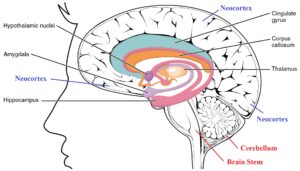 |
| Tiểu não (được tô đỏ) điều khiển các cử động của cơ thể. Tiểu não cũng giúp giữ thăng bằng và ghi nhớ các thao tác lặp đi lặp lại. Nếu thân não bị tổn thương đáng kể, người bệnh có thể tử vong. Thân não kiểm soát các chức năng sống còn như hô hấp. | |
- The limbic system plays a vital role in memory. It also deals with emotions. Components of the limbic system are indicated in black.
Hệ viền giữ vai trò thiết yếu trong trí nhớ và cũng xử lý cảm xúc. Các thành phần của hệ viền được tô màu đen.
- The neocortex (indicated in blue) is the largest area of the brain and manages sensory inputs such as vision and hearing. It is also the “thinking brain.” It wraps around the limbic system, starting from the edge of the cerebellum.
Tân vỏ não (được tô xanh dương) là vùng lớn nhất của não, xử lý các dữ liệu giác quan như thị giác và thính giác. Đây cũng là “bộ não tư duy.” Nó bao quanh hệ viền, bắt đầu từ rìa của tiểu não.
Click on the link to download the figure: “WebLink: JPG image download: Major Components of the Brain.”
Bấm vào liên kết để tải hình: “WebLink: JPG image download: Major Components of the Brain.”
Structural Information on the Three Regions of the Brain
Thông Tin Cấu Trúc Về Ba Vùng Của Não
- The above figure shows a brain cut in the middle. Some components of the limbic system have two parts on either side. For example, the hippocampus and amygdala have two identical structures on the brain’s left and right sides. [The hippocampus is a small, curved formation in the brain that plays an important role in the limbic system. The hippocampus is involved in the formation of new memories and is also associated with learning and emotions. The amygdala is a collection of cells near the base of the brain. There are two, one in each hemisphere or side of the brain. This is where emotions are given meaning, remembered, and attached to associations and responses to them (emotional memories). The amygdala is considered to be part of the brain’s limbic system.]
Hình trên cho thấy một bộ não được cắt dọc ở giữa. Một số thành phần của hệ viền có hai phần đối xứng hai bên. Chẳng hạn, hồi hải mã và hạch hạnh nhân có hai cấu trúc giống hệt nhau ở phía trái và phải của não. [Hồi hải mã là một cấu trúc nhỏ, cong trong não, giữ vai trò quan trọng trong hệ viền. Hồi hải mã tham gia hình thành ký ức mới và liên quan đến học tập và cảm xúc. Hạch hạnh nhân là một cụm tế bào gần đáy não. Có hai hạch, mỗi bên bán cầu một cái. Đây là nơi cảm xúc được gán ý nghĩa, được ghi nhớ và gắn với các liên tưởng cũng như các phản ứng (ký ức cảm xúc). Hạch hạnh nhân được xem là một phần của hệ viền.]
- On the other hand, the brain stem and cerebellum are single structures.
Ngược lại, thân não và tiểu não là các cấu trúc đơn lẻ.
- In contrast to both, the neocortex has different areas specialized for various tasks. Analysis of sensory inputs happens in the back (visual and auditory cortex.) Parts of the frontal cortex manage planning, speech, and related motor control aspects. The neocortex accounts for 76% of the brain.
Trái với hai vùng trên, tân vỏ não gồm nhiều khu vực chuyên trách các nhiệm vụ khác nhau. Phân tích dữ liệu đầu vào giác quan diễn ra ở phía sau (vỏ thị giác và vỏ thính giác). Các phần ở thùy trán đảm nhiệm lập kế hoạch, ngôn ngữ và các khía cạnh điều khiển vận động liên quan. Tân vỏ não chiếm khoảng 76% khối não.
Overview of Our Discussion So Far
Tổng Quan Những Điểm Đã thảo luận Đến giờ
- Now, we can better visualize our discussion so far in the previous few posts, especially the post on “Persistent Vegetative State – Buddhist View.” Let us first go over that post.
Giờ đây, ta có thể hình dung rõ hơn những điểm đã thảo luận trong các bài trước, đặc biệt là bài “Persistent Vegetative State – Buddhist View.” Hãy điểm lại bài đó trước.
- The brain stem regulates breathing, heart rate, and blood pressure. Therefore, it is likely that people in vegetative states do not have significant damage to their brain stems.
Thân não điều hòa hô hấp, nhịp tim và huyết áp. Do đó, nhiều khả năng người ở trạng thái thực vật không bị tổn thương đáng kể ở thân não.
- The loss of motor control (body movements) is likely due to damage to the cerebellum.
Mất kiểm soát vận động (cử động cơ thể) nhiều khả năng là do tổn thương tiểu não.
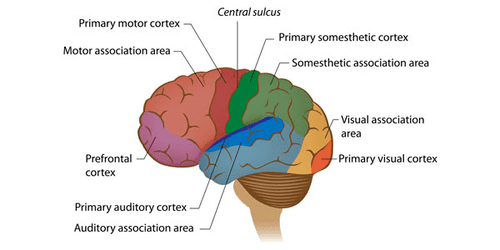 |
§ The visual and auditory cortexes are close to the cerebellum (left figure). Click to download the figure: “WebLink: PNG image download: Neocortex Areas and Cerebellum.” The limbic system is hidden in this view.
Vỏ thị giác và vỏ thính giác nằm gần tiểu não (hình bên trái). Nhấp để tải hình: “WebLink: PNG image download: Neocortex Areas and Cerebellum.” Hệ viền không thấy trong góc nhìn này. § That roughly matches what we discussed in the previous post about different situations of people in vegetative states. For example, suppose there is damage to the cerebellum area but minimal damage to the visual/auditory cortexes. Such patients may be able to see/hear but not able to respond. Điều đó đại thể phù hợp với những gì đã bàn trong bài trước về các tình huống khác nhau ở người trong trạng thái thực vật. Ví dụ, nếu vùng tiểu não bị tổn thương nhưng vỏ thị giác/thính giác hầu như không bị, bệnh nhân có thể nhìn/nghe được nhưng không thể đáp ứng. |
- On the other hand, if visual/auditory cortexes and the cerebellum are damaged, the patients would not be able to see or hear as well.
Ngược lại, nếu cả vỏ thị giác/thính giác lẫn tiểu não đều tổn thương, bệnh nhân cũng sẽ không thể nhìn hoặc nghe tốt.
- We discussed those two situations in the previous post.
Hai tình huống này đã được bàn trong bài trước.
The Opposite of a “Vegetative State” – Living Without Memory
Điều Trái Ngược Với “Trạng Thái Thực Vật” – Sống Mà Không Có Ký Ức
- Now, let us discuss a few people who were unfortunate to face different problems due to a third region of the brain located close to the middle of the brain. As we can see from the first figure above, the limbic system lies underneath the neocortex and sits above the brain stem/cerebellum area.
Bây giờ, ta xét một số trường hợp kém may mắn mắc những vấn đề khác, liên quan đến vùng thứ ba của não nằm gần phần giữa não. Như thấy ở hình đầu tiên, hệ viền nằm bên dưới tân vỏ não và phía trên vùng thân não/tiểu não.
- The limbic system is the “emotional center” of the brain because it controls emotions. It has several components, including the hippocampus, amygdala, and thalamus.
Hệ viền là “trung tâm cảm xúc” của não vì nó kiểm soát cảm xúc. Hệ này gồm nhiều thành phần như hồi hải mã, hạch hạnh nhân và đồi thị.
- Our focus here is on the hippocampus. As we will see, it plays a significant role in memory.
Ở đây, chúng ta tập trung vào hồi hải mã. Như sẽ thấy, nó giữ vai trò quan trọng trong trí nhớ.
- There are two symmetrically-placed hippocampi on either side of the brain. Surgeons removed both of them in a patient who went by the name “patient H.M.”
Có hai hồi hải mã bố trí đối xứng ở hai bên não. Các bác sĩ phẫu thuật đã cắt bỏ cả hai ở một bệnh nhân được biết đến với tên “bệnh nhân H.M.”
The account of “Patient H.M.” – Critical Role of Hippocampus
Trường hợp “Bệnh nhân H.M.” – Vai trò Then Chốt Của Hồi Hải Mã
- Patient H.M. (or Henry Molaison) suffered from frequent bouts of seizures. In 1953, a surgeon removed both his hippocampi in an attempt to solve that problem. Even though the episodes went away, HM suffered a devastating memory loss.
Bệnh nhân H.M. (tên thật Henry Molaison) bị các cơn co giật tái diễn. Năm 1953, một bác sĩ phẫu thuật đã cắt bỏ cả hai hồi hải mã của ông nhằm chữa trị vấn đề này. Dù các cơn co giật biến mất, HM lại chịu một tổn thất trí nhớ nghiêm trọng.
- HM lost the ability to retain NEW memories. But he could remember events up to the operation but could not remember anything for more than a few minutes AFTER the operation. The following video explains it in more detail.
HM mất khả năng giữ lại các ký ức MỚI. Ông vẫn nhớ được các sự kiện trước ca mổ nhưng KHÔNG thể nhớ điều gì quá vài phút kể từ SAU ca mổ. Video sau giải thích chi tiết hơn.
WebLink: youtube: What happens when you remove the hippocampus? – Sam Kean
- After extensive studies on patient HM (he died in 2008) and on several other patients with memory loss, neuroscientists have concluded that the hippocampus is the component in the brain that strengthens short term memories to long-term memories and “passes them over to the neocortex.”
Sau nhiều nghiên cứu sâu rộng về bệnh nhân HM (ông qua đời năm 2008) và một số bệnh nhân mất trí nhớ khác, các nhà thần kinh học kết luận rằng hồi hải mã là bộ phận trong não làm “củng cố” ký ức ngắn hạn thành ký ức dài hạn và “chuyển giao chúng cho tân vỏ não.”
- However, they do not know how those memories can be “passed over to another brain region” or how the brain can keep such “long-term memories” for long times. In the next post, we will discuss some people’s ability to remember past events extensively. For example, some people can remember what they ate for lunch several years ago on a specific arbitrary date! We will discuss that in upcoming posts.
Tuy nhiên, họ không biết bằng cách nào những ký ức đó có thể được “chuyển sang một vùng não khác” hoặc làm sao não có thể lưu giữ những “ký ức dài hạn” trong thời gian rất lâu. Ở bài kế tiếp, chúng ta sẽ bàn về khả năng của một số người có thể nhớ mênh mông các sự kiện quá khứ. Chẳng hạn, có người nhớ được họ ăn gì vào bữa trưa cách đây nhiều năm vào một ngày bất kỳ! Chúng ta sẽ thảo luận điều đó trong các bài sắp tới.
- The extensive study of patient HM is vital since it allows us to pinpoint one brain component responsible for long-term memories.
Việc nghiên cứu sâu rộng về bệnh nhân HM là rất quan trọng vì nó giúp xác định một thành phần của não chịu trách nhiệm cho ký ức dài hạn.
Nomenclature of Memory
Thuật ngữ về Trí nhớ
- We need to be aware are some standard terms used by neuroscientists. That will help us understand the content in the following videos.
Chúng ta cần biết một số thuật ngữ chuẩn được các nhà thần kinh học dùng. Điều đó sẽ giúp hiểu nội dung trong các video sau.
- Autobiographical (or episodic or declarative, or explicit) memory is about remembering events, facts, etc. These memories are about dates, events, names, etc. They are the same as nāmagotta in Buddha Dhamma. In Buddha Dhamma, nāmagotta are not in the brain but reside in the “viññāṇa” There is a “transmitter” in the brain that transmits memories to the “viññāṇa plane.” Then there is a “receiver” in the brain that makes it possible to recall memories from the “viññāṇa plane.” More on that in upcoming posts.
Ký ức tự truyện (hay còn gọi là trí nhớ tình tiết, khai báo, hoặc hiển ngôn) liên quan đến việc ghi nhớ các sự kiện, sự thật, v.v. Những ký ức này xoay quanh ngày tháng, sự kiện, tên gọi, v.v. Chúng tương ứng với nāmagotta trong Dhamma của Đức Phật. Trong Dhamma của Đức Phật, nāmagotta không nằm trong não mà tồn tại ở “cảnh giới viññāṇa.” Có một “bộ phát” trong não truyền ký ức đến “cảnh giới viññāṇa.” Rồi có một “bộ thu” trong não giúp truy hồi ký ức từ “cảnh giới viññāṇa.” Sẽ bàn thêm ở các bài tới.
- The other is habitual (or procedural or implicit) memory or being able to do repetitive tasks like playing the piano, riding a bicycle, brushing teeth, etc. They are related to one’s habits. These memories are “hard-wired” in the brain. It appears that the cerebellum in the brain is where such “memory connections” take place.
Loại còn lại là ký ức thói quen (hay thủ tục, hay ẩn ngôn) — tức khả năng thực hiện các tác vụ lặp lại như chơi piano, đi xe đạp, đánh răng, v.v. Chúng liên quan đến thói quen của một người. Những ký ức này được “đấu nối cứng” trong não. Có vẻ như tiểu não là nơi diễn ra các “liên kết trí nhớ” như vậy.
- Anterograde amnesia is the failure to store memories after trauma. Retrograde amnesia is the failure to recall memories before the trauma. The loss of the hippocampus leads to anterograde amnesia.
Chứng quên tiến triển là không thể lưu trữ ký ức sau sang chấn. Chứng quên thoái lui là không thể gợi lại ký ức trước sang chấn. Mất hồi hải mã dẫn đến chứng quên tiến triển.
Further Details on Patient H.M.
Chi tiết Khác về Bệnh nhân H.M.
- The following video is a bit long. But it provides a lot of information.
Video sau hơi dài, nhưng cung cấp rất nhiều thông tin.
WebLink: youtube: Patient HM and Jacopo Annese
- @ 4 minutes: Hippocampi on both sides of the brain surgically removed. After that, he couldn’t remember anything that had happened minutes ago. Of course, he could remember events before the operation.
Ở phút thứ 4: Hai hồi hải mã ở cả hai bên não đã bị cắt bỏ bằng phẫu thuật. Sau đó, ông không thể nhớ những gì xảy ra cách đó vài phút. Dĩ nhiên, ông vẫn nhớ các sự kiện trước ca mổ.
- Imagine the hippocampi to be the “transmitter.” Suppose it transmits new memories to the “viññāṇa plane,” where they remain intact forever. Then suppose another component (yet unidentified) in the brain can help recall memories. That “receiver” worked for patient H.M. since he could recall memories formed BEFORE removing the hippocampi.
Hãy hình dung hồi hải mã là “bộ phát.” Giả sử nó truyền các ký ức mới đến “cảnh giới viññāṇa,” nơi chúng tồn tại nguyên vẹn mãi mãi. Rồi giả sử có một thành phần khác (chưa xác định) trong não giúp truy hồi ký ức. “Bộ thu” đó đã hoạt động ở bệnh nhân H.M., vì ông có thể nhớ các ký ức hình thành TRƯỚC khi cắt bỏ hồi hải mã.
- We will discuss this “theory” in the next post. But keep this in mind as we continue the discussion here.
Chúng ta sẽ bàn về “giả thuyết” này trong bài tới. Nhưng hãy ghi nhớ điều đó khi tiếp tục thảo luận ở đây.
- @4:40 minutes: “Declarative memory” is the same as the aforementioned autobiographical memory. “Procedural memory” is the same as “habitual memory.”
Ở phút thứ 4:40: “Trí nhớ khai báo” chính là ký ức tự truyện đã nói. “Trí nhớ thủ tục” chính là “ký ức thói quen.”
- @5:40 minutes: The narrator says there is only one book on patient H.M., But there are two more. See 1.
Ở phút thứ 5:40: Người dẫn chuyện nói chỉ có một cuốn sách về bệnh nhân H.M., nhưng còn hai cuốn nữa. Xem Tài liệu tham khảo 1.
- The Nova clip @ 7 minutes says that memories are created and erased by chemical processes. But that is not consistent with either Buddha Dhamma or recent findings in science.
Đoạn Nova ở phút thứ 7 nói ký ức được tạo ra và xóa đi bởi các quá trình hóa học. Nhưng điều đó không phù hợp với cả Dhamma của Đức Phật lẫn một số phát hiện khoa học gần đây.
- @ 8:40 minutes: The account of H.M.’s medical problems led to surgery.
Ở phút thứ 8:40: Tường thuật các vấn đề y khoa của H.M. dẫn đến ca phẫu thuật.
- @ 10 minutes: Patient H.M. could remember everything that happened before his operation.
Ở phút thứ 10: Bệnh nhân H.M. có thể nhớ mọi điều xảy ra trước ca mổ.
- @ 10:30 minutes: Dr. Milner concluded that the hippocampus MAKES long-term memories. But we will see that there is a better explanation.
Ở phút thứ 10:30: Bác sĩ Milner kết luận hồi hải mã TẠO RA ký ức dài hạn. Nhưng chúng ta sẽ thấy có một cách giải thích tốt hơn.
- @ 11:00 minutes: The drawing experiment showed that he could learn repetitive processes. As we will see below, that comes under “habitual memory” (learning a motor skill) controlled by the cerebellum. But, of course, he had no memory of going through those trial runs of drawing the star.
Ở phút thứ 11:00: Thí nghiệm vẽ cho thấy ông có thể học các quy trình lặp lại. Như sẽ thấy bên dưới, điều đó thuộc “ký ức thói quen” (học một kỹ năng vận động) do tiểu não kiểm soát. Nhưng dĩ nhiên, ông không có ký ức về việc đã trải qua các lần thử vẽ ngôi sao đó.
- @ 12 minutes: Current scientific explanation of memory formation. This explanation is also consistent with Buddha Dhamma. Construction of “habitual memories” or motor skills appears to occur in the cerebellum.
Ở phút thứ 12: Cách giải thích khoa học hiện nay về sự hình thành ký ức. Cách giải thích này cũng phù hợp với Dhamma của Đức Phật. Việc hình thành “ký ức thói quen” hay các kỹ năng vận động dường như diễn ra ở tiểu não.
The Account of Patient E.P.
Trường hợp của Bệnh nhân E.P.
- The account of a different person, patient E.P. starts at 4:30 minutes. In 1992, E.P. suffered a viral infection that seemed to have damaged parts of the limbic system. That is very similar to the case of Clive Wearing that we will discuss below.
Trường hợp một người khác, bệnh nhân E.P., bắt đầu ở phút thứ 4:30. Năm 1992, E.P. bị một nhiễm virus có vẻ đã làm tổn thương một số phần của hệ viền. Điều này rất giống với trường hợp của Clive Wearing mà ta sẽ bàn bên dưới.
- @ 17 minutes: Patient E.P. could not retain memories of events AFTER coming down with the infection. But he remembered events before that. Thus, he does not have autobiographical memories of events AFTER the infection.
Ở phút thứ 17 phút: Bệnh nhân E.P. không thể giữ lại ký ức về các sự kiện SAU khi mắc nhiễm trùng. Nhưng ông nhớ các sự kiện trước đó. Do vậy, ông không có các ký ức tự truyện về những sự kiện SAU khi bị nhiễm.
- @ 19:30: The virus destroyed areas around the hippocampus. After that damage, patient E.P. could not retain any NEW autobiographical information. But he remembers everything that happened BEFORE that virus-induced damage. That is similar to the case of patient H.M.
Ở phút thứ 19:30: Virus đã phá hủy các vùng quanh hồi hải mã. Sau tổn thương đó, bệnh nhân E.P. không thể giữ lại bất kỳ thông tin tự truyện MỚI nào. Nhưng ông nhớ mọi điều xảy ra TRƯỚC khi bị tổn thương do virus. Trường hợp này tương tự bệnh nhân H.M.
- @ 22 minutes: The narrator says the hippocampus helps “record the memories.” But as we will see, the hippocampus transmits those memories to the viññāṇa
Ở phút thứ 22: Người dẫn chuyện nói hồi hải mã giúp “ghi lại ký ức.” Nhưng như sẽ thấy, hồi hải mã truyền các ký ức đó đến cảnh giới viññāṇa.
- @ 24 minutes: Brief discussion of Clive Wearing.
Ở phút thứ 24: Thảo luận ngắn về Clive Wearing.
- @ 25:40 minutes: The account of Dr. Jacopo Annese, who compiles records of the brains of people with different backgrounds, including those with memory problems.
Ở phút thứ 25:40: Tường thuật về Tiến sĩ Jacopo Annese, người biên soạn hồ sơ não bộ của những người có lý lịch khác nhau, bao gồm cả những người gặp vấn đề về trí nhớ.
- @ 30:10 to 32 minutes: The brain of patient H.M. The discussion relevant to our topic stops at 32 minutes.
Ở phút thứ 30:10 đến 32: Não của bệnh nhân H.M. Phần thảo luận liên quan đến chủ đề của chúng ta dừng ở phút 32.
- @ 32 minutes to end: Work of Dr. Annese. He plans to make a repository of complete brain scans of 1000 people.
Ở phút thứ 32 đến hết: Công việc của Tiến sĩ Annese. Ông dự định xây dựng một kho lưu trữ bản quét não hoàn chỉnh của 1000 người.
- Next, we discuss a third patient who lost ALL his memories AND cannot make ANY memories.
Tiếp theo, chúng ta bàn về bệnh nhân thứ ba, người đã mất TẤT CẢ ký ức VÀ không thể tạo BẤT KỲ ký ức nào.
Clive Wearing – Musician With Seven Second Memory
Clive Wearing – Nhạc Công Với Ký Ức Bảy Giây
- Clive Wearing was a reputable musician. A herpes virus damaged his brain (around the limbic system) just over a few days in 1985. Unlike patient H.M. and patient E.P., he cannot recall ANY memories. He can remember only those events within the last seven seconds. His situation is even worse than that of the previous two patients.
Clive Wearing là một nhạc công có uy tín. Một loại virus herpes đã làm tổn thương não ông (quanh hệ viền) chỉ trong vài ngày vào năm 1985. Khác với bệnh nhân H.M. và E.P., ông không thể gợi lại BẤT KỲ ký ức nào. Ông chỉ nhớ được những gì diễn ra trong bảy giây vừa qua. Tình trạng của ông còn tệ hơn hai bệnh nhân trước.
- Therefore, he cannot recognize anyone. Even though he cannot remember his wife’s name, he knows that she is a special person in his life.
Vì vậy, ông không thể nhận ra ai cả. Dù không nhớ tên vợ, ông vẫn biết đó là người đặc biệt trong đời mình.
- So, he virtually lives “just at that moment”!
Thành ra, ông hầu như sống “chỉ trong khoảnh khắc hiện tại”!
- The following video is a bit long. But it provides a lot of information.
Video sau hơi dài, nhưng cung cấp rất nhiều thông tin.
WebLink: youtube: The Man With The Seven Second Memory (Amnesia Documentary) | Real Stories
Significant Deductions from Clive Wearing’s Case
Những Suy Luận Quan Trọng Từ Trường Hợp Của Clive Wearing
- Note in the beginning that he can play the piano but cannot remember anything that happened even several seconds ago!
Lưu ý ngay từ đầu rằng ông có thể chơi piano nhưng không thể nhớ điều gì đã xảy ra dù chỉ vài giây trước!
- Therefore, his habitual memory is intact (consistent with his cerebellum undamaged.) But he has anterograde AND retrograde amnesia, i.e., total loss of autobiographical memory. Therefore, he seems to have lost both the transmitter (hippocampus) and “receiver” (cannot be identified yet.)
Vì thế, ký ức thói quen của ông vẫn nguyên vẹn (phù hợp với việc tiểu não không bị tổn thương). Nhưng ông bị cả quên tiến triển LẪN quên thoái lui, tức mất sạch ký ức tự truyện. Do đó, dường như ông đã mất cả “bộ phát” (hồi hải mã) lẫn “bộ thu” (chưa xác định được).
- @ 6:40 minutes: He says it is like being dead. No thoughts of any kind, except the one that passes by. In that sense, his state is a kind of a “vegetative state” even though he can maintain his physical activities.
Ở phút thứ 6:40: Ông nói cảm giác như đã chết. Không có bất kỳ ý nghĩ nào, ngoài ý nghĩ vừa lướt qua. Theo nghĩa đó, trạng thái của ông giống một dạng “trạng thái thực vật” dù vẫn duy trì hoạt động thể chất.
- @ 9:30 minutes: The account of how he lost memory in several days in 1985.
Ở phút thứ 9:30: Tường thuật cách ông mất trí nhớ chỉ trong vài ngày của năm 1985.
- Here are more notable things from the above video:
Dưới đây là vài điểm đáng chú ý khác từ video trên:
- @ 10 minutes: How he lost memory within several days. The herpes virus crossed the blood-brain barrier and got into the brain. There is only a one-in-a-million chance of that happening!
Ở phút thứ 10: Cách thức ông mất trí nhớ trong vài ngày. Virus herpes vượt qua hàng rào máu–não và xâm nhập não. Khả năng xảy ra chỉ khoảng một trên một triệu!
- @14 minutes; He says he cannot think about anything. That is why he initially cried all day long. He says it is like being dead.
Ở phút thứ 14: Ông nói mình không thể nghĩ về bất cứ điều gì. Vì thế ban đầu ông khóc suốt ngày. Ông bảo cảm giác như đã chết.
- @19 minutes: Every moment is the beginning of consciousness! He repeats that at @43 minutes. No thoughts mean like being dead! He was fortunate to be able to play the piano. As we mentioned, such “learned memories” remain hard-wired in the cerebellum. That is a notable difference from “episodic memories,” which are not (and cannot be) “stored” in the brain. We will discuss that in the next post. That is also why he can dress by himself, eat and do other “regular activities” by himself.
Ở phút thứ 19: Mỗi khoảnh khắc là sự khởi đầu của ý thức! Ông lặp lại điều đó ở phút thứ 43. Không có ý nghĩ tức là như đã chết! May mắn là ông còn có thể chơi piano. Như đã nói, những “ký ức đã học” kiểu này được “đấu nối cứng” ở tiểu não. Đó là khác biệt đáng chú ý với “trí nhớ tình tiết,” vốn không (và không thể) “lưu trữ” trong não. Ta sẽ bàn điều này ở bài kế tiếp. Cũng vì lý do đó mà ông vẫn có thể tự mặc quần áo, ăn uống và làm các “hoạt động thường ngày.”
- We can learn a lot about the working of the brain and the gandhabba by carefully analyzing the accounts of patient H.M., patient E.P., and Clive Wearing.
Qua việc phân tích kỹ các trường hợp H.M., E.P. và Clive Wearing, ta có thể học được rất nhiều về cách não vận hành và về gandhabba.
- We will continue the discussion in the next post.
Chúng ta sẽ tiếp tục thảo luận ở bài kế tiếp.
References
Tài liệu tham khảo
- Books on patient H.M.: Philip J. Hilts, Memory’s Ghost (1996). Suzanne Corkin WebLink: PDF Download: Permanent Present Tense: The Unforgettable Life of the Amnesic Patient, H. M. (2013). Luke Dittrich Patient H.M.: A Story of Memory, Madness, and Family Secrets (2017).
Sách về bệnh nhân H.M.: Philip J. Hilts, Memory’s Ghost (1996). Suzanne Corkin WebLink: PDF Download: Permanent Present Tense: The Unforgettable Life of the Amnesic Patient, H. M. (2013). Luke Dittrich, Patient H.M.: A Story of Memory, Madness, and Family Secrets (2017).
- Book on Clive Wearing: Deborah Wearing, Forever Today (2005).
Sách về Clive Wearing: Deborah Wearing, Forever Today (2005).
- One could Google and find much more information on any of these topics. I have provided just enough material to get the basic idea.
Có thể tìm thêm rất nhiều thông tin về các chủ đề này trên Google. Ở đây tôi chỉ cung cấp vừa đủ để nắm ý chính.
All posts in this section at, “Buddha Dhamma – A Scientific Approach.”
Tất cả các bài trong mục này tại “Buddha Dhamma – A Scientific Approach.”