May 1, 2023; revised May 2, 2023
Ngày 1/5/2023; chỉnh sửa ngày 2/5/2023
Saḷāyatana is incorrectly translated into English as the “six sense fields.” Arahants do not have saḷāyatana but have the six sense fields.
Saḷāyatana thường bị dịch sai sang tiếng Anh là “six sense fields (sáu căn).” Các Arahant không có saḷāyatana nhưng có sáu căn.
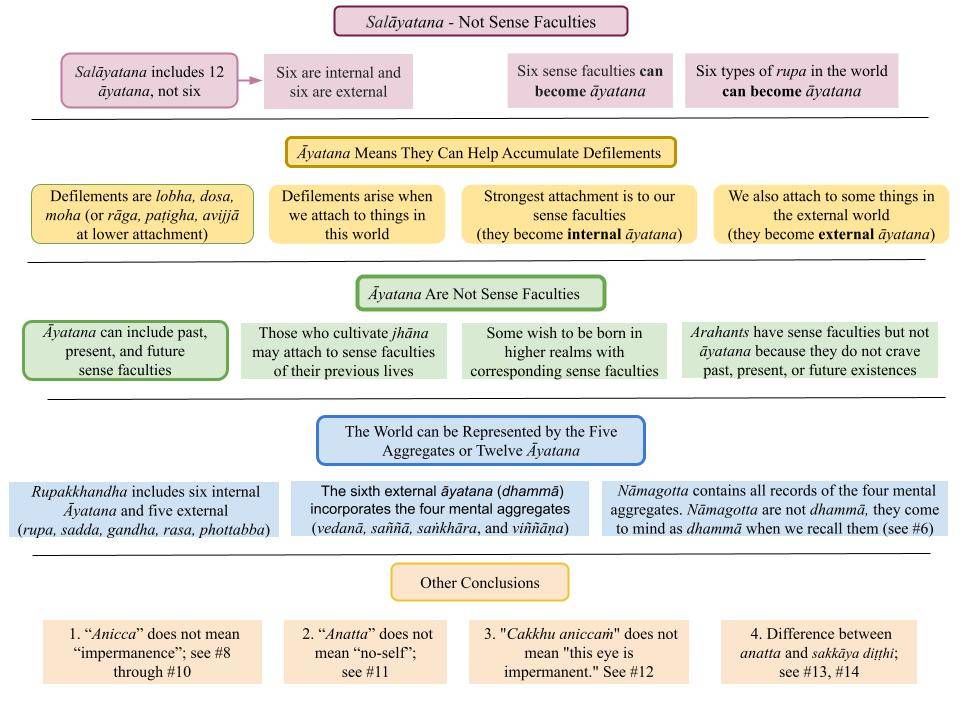
Buddhism – In Charts: 11. Saḷāyatana – Not Sense Faculties (with clickable links only in WebHelp)
Phật Giáo – dưới dạng Sơ đồ: 11. Saḷāyatana – Không Phải Là các Giác quan (liên kết chỉ bấm được trong WebHelp)
Print/Download: “WebLink: PDF Download: 11. Saḷāyatana – Not Sense Faculties”
In/ Tải xuống: “WebLink: PDF Download: 11. Saḷāyatana – Not Sense Faculties”
Introduction
Dẫn nhập
- Most English translations of suttas incorrectly translate “saḷāyatana” as the “six sense fields.” See, for example, “WebLink: suttacentral: Paṭiccasamuppāda Sutta (SN 12.1),” where “saḷāyatana nirodhā phassa nirodho” is translated as “When the six sense fields cease, contact ceases.” Arahants (or the Buddha) would have their sense fields working at optimum levels but do not have “saḷāyatana,” as I explain below.
Phần lớn các bản dịch tiếng Anh của các sutta dịch sai “saḷāyatana” thành “sáu căn.” Ví dụ xem “WebLink: suttacentral: Paṭiccasamuppāda Sutta (SN 12.1)”, trong đây câu “saḷāyatana nirodhā phassa nirodho” được dịch là “Khi sáu giác quan diệt thì xúc diệt.” Các vị Arahant (hay Đức Phật) vẫn có các giác quan vận hành ở mức tối ưu, nhưng không có “saḷāyatana”, như sẽ giải thích bên dưới.
- In most cases, it is best to look at the “definitions” of key Pāli words in the three Commentaries included with the Tipiṭaka (Paṭisambhidāmagga, Peṭakopadesa, and Nettippakarana) or the “Vibhaṅga” in the Abhidhamma Piṭaka.
Trong đa số trường hợp, tốt nhất nên xem “định nghĩa” các từ Pāli then chốt trong ba bộ Chú giải nằm trong Tipiṭaka (Paṭisambhidāmagga, Peṭakopadesa và Nettippakarana) hoặc phần “Vibhaṅga” thuộc Abhidhamma Piṭaka.
- Other Commentaries written later (and not included in the Tipiṭaka) have apparent contradictions with the Tipiṭaka; see “Tipiṭaka Commentaries – Helpful or Misleading?”
Các Chú giải biên soạn về sau (không thuộc Tipiṭaka) có những điểm mâu thuẫn rõ ràng với Tipiṭaka; xem “Tipiṭaka Commentaries – Helpful or Misleading?”.
Twelve Āyatana, Not Six
Mười hai Āyatana, Không phải Sáu
- The “WebLink: suttacentral: Āyatana vibhaṅga (Abhidhamma Vb 2)” section of the Vibhaṅga explains that there are 12 āyatana not just six: “cakkhāyatanaṁ, rūpāyatanaṁ, sotāyatanaṁ, saddāyatanaṁ, ghānāyatanaṁ, gandhāyatanaṁ, jivhāyatanaṁ, rasāyatanaṁ, kāyāyatanaṁ, phoṭṭhabbāyatanaṁ, manāyatanaṁ, dhammāyatanaṁ.”
Mục “WebLink: suttacentral: Āyatana vibhaṅga (Abhidhamma Vb 2)” trong Vibhaṅga giải thích rằng có 12 āyatana, không chỉ sáu: “cakkhāyatanaṁ, rūpāyatanaṁ, sotāyatanaṁ, saddāyatanaṁ, ghānāyatanaṁ, gandhāyatanaṁ, jivhāyatanaṁ, rasāyatanaṁ, kāyāyatanaṁ, phoṭṭhabbāyatanaṁ, manāyatanaṁ, dhammāyatanaṁ.”
- They are explained as six internal (cakkhāyatanaṁ, sotāyatanaṁ, ghānāyatanaṁ, jivhāyatanaṁ, kāyāyatanaṁ, manāyatanaṁ) and six external āyatana (rūpāyatanaṁ, saddāyatanaṁ, gandhāyatanaṁ, rasāyatanaṁ, phoṭṭhabbāyatanaṁ, dhammāyatanaṁ) in the “Saḷāyatana Vagga” in WebLink: suttacentral: Saṁyutta Nikāya (SN 4th Group.)
Chúng được phân thành sáu āyatana nội (cakkhāyatanaṁ, sotāyatanaṁ, ghānāyatanaṁ, jivhāyatanaṁ, kāyāyatanaṁ, manāyatanaṁ) và sáu āyatana ngoại (rūpāyatanaṁ, saddāyatanaṁ, gandhāyatanaṁ, rasāyatanaṁ, phoṭṭhabbāyatanaṁ, dhammāyatanaṁ) trong “Saḷāyatana Vagga” thuộc WebLink: suttacentral: Saṁyutta Nikāya (SN 4th Group.)
- Obviously, the six internal āyatana are associated with the six senses (five physical senses and the mind), and the six external āyatana are associated with the external world. The six senses BECOME six internal āyatana when interacting with the external world and accumulating kamma for the Saṁsāric journey (rebirth process.)
Rõ ràng sáu āyatana nội gắn với sáu giác quan (năm giác quan thân và tâm), và sáu āyatana ngoại gắn với thế giới bên ngoài. Sáu giác quan TRỞ THÀNH sáu āyatana nội khi tương tác với thế giới bên ngoài và tích lũy kamma cho hành trình Saṁsāra (tiến trình tái sinh).
- The brief explanation: When we attach to things in the external world, we convert our senses into āyatana (ajjhatta āyatana), i.e., we start using them to enjoy “pleasurable things” in the external world. Those “pleasurable things” then become “external āyatana” (bāhira āyatana.)
Giải thích ngắn gọn: Khi chúng ta chấp thủ vào các pháp/sự việc ở thế giới bên ngoài, ta biến các giác quan thành āyatana (ajjhatta āyatana) — tức bắt đầu dùng chúng để hưởng những “điều khả ái” ở thế giới bên ngoài. Khi ấy, những “điều khả ái” đó trở thành “āyatana ngoại” (bāhira āyatana).
- The WebLink: suttacentral: Saṁyutta Nikāya (SN 4th Group) starts with three suttas (SN 35.1 through 35.3), stating the anicca, dukkha, and anatta nature of the internal āyatana. The next three state the anicca, dukkha, and anatta nature of the external āyatana.
WebLink: suttacentral: Saṁyutta Nikāya (SN 4th Group) mở đầu bằng ba suttas (SN 35.1 đến 35.3) nêu rõ bản chất anicca, dukkha và anatta của āyatana nội. Ba bài tiếp theo nêu bản chất anicca, dukkha và anatta của āyatana ngoại.
Pada Nirutti of “Āyatana”
Pada Nirutti của “Āyatana”
- The Pāli word “āyatana” comes from “āya” + “thana,” where “āya” means “to acquire” and “thana” means “place” or “location.” Note that “āyatana” is pronounced as “āyathana,” as in “thief.” [āya [m.], income; profit. ṭhāna [nt.], place; locality; condition; reason; office; cause; standing up; stay.]
Từ Pāli “āyatana” bắt nguồn từ “āya” + “thana”, trong đó “āya” nghĩa là “thu nhận” và “thana” nghĩa là “chỗ” hay “vị trí.” Lưu ý “āyatana” phát âm như “āyathana”, tương tự trong “thief.” [āya [danh từ giống đực]: thu nhập; lợi nhuận. ṭhāna [trung tính]: nơi chốn; điều kiện; lý do; chức vụ; nguyên nhân; đứng dậy; ở lại.]
- In this specific case, “āyatana” is where one “collects (defilements)” for the rebirth process (Saṁsāra.)
Trong ngữ cảnh này, “āyatana” là “nơi” một người “tích lũy (các nhiễm ô hoặc)” cho tiến trình tái sinh (Saṁsāra).
- Defilements at an intense level are lobha, dosa, and Those reduce to rāga, paṭigha, and avijjā with the dispelling of the ten types of micchā diṭṭhi. See, “Micchā Diṭṭhi, Gandhabba, and Sotāpanna Stage.”
Các nhiễm ô hoặc ở mức thô mạnh là lobha, dosa và moha. Khi đoạn trừ mười loại micchā diṭṭhi, chúng được làm nhẹ thành rāga, paṭigha và avijjā. Xem thêm “Micchā Diṭṭhi, Gandhabba, and Sotāpanna Stage.”
- When the six sense faculties are used for “collecting,” they BECOME “āyatana.” The incentive for “collecting defilements” is attachment to things in this world (rūpā, saddā, gandha, rasa, phoṭṭhabba, dhammā.) Thus, they are external āyatana.
Khi sáu giác quan được dùng để “tích lũy,” chúng TRỞ THÀNH “āyatana.” Động lực khiến “tích lũy nhiễm ô hoặc” là sự chấp trước vào các pháp trong thế giới này (rūpā, saddā, gandha, rasa, phoṭṭhabba, dhammā). Do đó, những sự việc ấy là āyatana ngoại.
- Of course, Arahants do not engage in “collecting,” and thus, their sense faculties do not become āyatana; furthermore, external rūpa of all six types do not become āyatana
Dĩ nhiên, các vị Arahant không tham dự vào việc “tích lũy,” nên các giác quan của các ngài không trở thành āyatana; hơn nữa, các rūpa bên ngoài ở cả sáu loại cũng không trở thành āyatana.
Āyatana Are Not “Sense Faculties”
Āyatana không phải là “Các Căn”
- Since internal āyatana takes into account all past, present, and future (perceived) sense faculties, our current sense faculties are only a minute fraction of the category of “internal āyatana.”
Vì āyatana nội bao hàm toàn bộ các giác quan (nhận thức được) trong quá khứ, hiện tại và tương lai, nên các giác quan hiện tại của chúng ta chỉ là một phần rất nhỏ trong phạm trù “āyatana nội.”
- Furthermore, the sense faculties of living Arahants (or living Buddha) are NOT āyatana. They are mere “sense faculties.”
Hơn nữa, các giác quan của các vị Arahant đang sống (hay của một vị Phật đang sống) KHÔNG PHẢI là āyatana. Chúng chỉ là “các căn” mà thôi.
- The sense faculties BECOME āyatana ONLY IF one views/perceives them as one’s own. With that wrong view/perception, they use the sense faculties to “enjoy worldly things.” That is how sense faculties become āyatana.
Các giác quan CHỈ TRỞ THÀNH āyatana KHI một người xem/nhận chúng là “của mình.” Với tà kiến/nhận thức sai lầm ấy, người ta dùng các giác quan để “hưởng các pháp thế gian.” Đó là cách các giác quan trở thành āyatana.
- To get rid of wrong view/perception, we must see the anicca, dukkha, and anatta nature of the sense faculties (past, present, and future) as stated in the “WebLink: suttacentral: Ajjhattāyatanaanicca Sutta (SN 35.222)” through “WebLink: suttacentral: Ajjhattāyatanaanatta Sutta (SN 35.224).”
Để đoạn trừ tà kiến/nhận thức sai, ta phải thấy bản chất anicca, dukkha và anatta của các giác quan (quá khứ, hiện tại và tương lai) như được nêu trong “WebLink: suttacentral: Ajjhattāyatanaanicca Sutta (SN 35.222)” đến “WebLink: suttacentral: Ajjhattāyatanaanatta Sutta (SN 35.224).”
- Another revelation is that “anicca” does not mean “impermanence,” and “anatta” does not mean “no-self.”
Một điểm then chốt khác: “anicca” không có nghĩa là “vô thường,” và “anatta” không có nghĩa là “vô ngã.”
The whole World is Comprised of Twelve Āyatana
Toàn bộ Thế Giới Gồm Mười Hai Āyatana
- The sutta #23 of the Saḷāyatana Vagga states that “all” (“sabba”) in this world is included in the twelve āyatana: “WebLink: suttacentral: Sabba Sutta (SN 35.23).”
Sutta số 23 thuộc Saḷāyatana Vagga nói rằng “tất cả” (“sabba”) trong thế giới này nằm gọn trong mười hai āyatana: “WebLink: suttacentral: Sabba Sutta (SN 35.23).”
- A series of 59 short suttas from “WebLink: suttacentral: SN 35.168” through “WebLink: suttacentral: SN 35.227” explain that past, present, and paccuppanna (“present”) versions of internal and external āyatana are included in the category of āyatana.
Một loạt 59 sutta ngắn từ “WebLink: suttacentral: SN 35.168” đến “WebLink: suttacentral: SN 35.227” giải thích rằng các phiên bản āyatana nội và ngoại ở các thời quá khứ, hiện tại và paccuppanna (“hiện tại”) đều thuộc phạm trù āyatana.
- They further explain that they ALL have the anicca, dukkha, and anatta
Các sutta này còn nêu rằng TẤT CẢ đều mang bản chất anicca, dukkha và anatta.
- The reason is that the description of “the world” in terms of twelve āyatana is equivalent to the description of the five aggregates, for example.
Lý do là việc mô tả “thế giới” theo mười hai āyatana tương đương (ví dụ) với mô tả năm uẩn.
“The World” Can be Represented in Many Ways
“Thế giới” Có Thể Được Biểu Thị Theo Nhiều Cách
- As in the case of the five aggregates, the twelve āyatana are categorized as past, present, and paccuppanna (“present”), as pointed out above.
Tương tự trường hợp năm uẩn, mười hai āyatana cũng được phân loại theo quá khứ, hiện tại và paccuppanna (“hiện tại”), như đã nêu ở trên.
- That makes sense since the six internal and five external āyatana takes into account the rūpakkhandha.
Điều đó hợp lý vì sáu āyatana nội và năm āyatana ngoại bao hàm rūpakkhandha.
- The sixth external āyatana (dhammā) incorporates the kamma viññāṇa; thus, it can be represented by the viññāṇa Nāmagotta contains all records of the vipāka viññāṇa, and thus, can be represented by the first three mental aggregates.
Āyatana ngoại thứ sáu (dhammā) bao hàm kamma viññāṇa; do vậy có thể biểu thị bằng uẩn viññāṇa. Nāmagotta chứa toàn bộ các ghi nhận của vipāka viññāṇa, nên có thể biểu thị bằng ba uẩn tâm đầu tiên.
- The sixth external āyatana (dhammā) incorporates the four mental aggregates. Nāmagotta contains all records of the four mental aggregates.
Āyatana ngoại thứ sáu (dhammā) bao trùm bốn uẩn tâm. Nāmagotta chứa toàn bộ ghi nhận của cả bốn uẩn này.
- Even though nāmagotta are not dhammā, they come to mind as dhammā when we recall them. I have explained that in the forum (but I should write a post to explain it fully.) See comment #40356 (on September 14, 2022, at 2:42 pm) in the thread “WebLink: PureDhamma Forums: Post on ‘Nāmagotta, Bhava, Kamma Bīja, and Mano Loka (Mind Plane)’”
Dù nāmagotta không phải là dhammā, khi ta gợi lại thì chúng hiện khởi trong tâm như dhammā. Tôi đã giải thích điều đó trên diễn đàn (và sẽ viết bài riêng để trình bày đầy đủ). Xem bình luận #40356 (ngày 14/09/2022, 2:42 chiều) trong chủ đề “WebLink: PureDhamma Forums: Post on ‘Nāmagotta, Bhava, Kamma Bīja, and Mano Loka (Mind Plane)’”
- You may want to think about this carefully. See the analysis of the five aggregates in “The Five Aggregates (Pañcakkhandha).” We can discuss any questions in the forum.
Bạn có thể suy xét kỹ hơn điểm này. Xem phần phân tích năm uẩn trong “The Five Aggregates (Pañcakkhandha).” Chúng ta có thể thảo luận các câu hỏi trên diễn đàn.
Craving Āyatana Is Equivalent to “Pañca Upādānakkhandhā”
Chấp Thủ nơi Āyatana Tương Đương với “Pañca Upādānakkhandhā”
- In the section “The Five Aggregates (Pañcakkhandha),” we discussed the fact that we get attached to only a fraction of the five aggregates (things in this world.)
Trong mục “The Five Aggregates (Pañcakkhandha),” chúng ta đã bàn rằng ta chỉ chấp thủ một phần nào đó của năm uẩn (các pháp trong thế giới này).
- In this “analysis in terms of the twelve āyatana,” we can see that we attach to the same pañca upādānakkhandā (pañcupādānakkhandā.)
Trong “phân tích theo mười hai āyatana” này, ta thấy rằng mình chấp thủ vào chính pañca upādānakkhandā (pañcupādānakkhandā) đó.
- We attach to all six internal āyatana. That happens for all average humans who view/perceive all internal sense faculties as “mine.” As we discussed, that view is sakkāya diṭṭhi.
Ta chấp thủ vào cả sáu āyatana nội. Điều này xảy ra với người phàm vì họ xem/nhận các giác quan nội là “của tôi.” Như đã bàn, đó chính là sakkāya diṭṭhi.
- However, we attach to only a fraction of external āyatana. For example, we attach only to a fraction of external rūpa, sadda, gandha, rasa, and phoṭṭhabba.
Tuy nhiên, ta chỉ chấp thủ một phần các āyatana ngoại. Chẳng hạn, ta chỉ chấp thủ vào một phần rūpa, sadda, gandha, rasa và phoṭṭhabba bên ngoài.
- With the above background, we can now discuss some critical facts.
Với nền tảng trên, giờ ta có thể bàn một số điểm mấu chốt.
Wrong Translations of Anicca
Những Bản Dịch Sai về Anicca
- I mentioned above (#4, #5) that the twelve āyatana are categorized as past, present, and paccuppanna (“present”) That is elaborated in a series of suttas from SN 35.186 through SN 35.227.
Như đã nêu ở trên (#4, #5), mười hai āyatana được phân thành quá khứ, hiện tại và paccuppanna (“hiện tại”). Điều này được triển khai trong một loạt suttas từ SN 35.186 đến SN 35.227.
- The three suttas “WebLink: suttacentral: Ajjhattātītānicca Sutta (SN 35.186),” “WebLink: suttacentral: Ajjhattānāgatānicca Sutta (SN 35.187),” and “WebLink: suttacentral: Ajjhattapaccuppannānicca Sutta (SN 35.188)” state that the six internal āyatana belonging to the past, future and present are of the anicca
Ba sutta “WebLink: suttacentral: Ajjhattātītānicca Sutta (SN 35.186),” “WebLink: suttacentral: Ajjhattānāgatānicca Sutta (SN 35.187),” và “WebLink: suttacentral: Ajjhattapaccuppannānicca Sutta (SN 35.188)” nêu rằng sáu āyatana nội thuộc quá khứ, tương lai và hiện tại đều có bản chất anicca.
- Obviously, the past āyatana refers to those that one had in previous lives, i.e., one’s past āyatana ARE of anicca It does not make sense to say, “One’s past āyatana ARE impermanent.”
Rõ ràng, āyatana quá khứ là những gì một người có trong các đời trước; tức āyatana quá khứ CÓ bản chất anicca. Nói “āyatana quá khứ LÀ vô thường” thì không hợp lý.
- The point is that some yogis who can look at previous lives and see their births in Deva or Brahma realms may boast about them. Yet, those “seemingly valuable existences” could not be maintained. Any existence among the 31 realms (whether now, in the past, or in the future) is of anicca nature; not one can be maintained in that state.
Ý chính là: một số yogi có thể thấy tiền kiếp và thấy mình từng sinh về cõi Deva hay Brahma rồi lấy đó mà tự hào. Thế nhưng những “(sự hiện) hữu dường như quý giá” ấy đều không thể duy trì. Mọi hình thức tồn tại trong 31 cõi (dù hiện tại, quá khứ hay tương lai) đều có bản chất anicca; không có hữu nào giữ nguyên được. - Therefore, it should be clear that the translation of “anicca” as “impermanence” does not make sense.
Do đó, có thể thấy rõ việc dịch “anicca” thành “impermanence” (vô thường) là không hợp lý.
- The three suttas “WebLink: suttacentral: Bāhirātītādianicca Sutta (SN 35.195-197)” state that the six external āyatana belonging to the past, future and present are of the anicca nature: “Rūpā, bhikkhave, aniccā atītā anāgatā paccuppannā. Saddā … gandhā … rasā … phoṭṭhabbā … dhammā aniccā atītā anāgatā paccuppannā.”
Ba sutta “WebLink: suttacentral: Bāhirātītādianicca Sutta (SN 35.195-197)” nêu rằng sáu āyatana ngoại thuộc quá khứ, tương lai và hiện tại đều có bản chất anicca: “Rūpā, bhikkhave, aniccā atītā anāgatā paccuppannā. Saddā … gandhā … rasā … phoṭṭhabbā … dhammā aniccā atītā anāgatā paccuppannā.”
- Again, all three tenses are shown without distinction.
Một lần nữa, cả ba thời đều được nêu ra rõ ràng, không phân biệt.
- That verse should be translated as, “Bhikkhus, any rūpa, whether past, future, or present, has the anicca The same applies to any sadda (sounds,) .., and dhammā.” Also, note that dhammā is incorrectly translated as “thoughts.” That error seems to be in all the suttas in SN 35.
Câu ấy nên được dịch: “Này các Bhikkhus, mọi rūpa, dù thuộc quá khứ, tương lai hay hiện tại, đều có bản chất anicca. Điều này cũng áp dụng cho mọi sadda (âm thanh), … và dhammā.” Cũng lưu ý, dhammā thường bị dịch sai thành “thoughts” (ý nghĩ). Lỗi này dường như xuất hiện trong tất cả các sutta thuộc SN 35.
- That is what happens when the translator does not understand the fundamentals of Buddha Dhamma!
Đó là điều xảy ra khi người dịch chưa nắm vững nền tảng của Dhamma của Đức Phật!
Wrong Translations of Anatta
Những Bản Dịch Sai về Anatta
- In most English texts, “anatta” is translated as “no-self.” Here we also find evidence to the contrary.
Trong đa số tài liệu tiếng Anh, “anatta” được dịch là “no-self” (vô ngã). Ở đây, ta cũng có bằng chứng cho thấy điều đó không đúng.
- The “WebLink: suttacentral: Bāhirāyatanaanatta Sutta (SN 35. 227)” states, “Rūpā, bhikkhave, anattā. Saddā … gandhā … rasā … phoṭṭhabbā … dhammā anattā.” That is translated word by word as, “Mendicants, sights, sounds, smells, tastes, touches, and thoughts are not-self.”
“WebLink: suttacentral: Bāhirāyatanaanatta Sutta (SN 35. 227)” nêu rằng: “Rūpā, bhikkhave, anattā. Saddā … gandhā … rasā … phoṭṭhabbā … dhammā anattā.” Bản dịch từng chữ là: “Này chư Tỷ-kheo, các sắc, thanh, hương, vị, xúc và pháp là không phải tự ngã (not-self).”
- What does it mean to say “sights” are “no-self”? Touches are “no-self”? How can sights, sounds, ..touches have a “self”?
Ý gì khi nói “sắc” là “vô ngã”? “Xúc” là “vô ngã”? Làm sao sắc, thanh, … xúc lại có một “ngã”?
- “WebLink: suttacentral: Bāhirānattachandādi Sutta (SN 35.183-185)” has similar verses for saddā … gandhā … rasā … phoṭṭhabbā … dhammā.
“WebLink: suttacentral: Bāhirānattachandādi Sutta (SN 35.183-185)” cũng có các câu tương tự cho saddā … gandhā … rasā … phoṭṭhabbā … dhammā.
- The correct meaning of anatta is explained in “Anatta – A Systematic Analysis.”
Ý nghĩa đúng của anatta được giải thích trong “Anatta – A Systematic Analysis.”
“Cakkhu Aniccaṁ” Means “Cakkhāyatana Is of Anicca Nature”
“Cakkhu Aniccaṁ” Nghĩa Là “Cakkhāyatana Mang Bản Chất Anicca”
- Many think “Cakkhu, bhikkhave, aniccaṁ” Means “Bhikkhus, the eye is impermanent.” That is how most translators have translated it. So, many people meditate, saying, “My eyes are impermanent.”
Nhiều người cho rằng “Cakkhu, bhikkhave, aniccaṁ” nghĩa là “Này Bhikkhus, con mắt là vô thường.” Đa số dịch giả dịch như vậy, nên nhiều người hành thiền bằng cách nhẩm “mắt tôi là vô thường.”
- But the meaning is more profound: “The use of eye faculty to accumulate sensory pleasures will not lead to the intended outcome in the long run. Furthermore, it will lead to unintended detrimental outcomes in the long run.”
Nhưng ý nghĩa sâu xa hơn là: “Việc dùng giác quan mắt để tích lũy các lạc thú giác quan sẽ không đưa đến kết quả như mong muốn về lâu dài. Hơn nữa, về lâu dài còn dẫn đến những hệ quả bất lợi ngoài ý muốn.”
- I specifically mention “in the long run” because some outcomes materialize only in future lives.
Nhấn mạnh “về lâu dài” là vì có những hệ quả chỉ trổ sanh trong các đời sau.
- Any cakkhu (set of physical eyes with associated cakkhu pasāda rūpa) that we ever had, we have now, or may have in the future, HAVE the anicca nature!
Bất kỳ cakkhu nào (mắt vật lý cùng cakkhu pasāda rūpa đi kèm) ta từng có, đang có hoặc có thể có trong tương lai đều MANG bản chất anicca!
- Of course, the same hold for all 12 internal and external āyatana.
Dĩ nhiên, điều ấy áp dụng cho cả 12 āyatana nội và ngoại.
Connection to Three Diṭṭhis
Liên Hệ Với Ba Diṭṭhi
- “WebLink: suttacentral: Micchādiṭṭhipahāna Sutta (SN 35.165),” “WebLink: suttacentral: Sakkāyadiṭṭhipahāna Sutta (SN 35.166),” and “WebLink: suttacentral: Attānudiṭṭhipahāna Sutta (SN 35.167)” describe that one can get rid of micchā diṭṭhi, sakkāya diṭṭhi, and attānu diṭṭhi by realizing the anicca, dukkha, and anatta nature of the 12 āyatana respectively.
“WebLink: suttacentral: Micchādiṭṭhipahāna Sutta (SN 35.165),” “WebLink: suttacentral: Sakkāyadiṭṭhipahāna Sutta (SN 35.166),” và “WebLink: suttacentral: Attānudiṭṭhipahāna Sutta (SN 35.167)” mô tả rằng có thể đoạn trừ micchā diṭṭhi, sakkāya diṭṭhi và attānu diṭṭhi bằng cách thấy ra bản chất anicca, dukkha và anatta của 12 āyatana tương ứng.
- As I pointed out in #10 above, “anatta” is not about a “self.” The wrong view of an “unchanging self” is in the three views of micchā diṭṭhi, sakkāya diṭṭhi, and attānu diṭṭhi.
Như đã nêu ở #10 bên trên, “anatta” không bàn về một “cái ngã.” Tà kiến về “một ngã bất biến” nằm trong ba quan điểm/quan kiến là micchā diṭṭhi, sakkāya diṭṭhi và attānu diṭṭhi.
- Note that “atta” (related to “anatta”) is different from “attā” in attānu diṭṭhi. Sakkāya diṭṭhi and attānu diṭṭhi are about a “self” or “me” (attā) traversing the rebirth process. See “Anatta – the Opposite of Which Atta?”
Lưu ý “atta” (liên hệ với “anatta”) khác với “attā” trong attānu diṭṭhi. Sakkāya diṭṭhi và attānu diṭṭhi nói về một “ngã” hay “tôi” (attā) đi qua tiến trình luân hồi. Xem “Anatta – the Opposite of Which Atta?”
- On the other hand, “anatta nature” means that “anything in this world has no value; one becomes helpless in the long run when such things are pursued.”
Mặt khác, “bản chất anatta” nghĩa là “mọi thứ trong thế gian rốt cuộc không có giá trị thực; về lâu dài, theo đuổi chúng chỉ khiến ta bất lực/bị động trước khổ.”
- As we know, a Sotāpanna gets on the Noble Eightfold Path by just comprehending the “wider worldview” of the Buddha. Paṭicca Samuppāda explains that no “permanent self” (attā) traverses the rebirth process. That leads to the removal of sakkāya diṭṭhi and attānu diṭṭhi.
Như ta biết, một Sotāpanna bước lên Bát Chánh Đạo chỉ bằng việc hiểu thấu “thế giới quan rộng lớn” của Đức Phật. Paṭicca Samuppāda chỉ rõ không có “ngã thường hằng” (attā) đi xuyên suốt tiến trình tái sinh. Nhờ vậy đoạn trừ sakkāya diṭṭhi và attānu diṭṭhi.
- Concomitantly, one realizes anything in this world is of anicca, dukkha, and anatta nature (Tilakkhaṇa.)
Đồng thời, người hành thấy ra mọi pháp thế gian đều mang anicca, dukkha và anatta (Tilakkhaṇa).
- Those two realizations involve two types of atta. Sakkāya diṭṭhi involves “attā” (with a long “a”), and anatta in Tilakkhaṇa involves atta (with a long “a.”)
Hai sự nhận thức (tuệ tri) ấy liên quan đến hai cách dùng atta: Sakkāya diṭṭhi liên đới “attā” (có âm “a” dài), còn anatta trong Tilakkhaṇa liên đới atta (có âm “a.” dài).
- This post is packed with many subtle issues. Please take the time to review the links provided. Don’t hesitate to ask questions in the forum. It is not possible to include details in a single post.
Bài viết này chứa nhiều điểm vi tế. Vui lòng dành thời gian xem các liên kết đính kèm. Đừng ngần ngại đặt câu hỏi trên diễn đàn. Khó có thể trình bày hết chi tiết trong một bài viết.
- All posts in the new section with charts: “Buddhism – In Charts.”
Tất cả các bài viết trong chuyên mục mới kèm sơ đồ: “Buddhism – In Charts.”