March 1, 2025
Ngày 01/03/2025
Sotāpanna stage is reached by removing sakkāya diṭṭhi, the wrong view that “sensory pleasures” are worthwhile pursuing. That realization can be achieved from the kāma loka, and cultivating a jhāna is not a requirement.
Bậc Sotāpanna đạt được bằng cách loại bỏ sakkāya diṭṭhi, tức là tà kiến cho rằng “khoái lạc giác quan” là đáng để theo đuổi. Sự nhận ra này có thể đạt được ngay từ kāma loka, và việc tu tập jhāna không phải là điều bắt buộc.
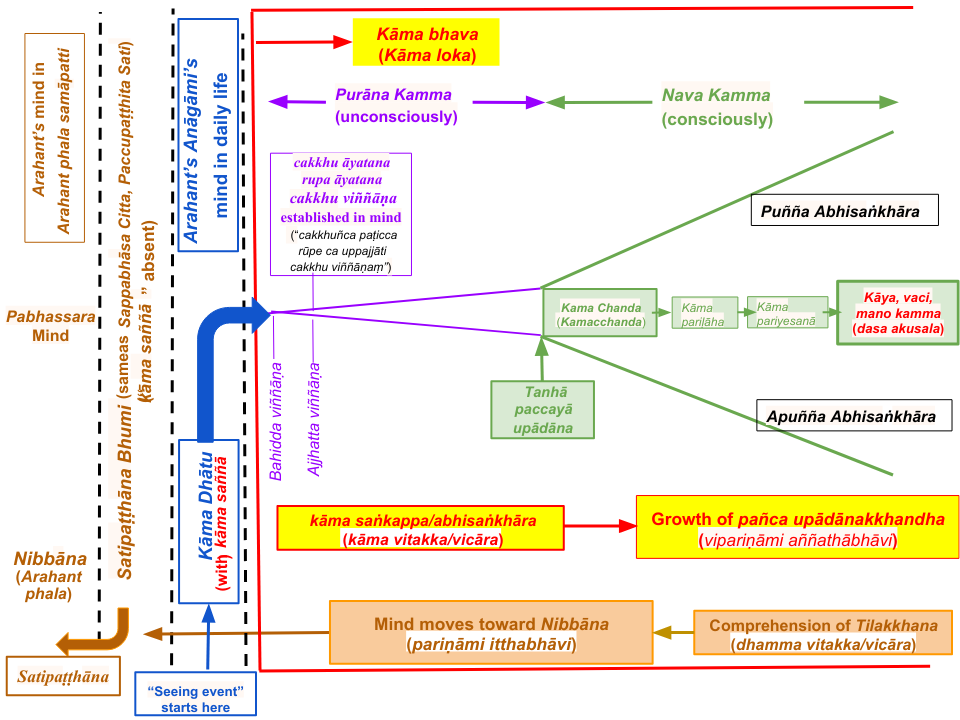
Path to Sotāpanna from Kāma Loka
Con đường đến Sotāpanna từ Kāma Loka
Download/Print: “WebLink: PDF File Download: Path to Sotāpanna from Kama Loka”
Tải xuống/In: “WebLink: PDF File Download: Path to Sotāpanna from Kama Loka”
Any Sense Event Takes a Mind Away from Nibbāna
Bất Kỳ Đối Tượng Cảm Giác Nào Cũng Đưa Tâm Rời Xa Nibbāna
- Any sense event takes the mind of a puthujjana (whose ten saṁyojana remain intact) away from Nibbāna, as seen in the above chart. Thus, without that understanding, a puthujjana cannot attain Nibbāna (by separating from the world). In other words, a puthujjana is always on a downward path (vipariṇāma). That path must be reversed toward the better outcome of Nibbāna (pariṇāma); see the above chart (see Ref. 1 for an explanation of pariṇāma/vipariṇāma). If one can get that idea to sink into the mind, that goes a long way to remove sakkāya diṭṭhi.
Bất kỳ đối tượng cảm giác nào cũng đưa tâm của một puthujjana (còn đầy đủ mười saṁyojana) rời xa Nibbāna, như thể hiện trong sơ đồ trên. Do đó, nếu không hiểu điều này, một puthujjana không thể đạt Nibbāna (bằng cách tách khỏi thế giới). Nói cách khác, một puthujjana luôn ở trên con đường đi xuống (vipariṇāma). Con đường đó phải được đảo ngược để hướng đến kết quả tốt hơn là Nibbāna (pariṇāma); xem sơ đồ trên (xem Tài liệu Tham khảo 1 để hiểu về pariṇāma/vipariṇāma). Nếu có thể làm cho ý tưởng này thấm sâu vào tâm, điều đó sẽ góp phần rất lớn trong việc loại bỏ sakkāya diṭṭhi.
- That is because any sense event starts with a “distorted saññā,” and the mind of a puthujjana (any average human) automatically attaches to it and moves to kāma loka/bhava. They do not understand that the “temporary sense of pleasure” will trap them in the rebirth process.
Đó là vì bất kỳ đối tượng cảm giác nào cũng bắt đầu với “saññā bị méo mó”, và tâm của một puthujjana (một người bình thường) tự động dính mắc vào đó và chuyển sang kāma loka/bhava. Họ không hiểu rằng “cảm giác khoái lạc tạm thời” sẽ trói buộc họ trong vòng tái sinh.
- There are two ways to overcome attachment to sensory pleasures: (i) Understanding that even if those “pleasures” are real, attachment to them leads to immoral deeds that will bring adverse consequences in the future (rebirth in the apāyās), (ii) The Buddha showed that those “pleasures” are an illusion, which makes it a “no brainer” not to attach to them. For example, we don’t take magic shows seriously, even though many enjoy watching them.
Có hai cách để vượt qua sự dính mắc vào khoái lạc giác quan: (i) Hiểu rằng ngay cả khi những “khoái lạc” đó là thật, việc dính mắc vào chúng sẽ dẫn đến các hành vi bất thiện gây ra hậu quả xấu trong tương lai (tái sinh vào apāyā), (ii) Đức Phật đã chỉ ra rằng những “khoái lạc” đó là ảo tưởng, khiến việc không dính mắc vào chúng trở nên hiển nhiên. Ví dụ, chúng ta không coi các màn ảo thuật là thật, dù nhiều người vẫn thích xem.
- One could eliminate sakkāya diṭṭhi by taking the approach (i) above. However, it becomes much easier to remove sakkāya diṭṭhi if one can figure out that “sensory pleasures” are an illusion, i.e., by following the deeper approach (ii). See “Fooled by Distorted Saññā (Sañjānāti) – Origin of Attachment (Taṇhā).”
Một người có thể loại bỏ sakkāya diṭṭhi bằng cách theo cách (i) ở trên. Tuy nhiên, việc loại bỏ sakkāya diṭṭhi sẽ dễ dàng hơn nhiều nếu nhận ra rằng “khoái lạc giác quan” là ảo tưởng, tức là theo cách sâu hơn (ii). Xem “Fooled by Distorted Saññā (Sañjānāti) – Origin of Attachment (Taṇhā).”
- This is a highly condensed post. Please read the suggested links to get the ideas to sink into your mind. It is impossible to write everything relevant in a single post. Furthermore, getting to the “distorted saññā-free” Satipaṭṭhāna Bhumi in the above chart requires a mind to get to samādhi first. That, in turn, requires a mind engaging in dhamma vitakka/vicāra (contemplating Tilakkhaṇa and associated concepts explained in the links provided) for an extended time! Making printouts of those posts and spending an hour or so going through them during quiet time is a good idea. Try that once and see whether it helps the mind get to samādhi. This is an advantage in listening to a discourse because one’s mind will be focused for an extended time. Thus, if the “reading mode” is used, one MUST follow the suggested procedure. The two modes of learning were discussed in the previous post, “Path to Nibbāna – Learning Dhamma to Become a Sotāpanna.”
Đây là một bài viết rất cô đọng. Hãy đọc các liên kết được đề xuất để các ý tưởng thấm sâu vào tâm. Không thể trình bày tất cả trong một bài viết duy nhất. Hơn nữa, để đạt Satipaṭṭhāna Bhumi “không còn saññā bị méo mó” trong sơ đồ trên, tâm cần đạt samādhi trước. Điều này đòi hỏi tâm phải duy trì dhamma vitakka/vicāra (quán chiếu Tilakkhaṇa và các khái niệm liên quan) trong thời gian dài. Việc in các bài viết đó và dành khoảng một giờ đọc trong lúc yên tĩnh là một ý hay. Hãy thử và xem liệu nó có giúp tâm đạt samādhi hay không. Đây cũng là lợi thế của việc nghe pháp thoại vì tâm sẽ tập trung trong thời gian dài. Do đó, nếu sử dụng “phương pháp đọc”, BẮT BUỘC phải làm theo quy trình đã đề xuất. Hai phương pháp học này đã được thảo luận trong bài trước, “Path to Nibbāna – Learning Dhamma to Become a Sotāpanna.”
Removal of Kāma Saññā Happens After Removal of Diṭṭhi Saṁyojana
Việc Loại Bỏ Kāma Saññā Xảy Ra Sau Khi Loại Bỏ Diṭṭhi Saṁyojana
- There are two steps in overcoming attachment to sensual pleasures: (i) “See with wisdom” that it is unwise to attach to sense pleasures. When this understanding sinks into the mind, three “diṭṭhi saṁyojana” (sakkāya diṭṭhi, vicikicchā, sīlabbata parāmāsa) will be broken with the removal of sakkāya diṭṭhi. (ii) Even though the wrong view of sakkāya diṭṭhi is removed, one would still attach to sensory pleasure due to the “false sense of pleasure” arising via the distorted kāma saññā. To overcome that “distorted kāma saññā” (which is built-in to our bodies), a Sotāpanna must cultivate Satipaṭṭhāna. That leads to the removal of two more sansāric bonds/saṁyojana (kāma rāga and paṭigha), leading to the Anāgāmi stage of Nibbāna.
Có hai bước để vượt qua sự dính mắc vào khoái lạc giác quan: (i) “Thấy bằng trí tuệ” rằng việc dính mắc vào khoái lạc giác quan là không khôn ngoan. Khi sự hiểu này thấm sâu vào tâm, ba “diṭṭhi saṁyojana” (sakkāya diṭṭhi, vicikicchā, sīlabbata parāmāsa) sẽ được đoạn trừ cùng với việc loại bỏ sakkāya diṭṭhi. (ii) Dù sakkāya diṭṭhi đã được loại bỏ, một người vẫn còn dính mắc vào khoái lạc giác quan do “cảm giác khoái lạc giả” phát sinh từ kāma saññā bị méo mó. Để vượt qua “kāma saññā bị méo mó” này (được “cài sẵn” trong thân), một Sotāpanna cần tu tập Satipaṭṭhāna. Điều này dẫn đến việc loại bỏ thêm hai saṁyojana (kāma rāga và paṭigha), đưa đến bậc Anāgāmi của Nibbāna.
- The following analogy can give the basic idea. An alcoholic will be able to “see with wisdom” that drinking leads to many adverse consequences (including health risks) by reading medical literature. That understanding can eliminate the “wrong view” that drinking is good for you. However, it takes an additional effort (usually therapy sessions) to overcome attachment to the “pleasure saññā” generated by having a drink. Just “seeing with wisdom” that drinking can have harmful consequences is not enough. That second step is equivalent to removing kāma rāga (and paṭigha) by overcoming kāma saññā. That requires cultivating Satipaṭṭhāna; see the chart above. In the analogy of an alcoholic, therapy sessions are comparable to cultivating Satipaṭṭhāna.
Ví dụ sau giúp làm rõ ý này. Một người nghiện rượu có thể “thấy bằng trí tuệ” rằng uống rượu gây ra nhiều hậu quả xấu (bao gồm rủi ro sức khỏe) khi đọc tài liệu y học. Sự hiểu đó có thể loại bỏ tà kiến rằng uống rượu là tốt. Tuy nhiên, cần thêm nỗ lực (thường là trị liệu) để vượt qua sự dính mắc vào “cảm giác khoái lạc” khi uống rượu. Chỉ “thấy bằng trí tuệ” là chưa đủ. Bước thứ hai tương đương với việc loại bỏ kāma rāga (và paṭigha) bằng cách vượt qua kāma saññā. Điều này đòi hỏi tu tập Satipaṭṭhāna; xem sơ đồ trên. Trong ví dụ này, các buổi trị liệu tương đương với việc tu tập Satipaṭṭhāna.
- The mind of an Anāgāmi or an Arahant has broken all five lower saṁyojana (sakkāya diṭṭhi, vicikicchā, sīlabbata parāmāsa, kāma rāga, and paṭigha) that bind a mind to the kāma bhava. They have fully understood that “kāma saññā” is an illusion and have overcome attachment to it!
Tâm của Anāgāmi hoặc Arahant đã đoạn trừ tất cả năm saṁyojana thấp (sakkāya diṭṭhi, vicikicchā, sīlabbata parāmāsa, kāma rāga và paṭigha) ràng buộc tâm vào kāma bhava. Họ đã hoàn toàn hiểu rằng “kāma saññā” là ảo tưởng và đã vượt qua sự dính mắc vào nó!
- Therefore, their minds do not “cross over” to kāma bhava/kāma loka. In other words, their mind does not automatically attach to any “sensory pleasure” that may arise with the “distorted kāma saññā.” See the above chart.
Do đó, tâm của họ không “chuyển sang” kāma bhava/kāma loka. Nói cách khác, tâm của họ không tự động dính mắc vào bất kỳ “khoái lạc giác quan” nào phát sinh từ “kāma saññā bị méo mó”. Xem sơ đồ trên.
Attachment Occurs Even Without Kāma Assāda
Sự Dính Mắc Xảy Ra Ngay Cả Khi Không Có Kāma Assāda
- Furthermore, a puthujjana’s mind will be attached to even those sense events that may not generate a “sensory pleasure” or “kāma assāda.” For example, seeing random things on the roadside while traveling in a car may not induce attachments. Still, the mind of a puthujjana attaches with moha (ignorance of the detailed description of a sense event). Thus, a puthujjana’s mind ALWAYS gets to the “purāṇa kamma” stage in kāma loka. This subtle point is discussed in Ref. 2.
Hơn nữa, tâm của một puthujjana sẽ dính mắc ngay cả với những đối tượng cảm giác không tạo ra “khoái lạc giác quan” hay “kāma assāda”. Ví dụ, khi nhìn thấy những cảnh vật ngẫu nhiên bên đường khi đi xe có thể không gây dính mắc rõ ràng. Tuy nhiên, tâm của puthujjana vẫn dính mắc với moha (không hiểu rõ bản chất chi tiết của một đối tượng cảm giác). Do đó, tâm của puthujjana LUÔN đi đến giai đoạn “purāṇa kamma” trong kāma loka. Điểm tinh tế này được thảo luận trong Tài liệu Tham khảo 2.
- Let us go through the “steps of attachment” to get an idea of this process, which can be discovered only by a Buddha. Once described, anyone can understand the process.
Hãy cùng xem qua “các bước dính mắc” để hiểu quá trình này, vốn chỉ có thể được khám phá bởi một vị Phật. Khi đã được mô tả, bất kỳ ai cũng có thể hiểu được.
- The key steps are shown in the chart above. Although the chart may look complex, if you read through the text while referencing it, both should be easy to grasp.
Các bước chính được thể hiện trong sơ đồ trên. Mặc dù sơ đồ có vẻ phức tạp, nếu đọc phần giải thích kèm theo, sẽ dễ hiểu.
- We will focus on reaching the Sotāpanna stage from kāma loka (human realm); in the next post, we will discuss how to reach it via jhāna.
Chúng ta sẽ tập trung vào việc đạt bậc Sotāpanna từ kāma loka (cõi người); trong bài tiếp theo, sẽ thảo luận cách đạt được qua jhāna.
Rūpa Paṭisaṁvedī in Kāma Dhātu
Rūpa Paṭisaṁvedī trong Kāma Dhātu
- Upon receiving a sense input, the mind of ANYONE born in the human realm falls first to the kāma dhātu state. The small blue arrow at the bottom of the chart indicates that. We will consider a “seeing event” as an example.
Khi nhận một đối tượng cảm giác, tâm của BẤT KỲ ai sinh trong cõi người đều rơi vào trạng thái kāma dhātu trước tiên. Mũi tên xanh nhỏ ở phía dưới sơ đồ biểu thị điều đó. Chúng ta sẽ lấy “sự kiện thấy” làm ví dụ.
- The mind of anyone born a human automatically gets the “kāma saññā” while in the “kāma dhātu” stage. Thus, an Arahant or Anāgāmi will also get the “distorted kāma saññā” (e.g., the sweetness of honey or the stench of rotten food, for example.)
Tâm của bất kỳ ai sinh làm người đều tự động có “kāma saññā” khi ở giai đoạn “kāma dhātu”. Do đó, một Arahant hay Anāgāmi cũng sẽ có “kāma saññā bị méo mó” (ví dụ như cảm nhận vị ngọt của mật ong hay mùi hôi của thức ăn thối).
- This is the “rūpappaṭisaṁvedī” (rūpa paṭisaṁvedī) step where the mind makes contact with the sense input. Here, paṭisaṁvedī (paṭi saṁvedī) means to experience the sight with the “distorted” saññā. As we discussed, this automatically happens to anyone born with a human body, including Arahants.
Đây là bước “rūpa paṭisaṁvedī” nơi tâm tiếp xúc với đối tượng cảm giác. Ở đây, paṭisaṁvedī (paṭi saṁvedī) nghĩa là trải nghiệm đối tượng với “saññā bị méo mó”. Như đã thảo luận, điều này tự động xảy ra với bất kỳ ai có thân người, kể cả Arahant.
- This happens in the “blue region” in the chart above. A mind has not advanced to the “kāma loka” yet.
Điều này xảy ra trong “vùng màu xanh” của sơ đồ trên. Tâm vẫn chưa chuyển sang “kāma loka”.
- Cakkhu viññāṇa (a viññāṇa is always defiled) has not arisen yet. The “blue region” is the “diṭṭhe diṭṭhamattaṁ bhavissati” state experienced by someone whose mind will not go through the next step of “attachment to that seeing” with kāma rāga. See #2 of “Saññā Nidānā hi Papañca Saṅkhā – Immoral Thoughts Based on “Distorted Saññā”.”
Cakkhu viññāṇa (một viññāṇa luôn bị nhiễm ô) vẫn chưa sinh khởi. “Vùng màu xanh” là trạng thái “diṭṭhe diṭṭhamattaṁ bhavissati” mà người có tâm không đi qua bước tiếp theo của “dính mắc vào việc thấy đó” với kāma rāga sẽ trải nghiệm. Xem mục #2 của “Saññā Nidānā hi Papañca Saṅkhā – Immoral Thoughts Based on “Distorted Saññā”.”
Rūparāga Paṭisaṁvedī Takes to Kāma Loka
Rūparāga Paṭisaṁvedī Dẫn đến Kāma Loka
- Attachment to that kāma saññā happens in the second step ONLY IF kāma rāga arises in the mind automatically. That is the subsequent “rūpa rāga paṭisaṁvedī” step. That happens only if one has the kāma rāga saṁyojana intact.
Sự dính mắc vào kāma saññā đó xảy ra ở bước thứ hai CHỈ KHI kāma rāga tự động sinh khởi trong tâm. Đó là bước tiếp theo “rūpa rāga paṭisaṁvedī”. Điều này chỉ xảy ra nếu kāma rāga saṁyojana vẫn còn.
- The difference between rūpa paṭisaṁvedī and rūpa rāga paṭisaṁvedī is discussed in Ref. 3.
Sự khác biệt giữa rūpa paṭisaṁvedī và rūpa rāga paṭisaṁvedī được thảo luận trong Tài liệu tham khảo 3.
- Thus, a puthujjana’s mind will automatically transition to the “purāṇa kamma” stage in kāma loka, as indicated by the big blue arrow in the middle of the chart.
Do đó, tâm của puthujjana sẽ tự động chuyển sang giai đoạn “purāṇa kamma” trong kāma loka, như được chỉ ra bởi mũi tên xanh lớn ở giữa sơ đồ.
- The purāṇa kamma stage starts at the bahiddha viññāṇa state, where the mind makes its own version of the external signal. Since it comes with the “distorted kāma saññā,” the mind automatically accepts it, believing it represents the true nature of that sight. Then, ajjhatta viññāṇa arises, and that is what we call “cakkhu viññāṇa.”
Giai đoạn purāṇa kamma bắt đầu ở trạng thái bahiddha viññāṇa, nơi tâm tạo ra phiên bản riêng của tín hiệu bên ngoài. Vì nó đi kèm với “kāma saññā bị méo mó”, tâm tự động chấp nhận nó, tin rằng đó là bản chất thật của đối tượng. Sau đó ajjhatta viññāṇa sinh khởi, và đó chính là “cakkhu viññāṇa”.
- Those steps occur automatically in the mind of a Sakadāgāmi, Sotāpanna, or a puthujjana. However, the “strength of attachment” is highest for a puthujjana with all five saṁyojana intact. That is why a Sotāpanna (or a Sakadāgāmi) is incapable of doing “apāyagāmi kamma.” Their attachment to the distorted saññā is reduced in strength with the removal of sakkāya diṭṭhi and the other two diṭṭhi saṁyojana.
Các bước này xảy ra tự động trong tâm của Sakadāgāmi, Sotāpanna hoặc puthujjana. Tuy nhiên, “mức độ dính mắc” là mạnh nhất đối với puthujjana còn đủ năm saṁyojana. Đó là lý do Sotāpanna (hoặc Sakadāgāmi) không thể thực hiện “apāyagāmi kamma”. Sự dính mắc vào saññā bị méo mó của họ đã giảm đi nhờ việc loại bỏ sakkāya diṭṭhi và hai diṭṭhi saṁyojana còn lại.
- Since the mind of an Arahant/Anāgāmi has removed kāma rāga, their minds will not attach to the distorted saññā and, thus, will not transition to the kāma loka (inside the “pink box” in the chart.)
Do tâm của một Arahant/Anāgāmi đã loại bỏ kāma rāga, nên tâm của họ sẽ không dính mắc vào saññā bị méo mó, và do đó sẽ không chuyển sang kāma loka (bên trong “khung màu hồng” trong sơ đồ).
Difference Between Kāma Dhātu and Kāma Bhava
Sự khác biệt giữa Kāma Dhātu và Kāma Bhava
- The Buddha described this difference in the “WebLink: suttacentral: Sanidāna Sutta (SN 14.12)”:
Đức Phật đã mô tả sự khác biệt này trong “WebLink: suttacentral: Sanidāna Sutta (SN 14.12)”:
“Kāmadhātuṁ, bhikkhave, paṭicca uppajjati kāmasaññā, kāmasaññaṁ paṭicca uppajjati kāmasaṅkappo, kāmasaṅkappaṁ paṭicca uppajjati kāmacchando, kāmacchandaṁ paṭicca uppajjati kāmapariḷāho, kāmapariḷāhaṁ paṭicca uppajjati kāmapariyesanā.” OR “Attachment to kāma dhātu leads to kāma saññā, attachment to kāma saññā leads to kāma saṅkappa, attachment to kāma saṅkappa leads to kāmacchanda..and so on to kāma pariyesanā.”
“Kāmadhātuṁ, bhikkhave, paṭicca uppajjati kāmasaññā, kāmasaññaṁ paṭicca uppajjati kāmasaṅkappo, kāmasaṅkappaṁ paṭicca uppajjati kāmacchando, kāmacchandaṁ paṭicca uppajjati kāmapariḷāho, kāmapariḷāhaṁ paṭicca uppajjati kāmapariyesanā.” HOẶC “Sự dính mắc vào kāma dhātu dẫn đến kāma saññā, sự dính mắc vào kāma saññā dẫn đến kāma saṅkappa, sự dính mắc vào kāma saṅkappa dẫn đến kāmacchanda… và tiếp tục đến kāma pariyesanā.”
- That verse explains why Arahants and Anagmis also have kāma saññā. The first step (“Kāmadhātuṁ, bhikkhave, paṭicca uppajjati kāmasaññā”) does not involve “rāga, dosa, moha,” or “saŋ” (alternatively written as “sañ”, “saṅ”, “san”, “sam” or “saṁ” ). Here, “kāma saññā” does not refer to “assāda” (or “placing a value on sensual pleasures.”) This is discussed below.
Đoạn kinh này giải thích tại sao Arahant và Anāgāmi vẫn có kāma saññā. Bước đầu tiên (“Kāmadhātuṁ, bhikkhave, paṭicca uppajjati kāmasaññā”) không liên quan đến “rāga, dosa, moha,” hay “saŋ” (còn viết là “sañ”, “saṅ”, “san”, “sam” hoặc “saṁ”). Ở đây, “kāma saññā” không có nghĩa là “assāda” (hay việc gán giá trị cho khoái lạc giác quan). Điều này sẽ được bàn thêm bên dưới.
- But Arahants’ minds don’t go through the rest of the steps in that verse: kāma saṅkappa, kāmacchanda, kāmapariḷāha, kāmapariyesanā. Kammic energies are generated in these steps.
Nhưng tâm của Arahant không đi qua các bước còn lại trong đoạn kinh đó: kāma saṅkappa, kāmacchanda, kāmapariḷāha, kāmapariyesanā. Năng lượng kamma được tạo ra trong các bước này.
- However, the mind of anyone below the Arahant/Anāgāmi stages may attach and automatically generate at least kāma saṅkappa.
Tuy nhiên, tâm của bất kỳ ai dưới mức Arahant/Anāgāmi đều có thể dính mắc và tự động sinh ra ít nhất kāma saṅkappa.
Once in Kāma Loka, Further Mind Contamination Occurs
Khi Đã Vào Kāma Loka, Sự Ô Nhiễm Của Tâm Tiếp Tục Diễn Ra
- Depending on the specific sense input, the mind may repeatedly attach to it via many steps. Even though we list the steps (as described by the Buddha), they happen so fast that no one other than a Buddha can discern them. A puthujjana usually becomes aware of the attachment at the end of the process, when one starts engaging in kāya, vacī, and mano kamma (see the chart).
Tùy vào đối tượng cảm giác cụ thể, tâm có thể lặp lại sự dính mắc qua nhiều bước. Dù các bước này được liệt kê (theo lời Đức Phật), chúng diễn ra nhanh đến mức không ai ngoài một vị Phật có thể nhận ra. Một puthujjana thường chỉ nhận biết sự dính mắc ở cuối quá trình, khi bắt đầu tạo kāya, vacī và mano kamma (xem sơ đồ).
- The steps in the attachment are outlined in “Purāṇa and Nava Kamma – Sequence of Kamma Generation” and “Ārammaṇa (Sensory Input) Initiates Critical Processes.”
Các bước của sự dính mắc được trình bày trong “Purāṇa and Nava Kamma – Sequence of Kamma Generation” và “Ārammaṇa (Sensory Input) Initiates Critical Processes.”
- Most sense events do not get to the “nava kamma” stage, where one engages in kamma accumulation via kāya, vacī, and mano kamma.
Phần lớn các đối tượng cảm giác không đi đến giai đoạn “nava kamma”, nơi tích lũy kamma qua kāya, vacī và mano kamma.
- The critical point is that even if the mind does not reach the “nava kamma” stage, it has already been contaminated with “kāma saṅkappa.” Here, saṅkappa are abhisaṅkhāra that are very subtle/weak. If the mind attaches further, saṅkappa becomes abhisaṅkhāra (and even strong kāya, vacī, mano kamma) in the nava kamma stage (as shown in the chart).
Điểm quan trọng là ngay cả khi tâm không đến giai đoạn “nava kamma”, nó đã bị ô nhiễm bởi “kāma saṅkappa”. Ở đây, saṅkappa là những abhisaṅkhāra rất vi tế/yếu. Nếu tâm tiếp tục dính mắc, saṅkappa sẽ trở thành abhisaṅkhāra (và thậm chí là các kāya, vacī, mano kamma mạnh) trong giai đoạn nava kamma (như trong sơ đồ).
- Since “kāma rāga” is defined as “saṅkappa rāgo purisassa kāmo” (“WebLink: suttacentral: Nibbedhika Sutta (AN 6.63)”), kāma rāga has already risen in the “purāṇa kamma” stage. Therefore, generating kāma rāga is AUTOMATIC for anyone with the kāma rāga saṁyojana intact; it happens without thinking.
Vì “kāma rāga” được định nghĩa là “saṅkappa rāgo purisassa kāmo” (“WebLink: suttacentral: Nibbedhika Sutta (AN 6.63)”), nên kāma rāga đã phát sinh ngay trong giai đoạn “purāṇa kamma”. Do đó, việc sinh ra kāma rāga là tự động đối với bất kỳ ai còn kāma rāga saṁyojana; nó xảy ra mà không cần suy nghĩ.
- Since an Arahant or Anāgāmi has removed kāma rāga, their minds will stay at the “kāma dhātu” stage.
Vì Arahant hoặc Anāgāmi đã loại bỏ kāma rāga, nên tâm của họ sẽ ở lại trong giai đoạn “kāma dhātu”.
Sandiṭṭhiko – Seeing That the “Origin of Saŋ” in the Purāṇa Kamma Stage
Sandiṭṭhiko – Thấy được “Nguồn gốc của Saŋ” trong Giai đoạn Purāṇa Kamma
- Many think abstaining from dasa akusala (in the nava kamma stage; see chart) is enough to attain Nibbāna.
Nhiều người nghĩ rằng chỉ cần tránh dasa akusala (ở giai đoạn nava kamma; xem sơ đồ) là đủ để đạt Nibbāna.
- However, we can see from the above discussion that separating from Nibbāna has already happened in the purāṇa kamma stage, well before the mind starts accumulating kāya, vacī, and mano kamma in the nava kamma stage; see the chart.
Tuy nhiên, như đã thấy ở trên, việc rời xa Nibbāna đã xảy ra ngay từ giai đoạn purāṇa kamma, trước khi tâm bắt đầu tích lũy kāya, vacī và mano kamma trong giai đoạn nava kamma; xem sơ đồ.
- Thus, one becomes a “sandiṭṭhiko” only when realizing that “attachment to saŋ (rāga, dosa, moha)” happens in the rūpa rāga paṭisaṁvedī step and NOT at the rūpa paṭisaṁvedī step; see #4 through #6 above.
Do đó, một người chỉ trở thành “sandiṭṭhiko” khi nhận ra rằng “sự dính mắc vào saŋ (rāga, dosa, moha)” xảy ra ở bước rūpa rāga paṭisaṁvedī chứ KHÔNG phải ở bước rūpa paṭisaṁvedī; xem mục #4 đến #6 ở trên.
- Please make sure to read Ref. 3 to understand this fully.
Hãy đảm bảo đọc Tài liệu Tham khảo 3 để hiểu đầy đủ điều này.
Until Kāma Rāga Saṁyojana is removed, a Mind Will Enter Kāma Loka
Cho Đến Khi Kāma Rāga Saṁyojana Được Loại Bỏ, Tâm Sẽ Đi Vào Kāma Loka
- Therefore, attachment to any sense input and entering kāma loka (inside the “red box” in the chart) is INEVITABLE for anyone with kāma rāga saṁyojana intact, i.e., anyone at or below the Sakadāgāmi stage.
Do đó, việc dính mắc vào bất kỳ đối tượng cảm giác nào và đi vào kāma loka (bên trong “khung đỏ” trong sơ đồ) là KHÔNG THỂ TRÁNH KHỎI đối với bất kỳ ai còn kāma rāga saṁyojana, tức là bất kỳ ai ở mức Sakadāgāmi trở xuống.
- As soon as a mind is exposed to kāma saññā, automatic attachment to it happens unless that mind has eliminated kāma rāga. The attachment will be stronger if the three “diṭṭhi saṁyojana” remain intact (as for a puthujjana.)
Ngay khi tâm tiếp xúc với kāma saññā, sự dính mắc tự động xảy ra trừ khi tâm đó đã loại bỏ kāma rāga. Sự dính mắc sẽ mạnh hơn nếu ba “diṭṭhi saṁyojana” vẫn còn (như ở một puthujjana).
- Once entering the kāma loka, a mind will get further defiled via the steps discussed in #4 through #6 above.
Khi đã vào kāma loka, tâm sẽ tiếp tục bị ô nhiễm qua các bước đã nêu ở mục #4 đến #6 ở trên.
- Key point: The “automatic attachment” in the “purāṇa kamma” stage is to pañcupādānakkhandha. Thus, the mind of a puthujjana NEVER experiences pañcakkhandha.
Điểm then chốt: “Sự dính mắc tự động” trong giai đoạn “purāṇa kamma” là đối với pañcupādānakkhandha. Do đó, tâm của một puthujjana KHÔNG BAO GIỜ trải nghiệm pañcakkhandha.
- To stop that “automatic attachment,” the mind of a puthujjana must avoid getting the “kāma saññā.” That critical step happens (for the first time ever) at the Sotāpanna phala moment.
Để chấm dứt “sự dính mắc tự động” đó, tâm của một puthujjana phải tránh việc phát sinh “kāma saññā”. Bước quan trọng này xảy ra (lần đầu tiên) tại khoảnh khắc Sotāpanna phala.
How to Bypass Kāma Saññā
Làm Thế Nào Để Vượt Qua Kāma Saññā
- Then the question arises: How did a Sotāpanna or a Sakadāgāmi avoid exposure to the kāma saññā (thereby avoiding attachment to pañcupādānakkhandha)? It must bypass the “kāma dhātu” stage! However, that is impossible to do with a sensory input since it will inevitably get the corresponding built-in “kāma saññā.”
Khi đó nảy sinh câu hỏi: Làm thế nào một Sotāpanna hoặc Sakadāgāmi tránh tiếp xúc với kāma saññā (từ đó tránh dính mắc vào pañcupādānakkhandha)? Phải vượt qua giai đoạn “kāma dhātu”! Tuy nhiên, điều này là không thể nếu dựa vào đối tượng cảm giác, vì chắc chắn sẽ phát sinh “kāma saññā” tương ứng vốn đã “cài sẵn”.
- Instead, a puthujjana must “go backward” starting from the “nava kamma” stage (where the mind of a puthujjana is) toward the left in the above chart and skip the “kāma dhātu” stage to get into “Satipaṭṭhāna bhumi.”
Thay vào đó, một puthujjana phải “đi ngược lại”, bắt đầu từ giai đoạn “nava kamma” (nơi tâm của puthujjana đang ở), tiến về bên trái trong sơ đồ trên và bỏ qua giai đoạn “kāma dhātu” để đi vào “Satipaṭṭhāna bhumi”.
- That can happen while listening to a discourse or reading posts like this one; see the last part of #1 above. It can also occur while contemplating what one learned from a discourse or a text. See #9 (and the links) of “Path to Nibbāna – Learning Dhamma to Become a Sotāpanna.”
Điều này có thể xảy ra khi nghe pháp thoại hoặc đọc các bài như bài này; xem phần cuối mục #1 ở trên. Nó cũng có thể xảy ra khi quán chiếu những gì đã học từ pháp thoại hoặc văn bản. Xem mục #9 (và các liên kết) của “Path to Nibbāna – Learning Dhamma to Become a Sotāpanna.”
A Mind Must Overcome the “Kāma Saññā” Temporarily to Get to the Sotāpanna Stage
Tâm Phải Tạm Thời Vượt Qua “Kāma Saññā” Để Đạt Đến Bậc Sotāpanna
- It is possible for a puthujjana’s mind to move backward and go beyond the “kāma dhātu” stage to get into a mental space free of “kāma saññā.” This mental space is called “Satipaṭṭhāna bhumi” (see the chart) or where Sammā Sati (part of the Noble Eightfold Path) is established in a defilement-free state (Satipaṭṭhāna means to “establish Sammā Sati.”)
Tâm của một puthujjana có thể đi ngược lại và vượt qua giai đoạn “kāma dhātu” để đi vào một trạng thái tâm không có “kāma saññā”. Trạng thái này được gọi là “Satipaṭṭhāna bhumi” (xem sơ đồ) hoặc nơi Sammā Sati (một phần của Bát Chánh Đạo) được thiết lập trong trạng thái không nhiễm ô (Satipaṭṭhāna nghĩa là “thiết lập Sammā Sati”).
- Once a mind is in the kāma loka, it is covered by pañca nīvaraṇa (five layers of defilements covering/shielding Nibbāna). See “Key to Calming the Mind – The Five Hindrances.”
Khi tâm đã ở trong kāma loka, nó bị che phủ bởi pañca nīvaraṇa (năm lớp nhiễm ô che chắn Nibbāna). Xem “Key to Calming the Mind – The Five Hindrances.”
- To reach Sammā Sati, the mind must overcome pañca nīvaraṇa and move backward toward the kāma dhātu state, overcome it, and cross over to the Satipaṭṭhāna bhumi.
Để đạt Sammā Sati, tâm phải vượt qua pañca nīvaraṇa, đi ngược lại về trạng thái kāma dhātu, vượt qua nó và chuyển sang Satipaṭṭhāna bhumi.
- That happens when a mind grasps the Buddha’s broader worldview to get to Sammā Diṭṭhi and becomes a Sotāpanna (upon comprehending the futility of attachment to pañcupādānakkhandha, i.e., to any sensory event). See Ref. 4.
Điều này xảy ra khi tâm nắm được cái nhìn tổng thể của Đức Phật để đạt Sammā Diṭṭhi và trở thành Sotāpanna (khi hiểu rõ sự vô ích của việc dính mắc vào pañcupādānakkhandha, tức là vào bất kỳ đối tượng cảm giác nào). Xem Tài liệu Tham khảo 4.
- It is critical to understand this point.
Điều này là cực kỳ quan trọng cần phải hiểu.
Moving a Mind Toward Satipaṭṭhāna Bhumi (Devoid of Kāma Saññā)
Đưa Tâm Hướng Về Satipaṭṭhāna Bhumi (Không Còn Kāma Saññā)
- When fully focused on a Dhamma concept, abhisaṅkhāra formation is temporarily stopped. Thus, the mind stops generating nava kamma and moves to the “purāṇa kamma” stage; see the chart. This is “pariṇāma” or “moving toward the better outcome”; see Ref. 1.
Khi hoàn toàn tập trung vào một khái niệm Dhamma, sự hình thành abhisaṅkhāra tạm thời dừng lại. Do đó, tâm ngừng tạo nava kamma và chuyển sang giai đoạn “purāṇa kamma”; xem sơ đồ. Đây là “pariṇāma” hay “di chuyển về kết quả tốt hơn”; xem Tài liệu Tham khảo 1.
- Suppose the material discussed in the discourse (or the text) is conducive to relaying the unfruitfulness of sensory pleasures and their adverse consequences. In that case, the mind can temporarily overcome the “purāṇa kamma” AND “kāma dhātu” stages and move into the “Satipaṭṭhāna bhumi” free of “kāma saññā.”
Nếu nội dung được trình bày trong pháp thoại (hoặc văn bản) giúp làm rõ sự vô ích của khoái lạc giác quan và hậu quả bất lợi của chúng, thì tâm có thể tạm thời vượt qua cả giai đoạn “purāṇa kamma” VÀ “kāma dhātu” và đi vào “Satipaṭṭhāna bhumi” không còn “kāma saññā”.
- That is when a puthujjana’s mind becomes free of the “kāma saññā” for the first time ever.
Đó là lúc tâm của một puthujjana lần đầu tiên thoát khỏi “kāma saññā”.
- At that moment, the mind will go through the Parikamma (P), Upacāra (U), Anuloma (A), Gotrabu (G), Path (magga) (Pa), and Fruit (phala) (Fr) for the Sotāpanna stage. See #16 of “Citta Vīthi – Processing of Sense Inputs.”
Vào thời điểm đó, tâm sẽ trải qua Parikamma (P), Upacāra (U), Anuloma (A), Gotrabu (G), Path (magga) (Pa) và Fruit (phala) (Fr) của bậc Sotāpanna. Xem mục #16 của “Citta Vīthi – Processing of Sense Inputs.”
Removal of Sakkāya Diṭṭhi
Loại bỏ Sakkāya Diṭṭhi
- In many cases, one approaches the Sotāpanna stage gradually, when Buddha’s teachings gradually become clear. In such cases, the mind of a puthujjana would get to the parikamma stage first. With repeated access to it, it will advance to the upacāra stage and start getting to it repeatedly when the transition to the anuloma stage occurs at some point.
Trong nhiều trường hợp, một người tiến dần đến bậc Sotāpanna khi giáo lý của Đức Phật dần trở nên rõ ràng. Khi đó, tâm của puthujjana sẽ đạt đến giai đoạn parikamma trước. Khi tiếp cận lặp đi lặp lại, nó sẽ tiến lên giai đoạn upacāra và bắt đầu đạt được trạng thái này nhiều lần, cho đến khi chuyển sang giai đoạn anuloma tại một thời điểm nào đó.
- Once the mind gets to the gotrabu state, that is the changing of the “gotra” or the “lineage” from a puthujjana to an Ariya or a Noble Person at the Sotāpanna Anugāmi stage.
Khi tâm đạt đến trạng thái gotrabu, đó là sự chuyển đổi “dòng giống” từ puthujjana sang Ariya hay một Bậc Thánh ở bậc Sotāpanna Anugāmi.
- Thus, one would become a Sotāpanna Anugāmi with the Gotrabu citta.
Do đó, một người trở thành Sotāpanna Anugāmi với Gotrabu citta.
- At some point (before the death of the current physical body), the mind will experience the Sotāpanna magga and phala moments while contemplating Dhamma, i.e., one will attain the Sotāpanna stage.
Tại một thời điểm nào đó (trước khi thân vật lý hiện tại chết), tâm sẽ trải qua các khoảnh khắc Sotāpanna magga và phala khi quán chiếu Dhamma, tức là đạt đến bậc Sotāpanna.
- There are two types of Sotāpanna Anugāmi, as explained in the “WebLink: suttacentral: Khandha Sutta (SN 25.10),” saddhānusārī and dhammānusārī (@2.1). The fact that they will attain the Sotāpanna stage before their deaths is stated at marker 2.3.
Có hai loại Sotāpanna Anugāmi, như được giải thích trong “WebLink: suttacentral: Khandha Sutta (SN 25.10)”: saddhānusārī và dhammānusārī (@2.1). Việc họ sẽ đạt bậc Sotāpanna trước khi chết được nêu ở marker 2.3.
Attachment to a Sensory Event
Sự Dính Mắc Vào Một Đối Tượng Cảm Giác
- Attachment to sense events is the cause of future suffering! This point must be fully understood. See “Sensory Inputs Initiate “Creation of the World” or “Loka Samudaya”.”
Sự dính mắc vào các đối tượng cảm giác là nguyên nhân của khổ trong tương lai! Điểm này cần được hiểu rõ. Xem “Sensory Inputs Initiate “Creation of the World” or “Loka Samudaya”.”
- We may attach to a sense event in three ways: (i) it generates a “sukha/somanassa vedanā,” (ii) it generates a dukkha/domanassa vedanā, (iii) it generates a neutral vedanā.
Chúng ta có thể dính mắc vào một đối tượng cảm giác theo ba cách: (i) nó tạo ra “sukha/somanassa vedanā”, (ii) nó tạo ra dukkha/domanassa vedanā, (iii) nó tạo ra vedanā trung tính.
- In the first case, we may engage in immoral deeds to get more of them; in the second, we may try to avoid them.
Trong trường hợp thứ nhất, ta có thể làm các hành vi bất thiện để có thêm; trong trường hợp thứ hai, ta có thể cố tránh chúng.
- In the third case, we may not take any action but still go through the “purāṇa kamma” stage because the relevant saṁyojana are intact (meaning we have not dispelled the ignorance about how we attach via all three ways.)
Trong trường hợp thứ ba, ta có thể không hành động gì nhưng vẫn đi qua giai đoạn “purāṇa kamma” vì các saṁyojana liên quan vẫn còn nguyên (tức là chưa loại bỏ vô minh về cách ta dính mắc theo cả ba cách này).
Why Is the Attachment Automatic?
Tại Sao Sự Dính Mắc Là Tự Động?
- The attachment to sense events is automatic because our bodies AND the external environment arise to provide a “distorted saññā” with any sense input. Those interested in fully understanding how the (distorted) kāma saññā arises via Paṭicca Samuppāda should read the first few posts in this section: “Worldview of the Buddha.”
Sự dính mắc vào các đối tượng cảm giác là tự động vì thân của chúng ta VÀ môi trường bên ngoài được hình thành để tạo ra “saññā sai lệch” với bất kỳ đối tượng cảm giác nào. Những ai muốn hiểu đầy đủ cách (kāma saññā sai lệch) phát sinh qua Paṭicca Samuppāda nên đọc các bài đầu trong phần này: “Worldview of the Buddha.”
- There is nothing more valuable than reaching the Sotāpanna stage. The opportunity to be exposed to the true teachings of a Buddha is a rare occurrence. There are even several concurrent Mahā Kappās (each lasting many billions of years) without the appearance of a single Buddha.
Không có gì quý giá hơn việc đạt đến bậc Sotāpanna. Cơ hội được tiếp xúc với giáo pháp chân chính của một vị Phật là vô cùng hiếm. Thậm chí có những Mahā Kappā kéo dài hàng tỷ năm mà không có một vị Phật nào xuất hiện.
- Make the effort to become a Sotāpanna; it is better than anything we can find in this world: “Why a Sotāpanna is Better off than any King, Emperor, or a Billionaire.”
Hãy nỗ lực để trở thành Sotāpanna; điều đó tốt hơn bất kỳ thứ gì chúng ta có thể tìm thấy trên thế gian này: “Why a Sotāpanna is Better off than any King, Emperor, or a Billionaire.”
- Many of us spend years in schools, universities, etc., to get a good education and a job. But many are reluctant to spend time learning Dhamma to become free of rebirths in the worst realms! Please don’t lose this opportunity, which we may not get again for billions of years.
Nhiều người trong chúng ta dành nhiều năm học ở trường, đại học… để có học vấn và công việc tốt. Nhưng lại ngại dành thời gian học Dhamma để thoát khỏi tái sinh vào những cảnh giới khổ đau nhất! Xin đừng bỏ lỡ cơ hội này, vì có thể chúng ta sẽ không có lại trong hàng tỷ năm.
Tài liệu tham khảo
- Pariṇāma and vipariṇāma discussed in “Aniccaṁ Vipariṇāmi Aññathābhavi – A Critical Verse.”
Pariṇāma và vipariṇāma được trình bày trong “Aniccaṁ Vipariṇāmi Aññathābhavi – A Critical Verse.”
- Summary of a very deep and critical sutta: “Mūlapariyāya Sutta – The Root of All Things.”
Tóm tắt một sutta rất sâu sắc và quan trọng: “Mūlapariyāya Sutta – The Root of All Things.”
- Mind contamination starts in the purāṇa kamma stage: “Sandiṭṭhiko – What Does It Mean? .”
Sự ô nhiễm của tâm bắt đầu ở giai đoạn purāṇa kamma: “Sandiṭṭhiko – What Does It Mean?”
- Critically important post on Satipaṭṭhāna: “Kāma Saññā – How to Bypass to Cultivate Satipaṭṭhāna.” We will discuss in detail how to cultivate Satipaṭṭhāna in upcoming posts.
Bài viết rất quan trọng về Satipaṭṭhāna: “Kāma Saññā – How to Bypass to Cultivate Satipaṭṭhāna.” Chúng ta sẽ bàn chi tiết cách tu tập Satipaṭṭhāna trong các bài tiếp theo.