February 8, 2025; minor revisions on the same day; revised on August 22, 2025
Ngày 08/02/2025; chỉnh sửa nhỏ cùng ngày; chỉnh sửa lại vào ngày 22/08/2025
Loka and Nibbāna are opposites. To attain Nibbāna, one must dissociate from the world (loka.) Attachment to the world is based on “distorted saññā” associated with all three lokās (kāma, rūpa, and arūpa) of the world.
Loka và Nibbāna là hai mặt đối lập. Để đạt Nibbāna, phải tách rời khỏi thế giới (loka). Sự dính mắc vào thế giới dựa trên “saññā bị méo mó” liên quan đến cả ba loka (kāma, rūpa và arūpa) của thế giới.
Distorted Sañña, Loka, and Nibbāna
Saññā Bị méo mó, Loka và Nibbāna
Download/Print: “WebLink: PDF file Download: Distorted Saññā, Loka, and Nibbāna”
Tải xuống/In: “WebLink: PDF file Download: Distorted Saññā, Loka, and Nibbāna”
Loka and Nibbāna – Overview
Loka và Nibbāna – Tổng quan
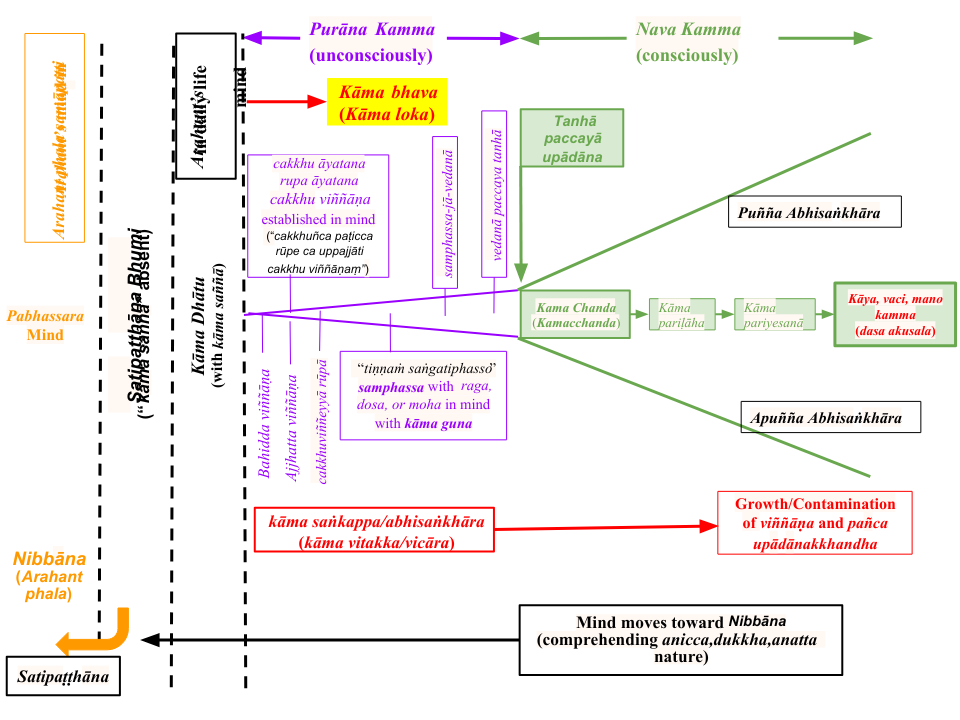
- Attachment to the world is based on “distorted saññā” associated with all three lokās (kāma, rūpa, and arūpa) of the world. One would have “loka saññā” (same as “distorted saññā”) while in the kāma, rūpa, or arūpa loka. To attain Nibbāna (Arahanthood), one must first “see the true nature (anicca, dukkha, anatta nature) of the world” (depicted by the above chart) at the Sotāpanna stage.
Sự dính mắc vào thế giới dựa trên “saññā bị méo mó” liên quan đến cả ba loka (kāma, rūpa và arūpa) của thế giới. Một người sẽ có “loka saññā” (cũng chính là “saññā bị méo mó”) khi ở trong kāma, rūpa hoặc arūpa loka. Để đạt Nibbāna (quả vị Arahant), trước hết phải “thấy được bản chất thật (anicca, dukkha, anatta) của thế giới” (được thể hiện trong sơ đồ trên) tại bậc Sotāpanna.
- Then, a Sotāpanna must cultivate Satipaṭṭhāna to overcome the “distorted saññā” associated with the kāma loka (same as “kāma saññā”), which is accomplished at the Anāgāmi stage. Satipaṭṭhāna Bhumi can be achieved from kāma loka or via rūpa loka (by cultivating jhāna.) This is discussed in details in “Path to Nibbāna – The Necessary Background.”
Sau đó, một Sotāpanna phải tu tập Satipaṭṭhāna để vượt qua “saññā bị méo mó” liên quan đến kāma loka (tức là “kāma saññā”), điều này được hoàn tất ở bậc Anāgāmi. Satipaṭṭhāna Bhumi có thể đạt được từ kāma loka hoặc thông qua rūpa loka (bằng cách tu tập jhāna). Nội dung này được trình bày chi tiết trong “Path to Nibbāna – The Necessary Background.”
- Finally, an Anāgāmi must further cultivate Satipaṭṭhāna to overcome the “distorted saññā” associated with the rūpa loka and arūpa loka to attain Arahanthood.
Cuối cùng, một Anāgāmi phải tiếp tục tu tập Satipaṭṭhāna để vượt qua “saññā bị méo mó” liên quan đến rūpa loka và arūpa loka để đạt quả vị Arahant.
- Those steps are summarized in the above chart.
Các bước đó được tóm tắt trong sơ đồ trên.
- The above chart extends the charts in the previous two posts: “Kāma Saññā – How to Bypass to Cultivate Satipaṭṭhāna” and “Is Cakkhu Viññāṇa Free of Defilements?.” Please print the two charts to review while we discuss the above chart. (Note: I corrected the chart in the latter post.) I am advancing the presentation gradually. Otherwise, it will be too difficult for most people to understand; I am also fine-tuning my understanding.
Sơ đồ trên mở rộng các sơ đồ trong hai bài trước: “Kāma Saññā – How to Bypass to Cultivate Satipaṭṭhāna” và “Is Cakkhu Viññāṇa Free of Defilements?”. Hãy in hai sơ đồ đó để xem lại trong khi chúng ta thảo luận sơ đồ trên. (Lưu ý: tôi đã chỉnh sửa sơ đồ trong bài sau.) Tôi đang trình bày theo từng bước. Nếu không, sẽ quá khó để đa số người hiểu; đồng thời tôi cũng đang hoàn thiện thêm sự hiểu biết của mình.
- The mind of a puthujjana (average person) will always be inside the “pink box” to the right. A mind free of defilements AND distorted saññā is the “pabhassara mind” (pabhassara citta) shown at the left.
Tâm của một puthujjana (người bình thường) luôn nằm trong “khung màu hồng” bên phải. Một tâm không còn ô nhiễm VÀ không còn saññā bị méo mó là “tâm pabhassara” (pabhassara citta) nằm ở bên trái.
- The mind is in the pabhassara state only for a living Arahant (while in “Arahant–phala samāpatti,”) as shown on the left. While living daily life, Arahant’s mind is in kāma dhātu (with kāma saññā). When the Arahant is in a rūpa jhāna, the mind will be in rūpa dhātu (with “rūpa saññā”). When the Arahant is in a arūpa samāpatti, the mind will be in arūpa dhātu (with “arūpa saññā”). These “dhātu states” lie outside the “pink box,” i.e., outside the world of 31 realms. Thus, an Arahant does not belong to kāma, rūpa, or arūpa loka.
Tâm ở trạng thái pabhassara chỉ có ở một Arahant còn sống (khi ở trong “Arahant-phala samāpatti”), như thể hiện bên trái. Khi sống đời thường, tâm của Arahant ở trong kāma dhātu (với kāma saññā). Khi Arahant ở trong rūpa jhāna, tâm ở trong rūpa dhātu (với “rūpa saññā”). Khi Arahant ở trong arūpa samāpatti, tâm ở trong arūpa dhātu (với “arūpa saññā”). Các “trạng thái dhātu” này nằm ngoài “khung màu hồng”, tức là ngoài thế giới 31 cõi. Do đó, Arahant không thuộc về kāma, rūpa hay arūpa loka.
Easy Way to Understand the “Anicca Nature” of the World
Cách Dễ Để Hiểu “Bản Chất Anicca” Của Thế Giới
- Upon receiving a sense input, a puthujjana’s mind ALWAYS moves to the inside of the “pink box,” starting at the bahiddha viññāṇa. Thus, as the chart shows, it will ALWAYS move away from Nibbāna, i.e., a puthujjana’s mind ALWAYS moves “deeper into the world” (“vipariṇāma”), i.e., to the right in the chart.
Khi tiếp nhận một đối tượng cảm giác, tâm của một puthujjana LUÔN di chuyển vào bên trong “khung màu hồng”, bắt đầu từ bahiddha viññāṇa. Do đó, như sơ đồ thể hiện, nó LUÔN rời xa Nibbāna, tức là tâm của puthujjana LUÔN đi “sâu hơn vào thế giới” (“vipariṇāma”), tức là về phía bên phải trong sơ đồ.
- On the other hand, “pariṇāma” or “move to improvement (Nibbāna)” should be to the left. See “Vipariṇāma – Two Meanings.”
Ngược lại, “pariṇāma” hay “di chuyển theo hướng tiến bộ (Nibbāna)” phải là về phía bên trái. Xem “Vipariṇāma – Two Meanings.”
- In other words, a puthujjana tends to engage in the abhisaṅkhāra generation. They do not see the unfruitful or “anicca nature” of actions done with abhisaṅkhāra. Such actions ALWAYS move a mind away from the “nicca nature of Nibbāna” and toward the “anicca nature of the world.” They crave (upādāna) worldly pleasures and strive to get more.
Nói cách khác, một puthujjana có xu hướng tạo ra abhisaṅkhāra. Họ không thấy được tính vô ích hay “bản chất anicca” của các hành động được thực hiện với abhisaṅkhāra. Những hành động đó LUÔN đưa tâm rời xa “bản chất nicca của Nibbāna” và hướng về “bản chất anicca của thế giới.” Họ khao khát (upādāna) các khoái lạc thế gian và cố gắng đạt được nhiều hơn.
- If one can comprehend that, one would at least be beginning to understand the “Noble Truth of Suffering” (“saṅkhittena pañcupādānakkhandhā dukkhā” OR “in brief, suffering is to crave worldly pleasures”); see #2 of “Essence of Buddhism – In the First Sutta.” ) [saṅkhittena means through overthrown by defilements, khitta : [pp. of khipati] thrown; overthrown; casted away; upset.]
Nếu một người có thể hiểu được điều đó, thì ít nhất họ đã bắt đầu hiểu “Chân lý cao quý về Khổ” (“saṅkhittena pañcupādānakkhandhā dukkhā” HOẶC “nói ngắn gọn, khổ là do khao khát các khoái lạc thế gian”); xem mục #2 của “Essence of Buddhism – In the First Sutta.”) [saṅkhittena nghĩa là bị lật đổ bởi các ô nhiễm; khitta: quá khứ phân từ của khipati, bị ném; bị lật; bị vứt bỏ; bị xáo trộn.]
Saṁyojana Prevents a Mind from Staying in a “Dhātu State”
Saṁyojana Ngăn Tâm Duy Trì Trong “Trạng Thái Dhātu”
- The Buddha divided the world into three “lokās”: kāma loka, rūpa loka, and arūpa loka. See “Sandiṭṭhiko – What Does It Mean?.”
Đức Phật chia thế giới thành ba “loka”: kāma loka, rūpa loka và arūpa loka. Xem “Sandiṭṭhiko – What Does It Mean?.”
- The mind of anyone born in kāma loka will fall on “kāma dhātu” first. Suppose at least one of the first five saṁyojana associated with kāma loka remains unbroken. In that case, the mind will automatically move to the bahiddha viññāṇa stage and enter kāma loka/kāma bhava.
Tâm của bất kỳ ai sinh trong kāma loka sẽ rơi vào “kāma dhātu” trước. Nếu ít nhất một trong năm saṁyojana đầu tiên liên quan đến kāma loka vẫn chưa được đoạn trừ, thì tâm sẽ tự động chuyển sang giai đoạn bahiddha viññāṇa và đi vào kāma loka/kāma bhava.
- The mind of anyone born in rūpa loka (rūpa loka Brahmās) will fall on “rūpa dhātu” first (while in a Brahma realm, kāma saññā cannot arise.) Suppose at least one of the four higher saṁyojana associated with rūpa loka (rūpa rāga, māna, uddhacca, avijjā) remains unbroken. In that case, the mind will automatically move to the bahiddha viññāṇa stage and enter rūpa loka/rūpa bhava.
Tâm của bất kỳ ai sinh trong rūpa loka (các Brahmā thuộc rūpa loka) sẽ rơi vào “rūpa dhātu” trước (trong cõi Brahma, kāma saññā không thể phát sinh). Nếu ít nhất một trong bốn saṁyojana cao hơn liên quan đến rūpa loka (rūpa rāga, māna, uddhacca, avijjā) vẫn chưa được đoạn trừ, thì tâm sẽ tự động chuyển sang giai đoạn bahiddha viññāṇa và đi vào rūpa loka/rūpa bhava.
- The mind of anyone born in arūpa loka (arūpa loka Brahmās) will fall on “arūpa dhātu” first (for them, kāma saññā or rūpa saññā cannot arise). Suppose at least one of four higher saṁyojana associated with rūpa loka (arūpa rāga, māna, uddhacca, avijjā) remain unbroken. In that case, the mind will automatically move to the bahiddha viññāṇa stage and enter arūpa loka/arūpa bhava.
Tâm của bất kỳ ai sinh trong arūpa loka (các Brahmā thuộc arūpa loka) sẽ rơi vào “arūpa dhātu” trước (đối với họ, kāma saññā hay rūpa saññā không thể phát sinh). Nếu ít nhất một trong bốn saṁyojana cao hơn liên quan đến rūpa loka (arūpa rāga, māna, uddhacca, avijjā) vẫn chưa được đoạn trừ, thì tâm sẽ tự động chuyển sang giai đoạn bahiddha viññāṇa và đi vào arūpa loka/arūpa bhava.
- Whether or not transition to the bahiddha viññāṇa stage is determined by relevant saṁyojana. The critical point is that if the corresponding saṁyojana remains unbroken, a mind will automatically get into one of the three lokās within the “pink box.”
Việc có chuyển sang giai đoạn bahiddha viññāṇa hay không được quyết định bởi các saṁyojana tương ứng. Điểm then chốt là nếu saṁyojana tương ứng chưa được đoạn trừ, tâm sẽ tự động đi vào một trong ba loka bên trong “khung màu hồng”.
- Let us consider a few examples to illustrate the above-highlighted point.
Hãy xem một vài ví dụ để minh họa điểm quan trọng nêu trên.
- An Arahant’s mind has removed all ten saṁyojana. Thus, it will never get into the “pink box.” During daily life, the mind of an Arahant will stay in “kāma dhātu” with kāma saññā but no defilements. If that Arahant gets into a rūpa jhāna, his mind will stay at “rūpa dhātu” with “jhāna saññā.” If he gets into an arūpa samāpatti, his mind will stay in “arūpa dhātu” with “arūpa/samāpatti saññā.” As indicated in the chart, his mind will be in the pabhassara state if he gets into “Arahant-phala samāpatti,” where “distorted saññā” of any type is also absent. Note the difference between “Arahant-phala samāpatti” and being in a dhātu stage with kāma, rūpa, or arūpa saññā.
Tâm của một Arahant đã loại bỏ tất cả mười saṁyojana. Do đó, nó sẽ không bao giờ đi vào “khung màu hồng”. Trong đời sống hằng ngày, tâm của Arahant sẽ ở trong “kāma dhātu” với kāma saññā nhưng không có ô nhiễm. Nếu vị Arahant đó nhập rūpa jhāna, tâm sẽ ở trong “rūpa dhātu” với “jhāna saññā”. Nếu vị ấy nhập arūpa samāpatti, tâm sẽ ở trong “arūpa dhātu” với “arūpa/samāpatti saññā”. Như thể hiện trong sơ đồ, tâm sẽ ở trạng thái pabhassara nếu vị ấy nhập “Arahant-phala samāpatti”, nơi mọi loại “saññā bị méo mó” đều không còn. Lưu ý sự khác biệt giữa “Arahant-phala samāpatti” và việc ở trong trạng thái dhātu với kāma, rūpa hoặc arūpa saññā.
- Sotāpannās’ and Sakadāgāmis’ minds will automatically move to kāma bhava/kāma loka since they have two of the five lower saṁyojana (kāma rāga, paṭigha) remain unbroken.
Tâm của Sotāpanna và Sakadāgāmi sẽ tự động chuyển sang kāma bhava/kāma loka vì họ vẫn còn hai trong năm saṁyojana thấp (kāma rāga, paṭigha) chưa được đoạn trừ.
- At the Anāgāmi stage, one would have broken all five saṁyojana associated with kāma loka. Thus, an Anāgāmi’s mind will also stay in “kāma dhātu” (with kāma saññā, but no kāma rāga) in daily life. If he cultivates a jhāna, Anāgāmi’s mind will stay in “rūpa loka/rūpa bhava” since the rūpa rāga saṁyojana remains intact. In contrast, an Arahant’s mind will not attach to that “rūpa saññā” and will stay in “rūpa dhātu.” Note the difference between an Anāgāmi and an Arahant while in a jhāna.
Ở giai đoạn Anāgāmi, một người đã đoạn trừ cả năm saṁyojana liên quan đến kāma loka. Do đó, tâm của Anāgāmi cũng sẽ ở trong “kāma dhātu” (với kāma saññā nhưng không có kāma rāga) trong đời sống hằng ngày. Nếu vị ấy tu tập jhāna, tâm của Anāgāmi sẽ ở trong “rūpa loka/rūpa bhava” vì saṁyojana rūpa rāga vẫn còn. Ngược lại, tâm của Arahant sẽ không dính mắc vào “rūpa saññā” đó và sẽ ở trong “rūpa dhātu”. Lưu ý sự khác biệt giữa Anāgāmi và Arahant khi ở trong jhāna.
First Experience of Sammā Sati (Satipaṭṭhāna Bhumi) Without “Distorted Saññā”
Trải Nghiệm Đầu Tiên Của Sammā Sati (Satipaṭṭhāna Bhumi) Không Có “Saññā Bị Méo Mó”
- A puthujjana experiences the “distorted saññā-free” Sammā Sati (in Satipaṭṭhāna Bhumi) for the first time when attaining the Sotāpanna stage. At the Sotāpanna phala moment, the mind overcomes the “distorted saññā” associated with the kāma loka (or the “distorted saññā” associated with the rūpa loka if in a jhāna) and moves to the Satipaṭṭhāna Bhumi.
Một puthujjana trải nghiệm Sammā Sati “không có saññā bị méo mó” (trong Satipaṭṭhāna Bhumi) lần đầu khi đạt bậc Sotāpanna. Tại khoảnh khắc Sotāpanna phala, tâm vượt qua “saññā bị méo mó” liên quan đến kāma loka (hoặc “saññā bị méo mó” của rūpa loka nếu đang ở trong jhāna) và chuyển đến Satipaṭṭhāna Bhumi.
- However, the mind stays there only briefly and returns to the kāma loka/kāma bhava or rūpa loka/rūpa bhava. Note: As the chart shows, a puthujjana cannot attain the Sotāpanna stage from arūpa loka, as they cannot listen to or read about Buddha’s teachings.
Tuy nhiên, tâm chỉ ở đó trong thời gian ngắn và quay lại kāma loka/kāma bhava hoặc rūpa loka/rūpa bhava. Lưu ý: như sơ đồ cho thấy, một puthujjana không thể đạt giai đoạn Sotāpanna từ arūpa loka, vì họ không thể nghe hoặc đọc giáo pháp của Đức Phật.
- A Sotāpanna can “get back to” the Satipaṭṭhāna Bhumi by cultivating Satipaṭṭhāna.
Một Sotāpanna có thể “quay lại” Satipaṭṭhāna Bhumi bằng cách tu tập Satipaṭṭhāna.
- If a Sotāpanna starts cultivating Satipaṭṭhāna, he can return to the Satipaṭṭhāna Bhumi without too much effort (but it is not trivial). With practice, they can enter it and remain there to engage in Vipassanā to attain higher magga phala.
Nếu một Sotāpanna bắt đầu tu tập Satipaṭṭhāna, họ có thể quay lại Satipaṭṭhāna Bhumi mà không cần quá nhiều nỗ lực (nhưng cũng không phải là dễ dàng). Với sự thực hành, họ có thể vào trạng thái đó và duy trì để thực hành Vipassanā nhằm đạt các magga phala cao hơn.
- Some well-known disciples of the Buddha (Visākha and Anāthapiṇḍika are two examples) did not try to attain higher magga phala. They remained Sotāpannās until their deaths.
Một số đệ tử nổi tiếng của Đức Phật (Visākha và Anāthapiṇḍika là hai ví dụ) không cố gắng đạt các magga phala cao hơn. Họ vẫn là Sotāpanna cho đến khi qua đời.
Sotāpanna Stage Reached via Comprehending the Anicca Nature of the World
Giai Đoạn Sotāpanna Đạt Được Nhờ Hiểu Bản Chất Anicca Của Thế Giới
- In the chart of “Kāma Saññā – How to Bypass to Cultivate Satipaṭṭhāna,” it is indicated that a mind — once getting into the bahiddha stage — WILL move away from Nibbāna. As shown in the chart above, a mind MUST move in the opposite direction to the left to reach Nibbāna (“pabhassara mind.”) This is called Paṭisotagāmī; see “Paṭisotagāmī – Moving Toward Satipaṭṭhāna Bhumi and Nibbāna.”
Trong sơ đồ của “Kāma Saññā – How to Bypass to Cultivate Satipaṭṭhāna,” cho thấy rằng khi tâm đã đi vào giai đoạn bahiddha thì SẼ rời xa Nibbāna. Như sơ đồ trên thể hiện, tâm PHẢI di chuyển theo hướng ngược lại về phía bên trái để đạt Nibbāna (“tâm pabhassara”). Điều này được gọi là Paṭisotagāmī; xem “Paṭisotagāmī – Moving Toward Satipaṭṭhāna Bhumi and Nibbāna.”
- A puthujjana must first overcome the “nava kamma” stage and then the “purāṇa kamma” stage. As we can see from the chart above, one must transition one’s mind toward Nibbāna (to the left inside the “pink box”) until they overcome the “kāma saññā” and transition to the Satipaṭṭhāna Bhumi for the first time. We will discuss that process in upcoming posts. It is essential to get the “broad overview” first.
Một puthujjana trước hết phải vượt qua giai đoạn “nava kamma” và sau đó là giai đoạn “purāṇa kamma”. Như có thể thấy từ sơ đồ trên, cần chuyển hướng tâm về phía Nibbāna (về bên trái trong “khung màu hồng”) cho đến khi vượt qua “kāma saññā” và lần đầu chuyển sang Satipaṭṭhāna Bhumi. Chúng ta sẽ bàn chi tiết quá trình này trong các bài viết tiếp theo. Điều quan trọng là phải nắm được “bức tranh tổng thể” trước.
- The first step toward Nibbāna (at the left) for a puthujjana is to comprehend the anicca, dukkha, and anatta nature of the world. This involves living a moral life and understanding how Paṭicca Samuppāda explains the conclusions made in #1 through #3 above.
Bước đầu tiên hướng đến Nibbāna (ở bên trái) đối với một puthujjana là hiểu được bản chất anicca, dukkha và anatta của thế giới. Điều này bao gồm việc sống đạo đức và hiểu cách Paṭicca Samuppāda giải thích các kết luận đã nêu ở mục #1 đến #3 ở trên.
- Since the mind of a human is in the “nava kamma” or “purāṇa kamma” stage, it must gradually start moving to the left. The first step is to minimize akusala kamma, which is done in the “nava kamma” stage.
Vì tâm của con người đang ở trong giai đoạn “nava kamma” hoặc “purāṇa kamma”, nên nó phải dần dần chuyển về phía bên trái. Bước đầu tiên là giảm thiểu akusala kamma, điều này được thực hiện trong giai đoạn “nava kamma”.
Saṁyojana Can be Removed Only via Cultivating Paññā (Wisdom)
Saṁyojana Chỉ Có Thể Được Đoạn Trừ Bằng Cách Tu Tập Paññā (Trí Tuệ)
- The first magga phala (Sotāpanna) is attained when the broad overview of Buddha’s worldview sinks into the mind. That means understanding that future suffering cannot be stopped until the kāma dhātu to bahiddha viññāṇa transition is stopped.
Magga phala đầu tiên (Sotāpanna) đạt được khi “bức tranh tổng thể” về thế giới quan của Đức Phật thấm sâu vào tâm. Điều đó có nghĩa là hiểu rằng khổ trong tương lai không thể chấm dứt cho đến khi sự chuyển từ kāma dhātu sang bahiddha viññāṇa được chấm dứt.
- As soon as a mind enters the “pink box,” it can only add to the existing suffering because the mind ALWAYS moves to the right within the “pink box.”
Ngay khi tâm đi vào “khung màu hồng”, nó chỉ có thể làm tăng thêm khổ hiện có vì tâm LUÔN di chuyển về phía bên phải trong “khung màu hồng”.
- For a puthujjana in kāma loka (let us consider a human), the automatic move into the “pink box” can be avoided only by eliminating the first five saṁyojana (sansāric bonds): sakkāya diṭṭhi, vicikicchā, sīlabbata parāmāsa, kāma rāga, and paṭigha. The first three are removed at the Sotāpanna stage by comprehending that one MUST avoid getting into the “pink box.” In this regard, sakkāya diṭṭhi is the wrong view that the world can provide lasting happiness. Sakkāya diṭṭhi is removed while listening to a discourse, reading, or contemplating the above idea.
Đối với một puthujjana trong kāma loka (ví dụ như con người), việc tự động đi vào “khung màu hồng” chỉ có thể tránh được bằng cách đoạn trừ năm saṁyojana đầu tiên (các ràng buộc luân hồi): sakkāya diṭṭhi, vicikicchā, sīlabbata parāmāsa, kāma rāga và paṭigha. Ba yếu tố đầu được loại bỏ ở bậc Sotāpanna bằng cách hiểu rằng PHẢI tránh đi vào “khung màu hồng”. Trong đó, sakkāya diṭṭhi là tà kiến rằng thế giới có thể mang lại hạnh phúc lâu dài. Sakkāya diṭṭhi được loại bỏ khi nghe pháp, đọc hoặc quán chiếu các ý tưởng trên.
- However, a Sotāpanna will still have kāma rāga (and paṭigha, a byproduct of kāma rāga) and, therefore, will attach to the “distorted kāma saññā” and will enter the kāma loka. The way to remove kāma rāga is to remove the tendency to attach to the kāma saññā: “WebLink: suttacentral: Sāriputta Sutta (AN 3.33).” I will explain this in detail in an upcoming post, but let us summarize it. [‘The giving up of both ‘Pahānaṁ kāmasaññānaṁ, sensual desires and displeasures, domanassāna cūbhayaṁ; the dispelling of dullness, thinassa ca panūdanaṁ, and the prevention of remorse; kukkuccānaṁ nivāraṇaṁ. pure equanimity and mindfulness, upekkhāsatisaṁsuddhaṁ, preceded by investigation of doctrines— dhammatakkapurejavaṁ; this, I declare, is liberation by enlightenment, aññāvimokkhaṁ pabrūmi, the smashing of ignorance.’” avijjāya pabhedanan’”ti. ]
Tuy nhiên, một Sotāpanna vẫn còn kāma rāga (và paṭigha, là hệ quả của kāma rāga), do đó vẫn dính mắc vào “kāma saññā bị méo mó” và sẽ đi vào kāma loka. Cách để loại bỏ kāma rāga là loại bỏ xu hướng dính mắc vào kāma saññā: “WebLink: suttacentral: Sāriputta Sutta (AN 3.33).” Tôi sẽ giải thích chi tiết trong bài viết tiếp theo, nhưng có thể tóm tắt như sau. [‘Từ bỏ cả “Pahānaṁ kāmasaññānaṁ”, các dục vọng và sự khó chịu, domanassāna cūbhayaṁ; xua tan sự uể oải, thinassa ca panūdanaṁ, và ngăn chặn sự hối hận; kukkuccānaṁ nivāraṇaṁ. Tâm xả và chánh niệm thanh tịnh, upekkhāsatisaṁsuddhaṁ, đi trước bởi sự suy xét về pháp— dhammatakkapurejavaṁ; điều này, ta nói, là sự giải thoát bằng trí tuệ, aññāvimokkhaṁ pabrūmi, sự phá vỡ vô minh.’ avijjāya pabhedanan’”ti.]
Removal of Kāma Rāga to Attain the Anāgāmi Stage
Loại Bỏ Kāma Rāga Để Đạt Bậc Anāgāmi
- Kāma saññā can be overcome only by cultivating Satipaṭṭhāna. Cultivating Satipaṭṭhāna REQUIRES the comprehension that our attachment to sense inputs is a mirage; see “Fooled by Distorted Saññā (Sañjānāti) – Origin of Attachment (Taṇhā).” Humans attach to pañca kāma (experienced with the five physical senses) due to the (distorted) kāma saññā associated with them. Kāma saññā can be overcome only by understanding how it arises via Paṭicca Samuppāda, i.e., with Vipassanā while in Satipaṭṭhāna Bhumi.
Kāma saññā chỉ có thể được vượt qua bằng cách tu tập Satipaṭṭhāna. Việc tu tập Satipaṭṭhāna ĐÒI HỎI phải hiểu rằng sự dính mắc của chúng ta vào các đối tượng cảm giác chỉ là ảo ảnh; xem “Fooled by Distorted Saññā (Sañjānāti) – Origin of Attachment (Taṇhā).” Con người dính mắc vào pañca kāma (trải nghiệm qua năm giác quan vật lý) do kāma saññā (bị méo mó) đi kèm. Kāma saññā chỉ có thể được vượt qua bằng cách hiểu cách nó phát sinh qua Paṭicca Samuppāda, tức là bằng Vipassanā khi ở trong Satipaṭṭhāna Bhumi.
- Those who have cultivated anāriya jhāna have temporarily suppressed the tendency to attach to kāma saññā. They attain jhānās without comprehending Buddha’s teachings and thus still have all ten sansāric bonds (saṁyojana) with them. But when in a jhāna, they have mindsets similar to those of a rūpa loka Brahma. If they are in a jhāna samāpatti (i.e., jhāna cittās flow continuously), their minds do not return to kāma loka while in samāpatti.
Những người đã tu tập anāriya jhāna đã tạm thời kiềm chế xu hướng dính mắc vào kāma saññā. Họ đạt được jhāna mà không hiểu giáo pháp của Đức Phật và do đó vẫn còn đầy đủ mười ràng buộc luân hồi (saṁyojana). Nhưng khi ở trong jhāna, tâm của họ giống với tâm của Brahma thuộc rūpa loka. Nếu họ ở trong jhāna samāpatti (tức là dòng jhāna cittā diễn ra liên tục), tâm của họ không quay lại kāma loka khi còn ở trong samāpatti.
- However, as soon as they come out of the jhāna, these minds fall back to get the kamma saññā, i.e., they will ALWAYS be within the “pink box” to the right.
Tuy nhiên, ngay khi thoát khỏi jhāna, những tâm này sẽ rơi trở lại và tiếp nhận kāma saññā, tức là LUÔN nằm trong “khung màu hồng” bên phải.
- The above description also applies to arūpa samāpatti.
Mô tả trên cũng áp dụng cho arūpa samāpatti.
- Thus, a yogi who can get into rūpa jhāna and arūpa samāpatti can get into those mental states at will. But they are always trapped in the rebirth process, i.e., stay within the “pink box.”
Do đó, một yogi có thể nhập rūpa jhāna và arūpa samāpatti có thể đạt được các trạng thái tâm đó theo ý muốn. Tuy nhiên, họ vẫn luôn bị mắc kẹt trong vòng tái sinh, tức là vẫn ở trong “khung màu hồng”.
(Distorted) Saññā in Brahma Realms
Saññā (bị méo mó) trong các cõi Brahma
- Brahmās in the 16 rūpa loka Brahma realms have “kāma saññā” suspended for the entirety of their lifetimes. However, they still retain parts of rūpa saññā (for sights) and sadda saññā intact, as they can still see and hear; only those sights and sounds associated with “sensual pleasures” (“kāma assāda”) do not trigger saññā for them. They do not generate kāma rāga upon seeing or hearing things. Their mindsets are similar to those of humans in jhānic states.
Các Brahmā trong 16 cõi rūpa loka có “kāma saññā” bị đình chỉ trong suốt cuộc đời của họ. Tuy nhiên, họ vẫn giữ lại một phần rūpa saññā (đối với hình ảnh) và sadda saññā, vì họ vẫn có thể thấy và nghe; chỉ những hình ảnh và âm thanh liên quan đến “khoái lạc giác quan” (“kāma assāda”) mới không kích hoạt saññā nơi họ. Họ không phát sinh kāma rāga khi thấy hoặc nghe. Tâm của họ tương tự như tâm của con người khi ở trong trạng thái jhāna.
- Brahmās in the four arūpa loka Brahma realms have only “dhamma saññā” of “arūpa samāpatti.” They cannot even see or hear. Again, that limited dhamma saññā lasts through their lifetimes.
Các Brahmā trong bốn cõi arūpa loka chỉ có “dhamma saññā” của “arūpa samāpatti”. Họ thậm chí không thể thấy hoặc nghe. Và dhamma saññā hạn chế đó tồn tại suốt cuộc đời của họ.
- All anāriya Brahmās get human births at the end of their lifetimes. After that, their future rebirths can be in any realm.
Tất cả các anāriya Brahmā sẽ tái sinh làm người khi kết thúc đời sống của họ. Sau đó, các lần tái sinh tiếp theo của họ có thể ở bất kỳ cõi nào.
- Per the above chart, a sense input to a rūpa loka Brahma starts at the bahiddha viññāṇa corresponding to the rūpa loka; it never stops at the “rūpa dhātu” stage.
Theo sơ đồ trên, một đối tượng cảm giác đối với Brahmā ở rūpa loka bắt đầu tại bahiddha viññāṇa tương ứng với rūpa loka; nó không dừng lại ở giai đoạn “rūpa dhātu”.
- Since their minds do not get to the “taṇhā paccayā upādāna” step in Paṭicca Samuppāda, only the “purāṇa kamma” stage is present. Thus, they do not accumulate “strong kamma” that can bring rebirth. However, they have all accumulated sufficient kamma bīja (from previous lives) to trigger numerous future rebirths.
Vì tâm của họ không đi đến bước “taṇhā paccayā upādāna” trong Paṭicca Samuppāda, nên chỉ có giai đoạn “purāṇa kamma” tồn tại. Do đó, họ không tích lũy “kamma mạnh” dẫn đến tái sinh. Tuy nhiên, họ đã tích lũy đủ kamma bīja (từ các đời trước) để kích hoạt nhiều lần tái sinh trong tương lai.
- A similar description applies to arūpa loka Brahmās.
Mô tả tương tự cũng áp dụng cho các Brahmā ở arūpa loka.
Arahant’s Mind Never Gets into the “Pink Box”
Tâm Của Arahant Không Bao Giờ Đi Vào “Khung Màu Hồng”
- As pointed out in #2 above (and shown in the chart above), a living Arahant’s mind is generally in “kāma dhātu.” Even though the mind is not defiled while in kāma dhātu, it has the (distorted) kamma saññā. Thus, an Arahant will also taste honey to be sweet, for example.
Như đã nêu ở mục #2 trên (và thể hiện trong sơ đồ), tâm của một Arahant còn sống thường ở trong “kāma dhātu”. Mặc dù tâm không bị ô nhiễm khi ở trong kāma dhātu, nó vẫn có kāma saññā (bị méo mó). Do đó, một Arahant vẫn sẽ nếm mật ong là ngọt, chẳng hạn.
- If an Arahant gets into a jhāna, his mind will stay in “rūpa dhātu.” He will experience the “jhānic pleasure” but will not attach to it.
Nếu một Arahant nhập jhāna, tâm sẽ ở trong “rūpa dhātu”. Vị ấy sẽ trải nghiệm “lạc của jhāna” nhưng không dính mắc vào nó.
- If the Arahant can get into arūpa samāpatti, his mind will stay in “arūpa dhātu.” He will experience the “samāpatti pleasure” but not attach to it.
Nếu Arahant có thể nhập arūpa samāpatti, tâm sẽ ở trong “arūpa dhātu”. Vị ấy sẽ trải nghiệm “lạc của samāpatti” nhưng không dính mắc vào nó.
- If the Arahant can get into Arahant-phala samāpatti, his mind will be in the “pabhassara state” without any of those “distorted saññās” (extreme left in the chart.)
Nếu Arahant có thể nhập Arahant-phala samāpatti, tâm sẽ ở trong “trạng thái pabhassara” mà không có bất kỳ “saññā bị méo mó” nào (ở cực bên trái của sơ đồ).
Only an Anāgāmi (and Arahant) can be in an Ariya Jhāna
Chỉ Anāgāmi (và Arahant) mới có thể ở trong Ariya Jhāna
- “Ariya jhāna” is not a term mentioned in the Tipiṭaka. We could define it as the jhānic state of a Noble Person who has permanently overcome kāma loka.
“Ariya jhāna” không phải là thuật ngữ được nêu trong Tipiṭaka. Ta có thể định nghĩa nó là trạng thái jhāna của một bậc Thánh đã vĩnh viễn vượt qua kāma loka.
If an Anāgāmi cultivates a jhāna, it will be an Ariya jhāna (per the above definition, since kāma rāga and paṭigha are eliminated for an Anāgāmi, they don’t belong to kāma loka). Since an Anāgāmi has not removed rūpa rāga, they will still be in “rūpa bhava” or “rūpa loka.”
Nếu một Anāgāmi tu tập jhāna, đó sẽ là Ariya jhāna (theo định nghĩa trên, vì kāma rāga và paṭigha đã được đoạn trừ ở Anāgāmi nên họ không còn thuộc kāma loka). Vì Anāgāmi chưa loại bỏ rūpa rāga, họ vẫn còn ở trong “rūpa bhava” hoặc “rūpa loka”.
- Other than Arahants, all others’ minds will be in “rūpa bhava” or “rūpa loka” while in a jhāna.
Ngoài Arahant, tất cả những người khác khi ở trong jhāna thì tâm vẫn thuộc “rūpa bhava” hoặc “rūpa loka”.
- Please ask questions in the forum if any of this is not clear.
Nếu có điều gì chưa rõ, hãy đặt câu hỏi trong diễn đàn.