January 11, 2025; revised (#11) on April 7, 2025; last revised (#9 – #13) on May 1, 2025; rewritten May 17, 2025
Ngày 11/01/2025; chỉnh sửa (#11) ngày 07/04/2025; chỉnh sửa lần cuối (#9 – #13) ngày 01/05/2025; viết lại ngày 17/05/2025
Sandiṭṭhiko is a Sotāpanna who can discern how “saŋ” (rāga, dosa, moha) gets “added” to a “pure mind” (pabhassara mind) via attaching to saññā. Each realm (except the asañña realm) has a “built-in” (distorted) saññā. Only by understanding the worldview of a Buddha can a mind overcome the tendency to attach to that (distorted) saññā.
Sandiṭṭhiko là một Sotāpanna có thể thấy rõ cách “saŋ” (rāga, dosa, moha) được “thêm vào” một “tâm trong sáng” (pabhassara mind) thông qua sự bám chấp vào saññā. Mỗi cõi (ngoại trừ cõi asañña) đều có saññā sai lệch “được tích hợp sẵn.” Chỉ khi hiểu được thế giới quan của Đức Phật thì tâm mới có thể vượt qua xu hướng bám chấp vào saññā sai lệch đó.
Ancient Yogis Also Realized Rāga and Dosa as Root Causes of Suffering
Các Yogi Cổ Xưa Cũng Nhận Ra Rāga và Dosa Là Nguyên Nhân Gốc Của Khổ
- Ancient yogis were there before the Buddha (like Āḷāra Kālāma and Uddaka Rāmaputta), who realized that attachment to sensual pleasures led to suffering. They forcefully abstained from sensual pleasures; they moved to jungles to avoid tempting situations, and even cultivated the highest jhāna and samāpatti. Even though they could avoid rebirths in the apāyās (temporarily), they could not reach Nibbāna, i.e., break away from the rebirth process.
Các yogi cổ xưa đã có trước Đức Phật (như Āḷāra Kālāma và Uddaka Rāmaputta), họ nhận ra rằng sự bám chấp vào các khoái lạc giác quan dẫn đến khổ. Họ cưỡng ép từ bỏ các khoái lạc giác quan; họ vào rừng để tránh các hoàn cảnh cám dỗ, và thậm chí tu tập các jhāna và samāpatti cao nhất. Dù có thể tránh được tái sinh vào các cõi apāyā (tạm thời), họ vẫn không thể đạt Nibbāna, tức là không thể thoát khỏi vòng luân hồi.
- The critical reason is that they did not and could not figure out the root cause of attachment to sensual pleasures. We attach to sensual pleasures like the sweet taste of honey because tasting honey generates a “pleasure sensation.”
Nguyên nhân then chốt là họ đã không và cũng không thể tìm ra nguyên nhân gốc của sự bám chấp vào khoái lạc giác quan. Chúng ta bám chấp vào các khoái lạc như vị ngọt của mật ong vì việc nếm mật ong tạo ra một “cảm giác dễ chịu.”
- By examining how the mind works, the Buddha discovered that such “pleasure sensations” are mind-made. We also have such “pleasurable experiences” when watching a good magic show. But it is no longer enjoyable once we realize how the magic trick works. The Buddha gave that same analogy in the “WebLink: suttacentral: Pheṇapiṇḍūpama Sutta (SN 22.95).” See “Fooled by Distorted Saññā (Sañjānāti) – Origin of Attachment (Taṇhā).”
Bằng cách quán sát cách tâm vận hành, Đức Phật phát hiện rằng những “cảm giác dễ chịu” đó do tâm tạo ra. Chúng ta cũng có những “trải nghiệm dễ chịu” như vậy khi xem một màn ảo thuật hay. Nhưng khi hiểu được cách trò ảo thuật hoạt động, nó không còn thú vị nữa. Đức Phật đã đưa ra cùng một ví dụ đó trong “WebLink: suttacentral: Pheṇapiṇḍūpama Sutta (SN 22.95).” Xem “Fooled by Distorted Saññā (Sañjānāti) – Origin of Attachment (Taṇhā).”
- Once we figure out how such “pleasure sensations” are built into our physical bodies (via Paṭicca Samuppāda), we would realize the futility of attaching to them. At that point, one does not need to forcefully abstain from sensual pleasures (like Āḷāra Kālāma and Uddaka Rāmaputta).
Khi hiểu được cách những “cảm giác dễ chịu” đó được tích hợp vào thân vật lý của chúng ta (thông qua Paṭicca Samuppāda), ta sẽ nhận ra sự vô ích của việc bám chấp vào chúng. Lúc đó, không cần phải cưỡng ép từ bỏ các khoái lạc giác quan (như Āḷāra Kālāma và Uddaka Rāmaputta).
Importance of Understanding the “Purāṇa Kamma” Stage
Tầm Quan Trọng Của Việc Hiểu Giai Đoạn “Purāṇa Kamma”
- Ancient yogis like Āḷāra Kālāma and Uddaka Rāmaputta understood how a mind becomes increasingly contaminated by attaching to sensory inputs, how that leads to committing immoral deeds, which in turn lead to future suffering (not only via rebirths in the apāyās, but also agitation/anxiety in the current life itself).
Các yogi cổ xưa như Āḷāra Kālāma và Uddaka Rāmaputta hiểu được cách tâm ngày càng bị ô nhiễm khi bám chấp vào các đối tượng giác quan, cách điều đó dẫn đến việc thực hiện các hành động bất thiện, và từ đó dẫn đến khổ trong tương lai (không chỉ qua tái sinh vào các cõi apāyā mà còn qua sự bất an/lo lắng ngay trong đời hiện tại).
- The Buddha discovered that the above part is preceded by an automatic process that occurs without our conscious awareness.
Đức Phật đã khám phá ra rằng phần trên còn được đi trước bởi một quá trình tự động xảy ra mà không có sự nhận biết có ý thức của chúng ta.
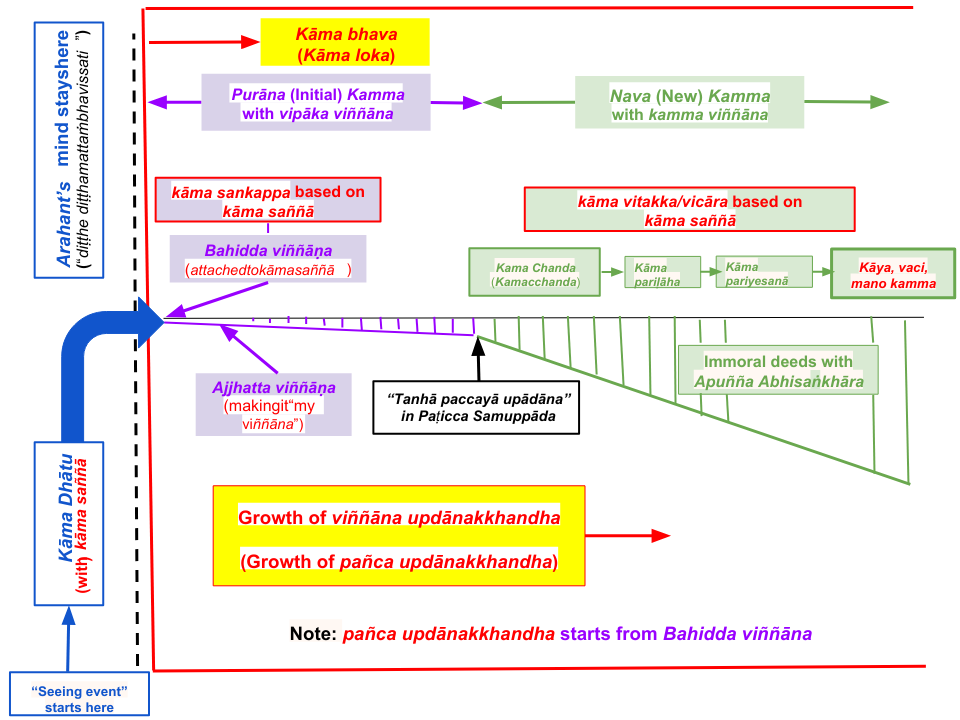
- In the following chart, only the “nava kamma” stage of a two-step process was known to those ancient yogis. It is preceded by the “purāṇa kamma” stage that Buddha discovered.
Trong sơ đồ sau, các yogi cổ xưa chỉ biết giai đoạn “nava kamma” của một quá trình hai bước. Trước đó là giai đoạn “purāṇa kamma” mà Đức Phật đã khám phá.
Purāṇa and Nava Kamma – 5
Purāṇa và Nava Kamma – 5
Download/Print: “WebLink: PDF Download: Purāṇa and Nava Kamma – 5”
Tải xuống/In: “WebLink: PDF Download: Purāṇa and Nava Kamma – 5”
- Even though the accumulation of “saŋ” (rāga, dosa, moha; see “What is ‘Saŋ’? Meaning of Sansāra (or Saṁsāra).”) is stronger in the “nava kamma” stage, a mind would not advance to that “nava kamma” stage if this two-step process is fully understood!
Mặc dù sự tích lũy “saŋ” (rāga, dosa, moha; xem “What is ‘Saŋ’? Meaning of Sansāra (or Saṁsāra).”) mạnh hơn ở giai đoạn “nava kamma”, nhưng tâm sẽ không tiến đến giai đoạn “nava kamma” nếu quá trình hai bước này được hiểu trọn vẹn!
- In other words, without stopping the first “purāṇa kamma” stage, it is impossible to stop the “nava kamma” stages entirely. Even those yogis’ minds would be attached to tempting sensual pleasures if they came back from the jungles to “pleasure-filled society.”
Nói cách khác, nếu không dừng được giai đoạn “purāṇa kamma” đầu tiên thì không thể dừng hoàn toàn các giai đoạn “nava kamma”. Ngay cả tâm của những đạo sĩ đó cũng sẽ bám chấp vào các khoái lạc giác quan hấp dẫn nếu họ rời rừng trở lại “xã hội đầy hưởng thụ.”
- Thus, without understanding the “purāṇa kamma” stage, one would not become a “sandiṭṭhiko” (who has “seen the origin of ‘saŋ’ with wisdom”), as we discuss below.
Do đó, nếu không hiểu giai đoạn “purāṇa kamma” thì không thể trở thành “sandiṭṭhiko” (người “thấy được nguồn gốc của ‘saŋ’ bằng trí tuệ”), như sẽ bàn dưới đây.
One Needs to Understand the “Purāṇa Kamma” Stage to Become “Sandiṭṭhiko”
Cần Hiểu Giai Đoạn “Purāṇa Kamma” Để Trở Thành “Sandiṭṭhiko”
- The first “purāṇa kamma” stage is where “saŋ” (rāga, dosa, moha) is incorporated into a “suffering-free pabhassara mind” automatically. We do not have direct control over that, i.e., we cannot stop it from proceeding at that time.
Giai đoạn “purāṇa kamma” đầu tiên là nơi “saŋ” (rāga, dosa, moha) được đưa vào một “tâm pabhassara không khổ” một cách tự động. Chúng ta không có sự kiểm soát trực tiếp đối với điều đó, tức là không thể ngăn nó diễn ra vào lúc đó.
- Instead, we must understand how a mind is enticed (attracted) by a “false/distorted saññā.”
Thay vào đó, chúng ta phải hiểu cách tâm bị lôi cuốn (hấp dẫn) bởi saññā sai lệch.
- That “pleasurable sensation” due to the “false/distorted saññā” leads to three ways of attaching to sensory inputs, i.e., via wrong view (diṭṭhi), cravings (taṇhā), and “a sense of me” (māna). The Buddha explained that in the “WebLink: suttacentral: Etaṁmama Sutta (SN 22.151),” among many other suttās. Let us briefly review that.
“Cảm giác dễ chịu” do saññā sai lệch đó dẫn đến ba cách bám chấp vào các đối tượng giác quan, tức là thông qua tà kiến (diṭṭhi), tham ái (taṇhā), và “cảm giác về cái tôi” (māna). Đức Phật đã giải thích điều đó trong “WebLink: suttacentral: Etaṁmama Sutta (SN 22.151),” cùng với nhiều bài sutta khác. Hãy xem lại ngắn gọn điều này.
- The pabhassara mind is discussed in “Pabhassara Citta and Saññā Vipallāsa” and “Anuseti – How Anusaya Grows with Saṅkhāra.”
Tâm pabhassara được bàn trong “Pabhassara Citta and Saññā Vipallāsa” và “Anuseti – How Anusaya Grows with Saṅkhāra.”
Diṭṭhi, Taṇhā, Māna – Three Ways of Attachment
Diṭṭhi, Taṇhā, Māna – Ba Cách Bám Chấp
- The following is my translation of the necessary verse in the “WebLink: suttacentral: Etaṁmama Sutta (SN 22.151)” to provide the basic idea. “Bhikkhus, what causes (an average) person to regard something (a rūpa) like this: ‘This is mine (etaṁ mama), this is “me” (esohamasmi or eso ahaṁ asmi), this is for my benefit (eso me attā)’?”
Sau đây là bản dịch của tôi về đoạn kệ cần thiết trong “WebLink: suttacentral: Etaṁmama Sutta (SN 22.151)” để nêu ý chính. “Này các bhikkhu, điều gì khiến một người (bình thường) xem một đối tượng (một rūpa) như thế này: ‘Đây là của tôi (etaṁ mama), đây là tôi (esohamasmi hoặc eso ahaṁ asmi), đây là vì lợi ích của tôi (eso me attā)’?”
- The “pleasurable sensation” (“false/distorted saññā”) leads to the wrong view (diṭṭhi) that it is beneficial, i.e., “it is for my benefit.”
“Cảm giác dễ chịu” (saññā sai lệch) dẫn đến tà kiến (diṭṭhi) rằng nó có lợi, tức là “nó mang lại lợi ích cho tôi.”
- That would, in turn, lead to a desire (taṇhā) to seek more of it with the perception that “it is worthwhile to make it mine.”
Điều đó lại dẫn đến tham ái (taṇhā) muốn tìm kiếm thêm, với nhận thức rằng “đáng để biến nó thành của tôi.”
- The more one keeps doing that, the more it leads to “a sense of me” (māna).
Càng làm như vậy nhiều, càng củng cố “cảm giác về cái tôi” (māna).
- We have been doing all three for an unimaginable time in the beginningless rebirth process.
Chúng ta đã thực hiện cả ba điều này trong một thời gian không thể tưởng tượng được trong vòng luân hồi không có khởi đầu.
Ten Saṁyojana that Bind Us to the Rebirth Process
Mười Saṁyojana Trói Buộc Chúng Ta Trong Luân Hồi
- The Buddha divided those three into subcategories of ten saṁyojana (sansāric bonds). As mentioned above, those bonds have been solidified over countless lives!
Đức Phật chia ba nhóm đó thành các phân loại nhỏ gồm mười saṁyojana (các trói buộc trong luân hồi). Như đã nói ở trên, các trói buộc này đã được củng cố qua vô số đời sống!
- The diṭṭhi category is divided into three saṁyojana: sakkāya diṭṭhi, vicikicchā, sīlabbata parāmāsa.
Nhóm diṭṭhi được chia thành ba saṁyojana: sakkāya diṭṭhi, vicikicchā, sīlabbata parāmāsa.
- The taṇhā category is divided into four saṁyojana: kāma rāga, rūpa rāga, and arūpa rāga. Here, kāma rāga also leads to paṭigha.
Nhóm taṇhā được chia thành bốn saṁyojana: kāma rāga, rūpa rāga, và arūpa rāga. Ở đây, kāma rāga cũng dẫn đến paṭigha.
- Finally, the “sense of me” (māna) leads to three saṁyojana: māna, uddhacca, avijjā.
Cuối cùng, “cảm giác về cái tôi” (māna) dẫn đến ba saṁyojana: māna, uddhacca, avijjā.
- We have discussed saṁyojana in “Dasa Saṁyojana – Bonds in Rebirth Process.”
Chúng ta đã bàn về saṁyojana trong “Dasa Saṁyojana – Bonds in Rebirth Process.”
- First, we can cultivate paññā (wisdom) and break the three saṁyojana associated with wrong views. That only leads to a preliminary understanding of the overall process, and one becomes a Sotāpanna.
Trước tiên, ta có thể tu tập paññā (trí tuệ) và phá vỡ ba saṁyojana liên quan đến tà kiến. Điều đó chỉ dẫn đến sự hiểu biết ban đầu về toàn bộ tiến trình, và người đó trở thành Sotāpanna.
- However, that understanding is insufficient to break the tendency to attach, i.e., the four saṁyojana associated with taṇhā. That requires the cultivation of Satipaṭṭhāna (Ānāpānasati).
Tuy nhiên, sự hiểu biết đó chưa đủ để phá vỡ xu hướng bám chấp, tức là bốn saṁyojana liên quan đến taṇhā. Điều này cần tu tập Satipaṭṭhāna (Ānāpānasati).
- At the Sakadāgāmi stage, one weakens kāma rāga and paṭigha saṁyojana, which are broken/removed at the Anāgāmi stage.
Ở giai đoạn Sakadāgāmi, kāma rāga và paṭigha saṁyojana được làm suy yếu, và được đoạn trừ hoàn toàn ở bậc Anāgāmi.
- The other five saṁyojana are removed at the Arahant stage.
Năm saṁyojana còn lại được đoạn trừ ở bậc Arahant.
Upavāṇasandiṭṭhika Sutta – How to Become Sandiṭṭhiko
Upavāṇasandiṭṭhika Sutta – Làm Thế Nào Để Trở Thành Sandiṭṭhiko
- In the “WebLink: suttacentral: Upavāṇasandiṭṭika Sutta (SN 35.70),” bhikkhu Upavāṇa asked the Buddha, “People talk about Dhamma being sandiṭṭhiko. What does it mean?” The Buddha explained as follows. Instead of translating verse by verse, I will convey the basic idea.
Trong “WebLink: suttacentral: Upavāṇasandiṭṭika Sutta (SN 35.70),” bhikkhu Upavāṇa hỏi Đức Phật: “Mọi người nói Dhamma là sandiṭṭhiko. Điều đó nghĩa là gì?” Đức Phật giải thích như sau. Thay vì dịch từng câu, tôi sẽ trình bày ý chính.
- To be a “sandiṭṭhiko” (one who has understood or seen how the “saŋ accumulation process starts”), one must know that it starts with the “purāna kamma” stage, where the critical rūparāgappaṭisaṁvedī step takes place without us being aware.
Để trở thành “sandiṭṭhiko” (người đã hiểu hoặc thấy được cách quá trình tích lũy “saŋ” bắt đầu), cần biết rằng nó khởi đầu từ giai đoạn “purāna kamma,” nơi bước quan trọng rūparāgappaṭisaṁvedī diễn ra mà ta không nhận biết.
- The Buddha explains how a mind attaches to a sight via two steps: “Idha pana, upavāṇa, bhikkhu cakkhunā rūpaṁ disvā rūpappaṭisaṁvedī ca hoti rūparāgappaṭisaṁvedī ca.”
Đức Phật giải thích cách tâm bám chấp vào một đối tượng thấy qua hai bước: “Idha pana, upavāṇa, bhikkhu cakkhunā rūpaṁ disvā rūpappaṭisaṁvedī ca hoti rūparāgappaṭisaṁvedī ca.”
- “Upavāna, take a bhikkhu who sees a sight with their eyes (which comes with the “distorted saññā”). This step happens for even an Arahant, and is expressed by rūpappaṭisaṁvedī (rūpa paṭisaṁvedī) in the above verse; this happens in the “kāma dhātu” stage. Here, the “(mind-made) rūpa” is based on the “distorted saññā” built into our bodies at birth.
“Upavāna, hãy xét một vị bikkhu thấy một đối tượng bằng mắt (đi kèm với saññā sai lệch). Bước này xảy ra ngay cả với Arahant, và được biểu thị bằng rūpappaṭisaṁvedī (rūpa paṭisaṁvedī) trong câu kệ trên; điều này xảy ra ở giai đoạn “kāma dhātu.” Ở đây, “rūpa do tâm tạo” dựa trên saññā sai lệch được tích hợp vào thân từ lúc sinh ra.
Automatic Attachment Process in the “Purāṇa Kamma” Stage
Quá Trình Bám Chấp Tự Động Trong Giai Đoạn “Purāṇa Kamma”
- Even before the “purāṇa kamma” stage, a mind becomes aware of a rūpa with enticing qualities in the “kāma dhātu” stage; see the chart above. This is the “rūpappaṭisaṁvedī” (rūpa paṭisaṁvedī) in verse 2.1. Here, paṭisaṁvedī (paṭi saṁvedī) means to experience the sight with the “distorted” saññā. As we discussed, this automatically happens to anyone born with a human body, including Arahants.
Ngay cả trước giai đoạn “purāṇa kamma,” tâm đã nhận biết một rūpa có tính hấp dẫn trong giai đoạn “kāma dhātu”; xem sơ đồ trên. Đây là bước “rūpappaṭisaṁvedī” (rūpa paṭisaṁvedī) trong câu 2.1. Ở đây, paṭisaṁvedī (paṭi saṁvedī) nghĩa là trải nghiệm đối tượng thấy với saññā sai lệch. Như đã bàn, điều này xảy ra tự động với bất kỳ ai sinh ra với thân người, kể cả Arahant.
- Attachment happens in the second step (rūparāgappaṭisaṁvedī) ONLY IF rāga arises in the mind automatically in a person with kāma rāga saṁyojana. That is the subsequent “rūpa rāga paṭisaṁvedī” step. With that attachment (with rāga), the mind moves to the “kāma loka” as indicated by the big blue arrow in the above chart.
Sự bám chấp xảy ra ở bước thứ hai (rūparāgappaṭisaṁvedī) CHỈ KHI rāga tự động khởi lên trong tâm của người còn kāma rāga saṁyojana. Đây là bước tiếp theo “rūpa rāga paṭisaṁvedī”. Khi có sự bám chấp đó (với rāga ), tâm chuyển sang “kāma loka” như mũi tên xanh lớn trong sơ đồ trên.
- This automatic attachment is strongest when all ten saṁyojana are intact, i.e., in a puthujjana. The “attachment strength” is less in a Sotāpanna because the three diṭṭhi saṁyojana have been removed.
Sự bám chấp tự động này mạnh nhất khi cả mười saṁyojana còn nguyên vẹn, tức là ở puthujjana. Mức độ bám chấp yếu hơn ở Sotāpanna vì ba diṭṭhi saṁyojana đã được đoạn trừ.
- Since Sotāpannās are attached with less saṁyojana, their attachments are weaker. Thus, even at the latter stages of attachment (in the “nava kamma” stage; see “Purāṇa and Nava Kamma – Sequence of Kamma Generation”), a Sotāpanna would not generate potent kāya and vacī kamma that can lead to rebirths in the apāyās. Note that this does not require “willpower” since it happens automatically in the “purāṇa kamma” stage. However, one can use willpower in the “nava kamma” stage to learn Buddha’s teachings and break saṁyojanā. Also see, “Free Will in Buddhism – Connection to Saṅkhāra.”
Vì Sotāpanna còn ít saṁyojana hơn, nên sự bám chấp của họ yếu hơn. Do đó, ngay cả ở các giai đoạn sau của sự bám chấp (trong giai đoạn “nava kamma”; xem “Purāṇa and Nava Kamma – Sequence of Kamma Generation”), một Sotāpanna sẽ không tạo ra kāya kamma và vacī kamma mạnh dẫn đến tái sinh vào các cõi apāyā. Lưu ý rằng điều này không cần “ý chí” vì nó diễn ra tự động trong giai đoạn “purāṇa kamma.” Tuy nhiên, có thể dùng ý chí trong giai đoạn “nava kamma” để học Dhamma của Đức Phật và đoạn trừ saṁyojana. Xem thêm “Free Will in Buddhism – Connection to Saṅkhāra.”
- An Anāgāmi has removed all five saṁyojana (including kāma rāga and paṭigha) associated with the kāma loka. Of course, the mind of an Arahant would also not attach, and thus, neither Arahants’ nor Anāgāmis’ minds will move to the kāma loka/kāma bhava in the above chart. (I have only indicated that for Arahants in the above chart.)
Một Anāgāmi đã đoạn trừ cả năm saṁyojana (bao gồm kāma rāga và paṭigha) liên quan đến kāma loka. Dĩ nhiên, tâm của Arahant cũng không bám chấp, và do đó, tâm của cả Arahant lẫn Anāgāmi sẽ không chuyển sang kāma loka/kāma bhava trong sơ đồ trên. (Trong sơ đồ, tôi chỉ minh họa điều đó cho Arahant.)
Unless the Second Step Occurs, the Mind Will Not Get into Kāma Bhava
Nếu Bước Thứ Hai Không Xảy Ra, Tâm Sẽ Không Đi Vào Kāma Bhava
- Only if the mind attaches to the (distorted) saññā applicable in kāma loka will the mind get into the “kāma bhava.” The Buddha explained that Ven. Ānanda in the “WebLink: suttacentral: Paṭhamabhava Sutta (AN 3.76),” for example.
Chỉ khi tâm bám chấp vào saññā sai lệch tương ứng với kāma loka thì tâm mới đi vào “kāma bhava.” Đức Phật đã giải thích điều này cho Tôn giả Ānanda trong “WebLink: suttacentral: Paṭhamabhava Sutta (AN 3.76).”
- Ven. Ānanda asks the Buddha, “What is meant by ‘bhava’?”
Tôn giả Ānanda hỏi Đức Phật: “Bhava nghĩa là gì?”
- Buddha replied, “Kāmadhātuvepakkañca, ānanda, kammaṁ nābhavissa, api nu kho kāmabhavo paññāyethā’ti?” The translation in the link is not adequate.
Đức Phật trả lời: “Kāmadhātuvepakkañca, ānanda, kammaṁ nābhavissa, api nu kho kāmabhavo paññāyethā’ti?” Bản dịch trong đường link chưa đầy đủ.
- Translation: “If a kamma is not done (kammaṁ nābhavissa) to ‘ripen and expand the kāma dhātu,’ would it be possible to talk about (or to declare) getting into kāma bhava (kāmabhavo paññāyethā)?”
Dịch: “Nếu không có kamma được tạo (kammaṁ nābhavissa) để ‘chín muồi và mở rộng kāma dhātu,’ thì có thể nói (hay xác định) việc đi vào kāma bhava (kāmabhavo paññāyethā) hay không?”
- Here, the kamma is done for a puthujjana or a Sotāpanna via saṅkappa (weak form of abhisaṅkhāra), which does not require “conscious thinking.” If one or more relevant saṁyojana remain intact, the mind automatically attaches to that sensory input.
Ở đây, kamma được tạo bởi puthujjana hoặc Sotāpanna thông qua saṅkappa (dạng yếu của abhisaṅkhāra), không cần “suy nghĩ có ý thức.” Nếu một hay nhiều saṁyojana liên quan vẫn còn, tâm sẽ tự động bám chấp vào đối tượng giác quan đó.
- The minds of an Anāgāmi or Arahant will not “fall into kāma bhava” because they have eliminated all five saṁyojana associated with kāma loka. Thus, they will experience the (distorted) saññā like anyone else but not generate any saṅkappa (with attachment).
Tâm của Anāgāmi hoặc Arahant sẽ không “rơi vào kāma bhava” vì họ đã đoạn trừ cả năm saṁyojana liên quan đến kāma loka. Do đó, họ vẫn trải nghiệm saññā sai lệch như mọi người nhưng không tạo ra saṅkappa (có bám chấp).
Anāgāmi or Arahant will Experience Kāma Dhātu
Anāgāmi hoặc Arahant Vẫn Trải Nghiệm Kāma Dhātu
- Therefore, the mind of an Anāgāmi or Arahant will remain at the “kāma dhātu” stage without getting into the “kāma bhava” or “kāma loka.”
Do đó, tâm của Anāgāmi hoặc Arahant sẽ dừng lại ở giai đoạn “kāma dhātu” mà không đi vào “kāma bhava” hay “kāma loka.”
- Thus, they will experience sensory inputs like anyone else: Taste the sweetness of honey, the pleasant aroma of flowers, or the pleasing sound of music. In the same way, they will also experience the “unpleasantness” of the taste of rotten food, the smell of feces, or when hit with a stick.
Do đó, họ vẫn trải nghiệm các đối tượng giác quan như mọi người: nếm vị ngọt của mật ong, ngửi hương thơm dễ chịu của hoa, hay nghe âm thanh êm dịu của âm nhạc. Tương tự, họ cũng trải nghiệm sự “khó chịu” của vị thức ăn hư, mùi phân, hoặc khi bị đánh bằng gậy.
- The only difference is that their minds will not generate attachment to such sensory events with “liking” (for the sensory inputs of the first kind above) or with “dislike” for the latter.
Điểm khác biệt duy nhất là tâm của họ không tạo ra sự bám chấp đối với các trải nghiệm giác quan đó, dù là “ưa thích” (đối với loại thứ nhất) hay “không ưa” (đối với loại thứ hai).
- Therefore, the mind of an Anāgāmi or Arahant will never get into “kāma bhava” but will experience sensory inputs the same as anyone else.
Vì vậy, tâm của Anāgāmi hay Arahant sẽ không bao giờ đi vào “kāma bhava” nhưng vẫn trải nghiệm các đối tượng giác quan như mọi người.
Removal of Kāma Rāga (and Paṭigha) Requires Cultivation of Satipaṭṭhāna
Việc Đoạn trừ Kāma Rāga (và Paṭigha) Cần Tu Tập Satipaṭṭhāna
- Even though a Sotāpanna (a sandiṭṭhiko) still attaches to such a sensory input, they know that the second step happens only because they have kāma rāga saṁyojana left in them. To continue our discussion in #7, this is expressed in verse 2.2 of the “WebLink: suttacentral: Upavāṇasandiṭṭhika Sutta (SN 35.70)”: “Santañca ajjhattaṁ rūpesu rāgaṁ ‘atthi me ajjhattaṁ rūpesu rāgo’ti pajānāti.”
Mặc dù một Sotāpanna (một sandiṭṭhiko) vẫn còn bám chấp vào đối tượng giác quan như vậy, họ biết rằng bước thứ hai chỉ xảy ra vì họ vẫn còn kāma rāga saṁyojana. Tiếp theo phần #7, điều này được diễn đạt trong câu 2.2 của “WebLink: suttacentral: Upavāṇasandiṭṭhika Sutta (SN 35.70)”: “Santañca ajjhattaṁ rūpesu rāgaṁ ‘atthi me ajjhattaṁ rūpesu rāgo’ti pajānāti.”
- As expressed in verse 2.5 (“Evampi kho, upavāṇa, sandiṭṭhiko dhammo hoti akāliko ehipassiko opaneyyiko paccattaṁ veditabbo viññūhi”): “This is why (Buddha) Dhamma is timeless (akāliko), can be discerned with each sense input as it happens (ehipassiko), things happen due to the universal principle of Paṭicca Samuppāda (opaneyyiko), so that a sandiṭṭhiko knows it for themselves (paccattaṁ veditabbo viññūhi).”
Như được nói trong câu 2.5 (“Evampi kho, upavāṇa, sandiṭṭhiko dhammo hoti akāliko ehipassiko opaneyyiko paccattaṁ veditabbo viññūhi”): “Đó là lý do Dhamma của Đức Phật là vượt thời gian (akāliko), có thể được thấy trực tiếp ngay trong từng đối tượng giác quan (ehipassiko), mọi sự diễn ra theo nguyên lý phổ quát Paṭicca Samuppāda (opaneyyiko), để một sandiṭṭhiko tự mình biết (paccattaṁ veditabbo viññūhi).”
- Then, the Buddha repeated that for the other five types of sensory inputs.
Sau đó, Đức Phật lặp lại điều này cho năm loại đối tượng giác quan còn lại.
- For example, @ 3.1 the process for tasting food is explained: “Puna caparaṁ, upavāṇa, bhikkhu jivhāya rasaṁ sāyitvā rasappaṭisaṁvedī ca hoti rasarāgappaṭisaṁvedī ca. Santañca ajjhattaṁ rasesu rāgaṁ ‘atthi me ajjhattaṁ rasesu rāgo’ti pajānāti.”
Ví dụ, tại @ 3.1 quá trình nếm thức ăn được giải thích: “Puna caparaṁ, upavāṇa, bhikkhu jivhāya rasaṁ sāyitvā rasappaṭisaṁvedī ca hoti rasarāgappaṭisaṁvedī ca. Santañca ajjhattaṁ rasesu rāgaṁ ‘atthi me ajjhattaṁ rasesu rāgo’ti pajānāti.”
- Translation: When the tongue experiences a tasty food (jivhāya rasaṁ sāyitvā rasappaṭisaṁvedī), it can lead to a craving for that taste (rasa rāga paṭisaṁvedī.) If the second step happens, one would immediately know (pajānāti) that “rasa rāga has arisen in me (‘atthi me ajjhattaṁ rasesu rāgo’ti).”
Dịch: Khi lưỡi trải nghiệm một vị ngon (jivhāya rasaṁ sāyitvā rasappaṭisaṁvedī), nó có thể dẫn đến tham ái đối với vị đó (rasa rāga paṭisaṁvedī). Nếu bước thứ hai xảy ra, người đó sẽ ngay lập tức biết (pajānāti) rằng “rasa rāga đã khởi lên trong tôi (‘atthi me ajjhattaṁ rasesu rāgo’ti).”
- Thus, even though a Sotāpanna has not yet removed the kāma rāga and paṭigha saṁyojanā, they will know when they arise. They also know that they can prevent them from arising (that is done via the lokuttara version of Satipaṭṭhāna, as we will discuss in upcoming posts).
Do đó, dù Sotāpanna chưa đoạn trừ kāma rāga và paṭigha saṁyojana, họ sẽ biết khi chúng khởi lên. Họ cũng biết rằng có thể ngăn chúng không sinh khởi (điều này được thực hiện qua phiên bản lokuttara của Satipaṭṭhāna, sẽ bàn trong các bài sau).
- Then @5.1 marker, the Buddha explains that those who have removed all five saṁyojanā (Anāgāmis and Arahants) will experience a “mind-pleasing sight” (rūpappaṭisaṁvedī) but will not attach to it (no ca rūparāgappaṭisaṁvedī).
Sau đó tại @5.1, Đức Phật giải thích rằng những người đã đoạn trừ cả năm saṁyojana (Anāgāmi và Arahant) sẽ trải nghiệm một “đối tượng làm tâm ưa thích” (rūpappaṭisaṁvedī) nhưng không bám chấp vào nó (no ca rūparāgappaṭisaṁvedī).
- @marker 5: “There is no desire for such sights in them, and they understand that” (Asantañca ajjhattaṁ rūpesu rāgaṁ ‘natthi me ajjhattaṁ rūpesu rāgo’ti pajānāti.)
@marker 5: “Không có tham ái đối với các đối tượng như vậy nơi họ, và họ biết điều đó” (Asantañca ajjhattaṁ rūpesu rāgaṁ ‘natthi me ajjhattaṁ rūpesu rāgo’ti pajānāti.)
- In #6 of the post “Purāṇa and Nava Kamma – Sequence of Kamma Generation,” rūpa paṭisaṁvedī (or rasa paṭisaṁvedī for a tasting event) corresponds to kāma dhātu (with kāma saññā), and bahiddha viññāṇa corresponds to the rūpa rāga paṭisaṁvedī (or rasa rāga paṭisaṁvedī for a tasting event).
Trong mục #6 của bài “Purāṇa and Nava Kamma – Sequence of Kamma Generation,” rūpa paṭisaṁvedī (hoặc rasa paṭisaṁvedī khi nếm) tương ứng với kāma dhātu (với kāma saññā), và bahiddha viññāṇa tương ứng với rūpa rāga paṭisaṁvedī (hoặc rasa rāga paṭisaṁvedī khi nếm).
- Those descriptions apply to all six types of sensory inputs; @marker 7.1, it is explained for an event arising in the mind (mano) without coming through the five physical senses.
Những mô tả này áp dụng cho cả sáu loại đối tượng giác quan; tại @marker 7.1, điều này được giải thích cho một sự kiện phát sinh trong tâm (mano) mà không đi qua năm giác quan vật lý.
- To complete the picture, let us briefly discuss the other two lokās (rūpa loka and arūpa loka).
Để hoàn chỉnh bức tranh, hãy xem ngắn gọn hai loka còn lại (rūpa loka và arūpa loka).
Different Types of Saññā in the Three Lokās
Các Loại Saññā Khác Nhau Trong Ba Loka
- The Buddha divided the world into three “lokās”: kāma loka, rūpa loka, and arūpa loka.
Đức Phật chia thế giới thành ba “loka”: kāma loka, rūpa loka và arūpa loka.
- In arūpa loka, an external world that can be experienced with the five physical senses is absent. Only the mind is active. The absence of the ability to experience “external rūpa” gives the name “arūpa loka.”
Trong arūpa loka, không có thế giới bên ngoài có thể được trải nghiệm bằng năm giác quan vật lý. Chỉ có tâm hoạt động. Sự vắng mặt của khả năng trải nghiệm “rūpa bên ngoài” tạo nên tên gọi “arūpa loka.”
- In rūpa loka, only the sights and sounds can be experienced.
Trong rūpa loka, chỉ có thể trải nghiệm hình ảnh và âm thanh.
- All five physical senses (including taste, smell, and touch) are present in kāma loka. Note that “dense physical entities” providing taste, smell, and touch are absent in rūpa loka; thus, the physical environment is vastly different in rūpa loka, i.e., fewer “things” to see and hear.
Cả năm giác quan vật lý (bao gồm vị, mùi và xúc chạm) đều có trong kāma loka. Lưu ý rằng các “thực thể vật lý đặc” tạo ra vị, mùi và xúc chạm không tồn tại trong rūpa loka; do đó, môi trường vật lý ở rūpa loka rất khác, tức là ít “đối tượng” để thấy và nghe hơn.
- The bodies of beings in kāma loka (as well as the physical environment) have been “prepared” via Paṭicca Samuppāda to provide an illusive sense of “joy” upon experiencing specific tastes, smells, and touches. Furthermore, seeing and hearing related to those also provide an illusive sense of “joy” or “distorted saññā.” That leads to the perceived happiness in enjoying “pañca kāma” (five types of sensory indulgence) in kāma loka.
Thân của các chúng sinh trong kāma loka (cũng như môi trường vật lý) đã được “chuẩn bị” thông qua Paṭicca Samuppāda để tạo ra cảm giác “vui thích” ảo khi trải nghiệm các vị, mùi và xúc chạm cụ thể. Hơn nữa, việc thấy và nghe liên quan đến chúng cũng tạo ra cảm giác “vui thích” ảo hay saññā sai lệch. Điều đó dẫn đến cảm giác hạnh phúc khi hưởng thụ “pañca kāma” (năm loại dục lạc giác quan) trong kāma loka.
- Some anāriya yogis, even before the Buddha, could see the adverse consequences of attaching to “pañca kāma” (with kāma guṇa arising in mind). By contemplating the adverse consequences of attaching to “pañca kāma,” they cultivated anāriya jhāna, which provided a better state of mind and also led to rebirths in the rūpa loka.
Một số anāriya yogi, ngay cả trước thời Đức Phật, đã thấy được hậu quả bất lợi của việc bám chấp vào “pañca kāma” (khi kāma guṇa sinh khởi trong tâm). Bằng cách quán xét những hậu quả đó, họ tu tập jhāna anāriya, đem lại trạng thái tâm tốt hơn và dẫn đến tái sinh trong rūpa loka.
- Some of them (like Āḷāra Kālāma and Uddaka Rāmaputta) also saw the drawbacks of the limited sights and sounds in rūpa loka and attained arūpa samāpatti. They experienced the “longer-lasting pleasure” of arūpa samāpatti, which led to rebirths in the arūpa loka.
Một số người (như Āḷāra Kālāma và Uddaka Rāmaputta) cũng thấy hạn chế của hình ảnh và âm thanh trong rūpa loka và đạt được arūpa samāpatti. Họ trải nghiệm “niềm vui kéo dài hơn” của arūpa samāpatti, dẫn đến tái sinh trong arūpa loka.
- The Buddha discovered that all those “pleasures” originate in the mind; they are mind-made illusions. However, this illusion is unlike the illusions presented by even the best magicians. That (distorted) saññā of “sensual pleasures in kāma loka,” “jhānic pleasures in rūpa loka,” or “samāpatti pleasures in arūpa loka” manifests via a Paṭicca Samuppāda. See the first three posts in the “Worldview of the Buddha” section and “Fooled by Distorted Saññā (Sañjānāti) – Origin of Attachment (Taṇhā).”
Đức Phật khám phá rằng tất cả những “niềm vui” đó đều xuất phát từ tâm; chúng là ảo tưởng do tâm tạo. Tuy nhiên, ảo tưởng này khác với ảo thuật của những nhà ảo thuật giỏi nhất. Saññā sai lệch về “dục lạc trong kāma loka,” “niềm vui jhāna trong rūpa loka,” hay “niềm vui samāpatti trong arūpa loka” đều biểu hiện thông qua Paṭicca Samuppāda. Xem ba bài đầu trong phần “Worldview of the Buddha” và “Fooled by Distorted Saññā (Sañjānāti) – Origin of Attachment (Taṇhā).”
Rūpāvacara Jhāna and Arūpāvacara Samāpatti
Rūpāvacara Jhāna và Arūpāvacara Samāpatti
- Some Anāgāmis and Arahants can get into rūpāvacara jhāna (corresponding to rūpa loka) or arūpāvacara samāpatti (corresponding to arūpa loka). In this case, there is a difference between Anāgāmi and Arahant.
Một số Anāgāmi và Arahant có thể đạt rūpāvacara jhāna (tương ứng với rūpa loka) hoặc arūpāvacara samāpatti (tương ứng với arūpa loka). Trong trường hợp này, có sự khác biệt giữa Anāgāmi và Arahant.
- Since an Anāgāmi has not eliminated rūpa rāga (i.e., rūpa rāga saṁyojana is intact), their minds will automatically attach to the (distorted) saññā of “jhānic pleasure.” Thus, they will automatically get into “rūpa bhava.” On the other hand, an Arahant’s mind will stay in “rūpa dhātu” and will not get into “rūpa bhava.”
Vì Anāgāmi chưa đoạn trừ rūpa rāga (tức là rūpa rāga saṁyojana còn tồn tại), nên tâm của họ sẽ tự động bám chấp vào saññā sai lệch của “hỷ lạc jhāna.” Do đó, họ sẽ tự động đi vào “rūpa bhava.” Ngược lại, tâm của vị Arahant sẽ ở lại “rūpa dhātu” và không đi vào “rūpa bhava.”
- If an Arahant has developed arūpa samāpatti, they can enter it. Since they have eliminated all ten saṁyojana, they will not get into “arūpa bhava” but remain at “arūpa dhātu.” Also, note that such an ubhatovimutti Arahant can be in one of the three at a time: kāma dhātu, rūpa dhātu, or arūpa dhātu. (For a discussion on the types of Arahants, see the end of the post “Kalahavivāda Sutta – Origin of Fights and Disputes.”)
Nếu một vị Arahant đã phát triển arūpa samāpatti, họ có thể nhập vào đó. Vì đã đoạn trừ tất cả mười saṁyojana, họ sẽ không đi vào “arūpa bhava” mà ở lại “arūpa dhātu.” Ngoài ra, một ubhatovimutti Arahant có thể ở trong một trong ba trạng thái tại một thời điểm: kāma dhātu, rūpa dhātu hoặc arūpa dhātu. (Xem thêm phần cuối bài “Kalahavivāda Sutta – Origin of Fights and Disputes.”)
- Of course, a puthujjana can cultivate anāriya jhāna and samāpatti. While in a jhāna, they are in “rūpa bhava,” while in an arūpa samāpatti, they are in “arūpa bhava.”
Dĩ nhiên, một puthujjana có thể tu tập anāriya jhāna và samāpatti. Khi ở trong jhāna, họ ở trong “rūpa bhava,” còn khi ở trong arūpa samāpatti, họ ở trong “arūpa bhava.”