Re-written April 17, 2020; revised April 19, 2020; October 30, 2022; rewritten with new chart, March 9, 2023
Viết lại ngày 17/04/2020; sửa ngày 19/04/2020; 30/10/2022; viết lại với sơ đồ mới ngày 09/03/2023
Five Aggregates (pañcakkhandha or pañca khandha) is not one’s own body, as many believe. All five components arise in the mind as pañca upādāna khandha (or pañcupādānakkhandha) in response to a sensory input.
Năm Uẩn (pañcakkhandha hay pañca khandha) không phải là thân thể của một người như nhiều người nghĩ. Cả năm thành phần đều sinh khởi trong tâm dưới dạng pañca upādāna khandha (hay pañcupādānakkhandha) khi có một dữ liệu đi vào qua giác quan.
Definition of the Five Aggregates
Định nghĩa về Năm Uẩn
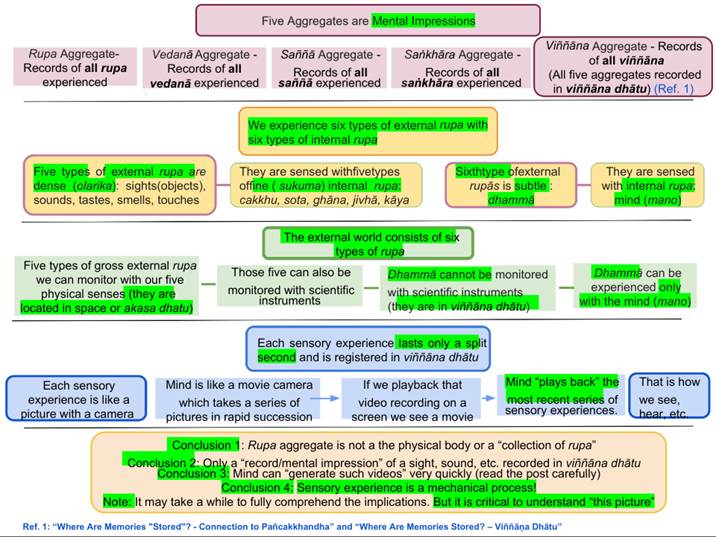
Buddhism – In Charts: 5. Five Aggregates – Mental Impression (with clickable links only in PDF and WebHelp)
Phật giáo – Dưới dạng Sơ đồ: 5. Năm Uẩn – Ấn tượng Tâm (với các liên kết có thể nhấp dưới dạng PDF và WebHelp)
Download/Print: WebLink: PDF Download: Chart #5. Five Aggregates – Mental Impressions
Tải xuống/In: WebLink: PDF Download: Chart #5. Five Aggregates – Mental Impressions
- Five aggregates (pañcakkhandha) are unique to each sentient being. We can see that by carefully analyzing a short sutta about the five aggregates: “WebLink: suttacentral: Khandha Sutta (SN 22.48).” ( 1)
Năm uẩn (pañcakkhandha) là riêng biệt đối với mỗi chúng sinh có tri giác. Ta có thể thấy điều đó bằng cách phân tích cẩn thận một sutta ngắn về năm uẩn: “WebLink: suttacentral: Khandha Sutta (SN 22.48).” (Tài liệu Tham khảo 1)
“And what are the five aggregates?”
“Vậy Năm Uẩn Là Gì?”
- “Any kind of rūpa at all—past, future, or present; internal or external; coarse or fine; inferior or superior; far or near: this is called the aggregate of rūpa.”
“Bất kỳ loại rūpa nào — quá khứ, tương lai hay hiện tại; thuộc nội thân hay ngoại cảnh; thô hay tế; thấp kém hay cao vượt; xa hay gần: tất cả được gọi là uẩn của rūpa.”
- “Any kind of vedanā at all—past, future, or present; internal or external; coarse or fine; inferior or superior; far or near: this is called the aggregate of vedanā.”
“Bất kỳ loại vedanā nào — quá khứ, tương lai hay hiện tại; thuộc nội thân hay ngoại cảnh; thô hay tế; thấp kém hay cao vượt; xa hay gần: tất cả được gọi là uẩn của vedanā.”
- “Any kind of saññā at all—past, future, or present; internal or external; coarse or fine; inferior or superior; far or near: this is called the aggregate of saññā.”
“Bất kỳ loại saññā nào — quá khứ, tương lai hay hiện tại; thuộc nội thân hay ngoại cảnh; thô hay tế; thấp kém hay cao vượt; xa hay gần: tất cả được gọi là uẩn của saññā.”
- “Any kind of saṅkhāra at all—past, future, or present; internal or external; coarse or fine; inferior or superior; far or near: this is called the aggregate of saṅkhāra.”
“Bất kỳ loại saṅkhāra nào — quá khứ, tương lai hay hiện tại; thuộc nội thân hay ngoại cảnh; thô hay tế; thấp kém hay cao vượt; xa hay gần: tất cả được gọi là uẩn của saṅkhāra.”
- “Any kind of viññāṇa at all—past, future, or present; internal or external; coarse or fine; inferior or superior; far or near: this is called the aggregate of viññāṇa.”
“Bất kỳ loại viññāṇa nào — quá khứ, tương lai hay hiện tại; thuộc nội thân hay ngoại cảnh; thô hay tế; thấp kém hay cao vượt; xa hay gần: tất cả được gọi là uẩn của viññāṇa.”
Therefore, each aggregate comprises 11 types: past, future, or present; internal or external; coarse or fine; inferior or superior; far or near.
Vì vậy, mỗi uẩn gồm 11 loại: quá khứ, tương lai hoặc hiện tại; nội hay ngoại; thô hay tế; thấp kém hay cao vượt; gần hay xa.
Brief Description of the 11 Types of Rūpa
Mô Tả Ngắn Về 11 Loại Rūpa
- A set of rūpa, vedanā, saññā, saṅkhāra, and viññāṇa arise whenever the mind makes contact with an external rūpa. Those can be of six types: vaṇṇa rūpa, sadda rūpa, gandha rūpa, rasa rūpa, phoṭṭhabba, and dhamma rūpa (in plain English, sight, sound, smell, taste, touch, and dhammā.) Note that “vaṇṇa rūpa” are also called “rūpa rūpa” or simply “rūpa.” Thus, depending on the context, one must be able to see what “rūpa” means. Six types of internal rūpa: They are cakkhu, sota, ghāna, jivhā, kāya, and mana. Note that these six are in the manomaya kaya (gandhabba) first five are pasāda rūpa, and the sixth is hadaya vatthu. They make contact with the six external rūpa. The Buddha called these 12 types of rūpa to be “all” because all experiences in this world arise via them; see “WebLink: suttacentral: Sabba Sutta (SN 35.23).”
Một tập hợp rūpa, vedanā, saññā, saṅkhāra, và viññāṇa sinh khởi bất cứ khi nào tâm tiếp xúc với một rūpa bên ngoài. Chúng có thể thuộc sáu loại: vaṇṇa rūpa, sadda rūpa, gandha rūpa, rasa rūpa, phoṭṭhabba, và dhamma rūpa (tức sắc, thanh, hương, vị, xúc và dhammā). Lưu ý “vaṇṇa rūpa” cũng được gọi là “rūpa rūpa” hay đơn giản là “rūpa.” Do đó, tùy theo ngữ cảnh, ta phải hiểu “rūpa” đang mang nghĩa nào. Sáu loại rūpa nội thân: đó là cakkhu, sota, ghāna, jivhā, kāya, và mana. Lưu ý rằng sáu loại này thuộc manomaya kāya (gandhabba); năm loại đầu là pasāda rūpa và loại thứ sáu là hadaya vatthu. Chúng tiếp xúc với sáu loại rūpa bên ngoài. Đức Phật gọi 12 loại rūpa này là “tất cả,” vì mọi trải nghiệm trong thế giới đều sinh ra thông qua chúng; xem “WebLink: suttacentral: Sabba Sutta (SN 35.23).”
- Rūpa we can see are coarse rūpa. The others (particularly the six internal rūpa and dhammā) belong to the “fine rūpa” category.
Những rūpa ta có thể thấy bằng mắt là rūpa thô. Các loại còn lại (đặc biệt là sáu rūpa nội thân và dhammā) thuộc loại rūpa vi tế.
- Any rūpa in the “good realms” are “superior rūpa,” and those in the lower realms are “inferior rūpa.”
Bất kỳ rūpa nào thuộc các “cõi lành” là “rūpa cao,” và những trong các cõi thấp là “rūpa thấp.”
- When one thinks about close-by rūpa, those are “near rūpa.” When one contemplates far away rūpa, they are “far rūpa.”
Khi nghĩ đến rūpa ở gần, đó là “rūpa gần.” Khi tưởng đến các rūpa ở xa, đó là “rūpa xa.”
- All those eight types of rūpa can belong to past, future, or present categories. “Past rūpa” are those one has experienced in the past; as we can see, this category is infinite since there is no beginning to the rebirth process. The “present rūpa” category is the smallest since it lasts only while a rūpa is experienced. “Future rūpa” is a bit complex category. Our future experiences are automatically “mapped out” according to the present status of the mind. However, it is a dynamic set that keeps changing. Only when a Bodhisatta gets “niyata vivarana” to become a Buddha will his future become fixed. That explanation requires a separate post.
Tám loại rūpa ấy đều có thể thuộc về quá khứ, tương lai hoặc hiện tại. “Rūpa quá khứ” là những gì ta đã từng kinh nghiệm; loại này là vô hạn vì vòng tái sinh không có khởi đầu. “Rūpa hiện tại” là loại nhỏ nhất vì chỉ tồn tại trong lúc đang được kinh nghiệm. “Rūpa tương lai” là loại phức tạp hơn: các kinh nghiệm tương lai của chúng ta được “phác sẵn” theo trạng thái hiện tại của tâm. Tuy nhiên, đó là một tập hợp luôn thay đổi. Chỉ khi một Bodhisatta được “niyata vivaraṇa” để thành Phật, tương lai của vị ấy mới trở nên cố định. Việc giải thích chi tiết cần một bài viết riêng.
- The other four aggregates similarly fall into the same 11 categories. For details, see “The Five Aggregates (Pañcakkhandha).”
Bốn uẩn còn lại cũng rơi vào cùng 11 loại như vậy. Chi tiết xem “The Five Aggregates (Pañcakkhandha).”
How Do the Five Aggregates Arise?
Năm Uẩn Sinh Khởi Như Thế Nào?
- It is a sensory experience that triggers a “new addition” to the set of five aggregates. For example, “seeing an object” means the contact of an external rūpa with an internal rūpa.
Một trải nghiệm giác quan là điều kích hoạt “một phần mới” trong tập hợp năm uẩn. Ví dụ, “thấy một đối tượng” nghĩa là sự tiếp xúc giữa một rūpa bên ngoài với một rūpa nội thân.
- That leads to “vedanā” and “saññā” arising in mind automatically (to recognize the object and there is a vedanā associated with it). Then the mind generates “saṅkhāra” according to one’s gati. That sensory experience is a “vipāka viññāṇa”; but if we generate abhisaṅkhāra, it can become a “kamma viññāṇa” too.
Điều đó khiến “vedanā” và “saññā” sinh khởi tự động trong tâm (để nhận ra đối tượng và tạo ra một vedanā đi kèm). Sau đó tâm tạo ra “saṅkhāra” tùy theo gati của mỗi người. Trải nghiệm giác quan ấy là một “vipāka viññāṇa”; nhưng nếu ta tạo abhisaṅkhāra, nó có thể trở thành “kamma viññāṇa.”
- That is a brief description of rūpa, vedanā, saññā, saṅkhāra, and viññāṇa arising with each sensory event.
Đó là mô tả ngắn gọn về sự sinh khởi của rūpa, vedanā, saññā, saṅkhāra, và viññāṇa trong mỗi sự kiện giác quan.Top of Form
- Then a record of that sensory event gets recorded in the “viññāṇa dhātu.” That record is a “namagotta.” If abhisaṅkhāra were involved, that record would also be associated with kammic energy, i.e., a “kamma bīja” can bring vipāka in the future.
Rồi một bản ghi về sự kiện giác quan đó được lưu lại trong “viññāṇa dhātu.” Bản ghi ấy gọi là “namagotta.” Nếu có abhisaṅkhāra tham gia, bản ghi đó cũng mang theo năng lượng kamma, tức là một “kamma bīja” có thể trổ vipāka trong tương lai.
- This is a complex but fascinating process.
Đây là một tiến trình phức tạp nhưng rất thú vị.
- As we can see, the accumulation of the five aggregates will stop only at the death of an Arahant. Since there is no rebirth, no more “internal rūpa” to make sensory experiences! That may sound alarming, but remember that each birth only leads to suffering, and most rebirths have unimaginable suffering.
Như ta thấy, sự tích lũy của năm uẩn chỉ dừng lại khi một vị Arahant qua đời. Vì không còn tái sinh, không còn “rūpa nội tại” để tạo ra những trải nghiệm giác quan nữa! Điều này có thể nghe có vẻ kỳ lạ, nhưng hãy nhớ rằng mỗi lần sinh ra đều dẫn đến khổ, và phần lớn các lần tái sinh chứa đựng những đau khổ không thể tưởng tượng được.
One Type of Consciousness (Vipāka Viññāṇa) Arises With an Ārammaṇa
Một Loại Thức (Vipāka Viññāṇa) Khởi Lên Khi Có Một Ārammaṇa
- We think of the mind as our own and are always present. But in reality, our consciousness arises based on two conditions.
Ta nghĩ rằng tâm là của mình và luôn hiện hữu. Nhưng thực ra, thức của chúng ta chỉ khởi lên dựa trên hai điều kiện.
- First, we must be awake. If someone is unconscious, no matter how loud we talk, he will not hear. No matter how hard we shake him, he will not feel. When unconscious (or in a deep sleep), our physical bodies shut down. Even though the “mental body/gandhabba” never sleeps, it is not getting any sensory inputs from the brain.
Thứ nhất, ta phải đang tỉnh táo. Nếu ai đó bất tỉnh, dù ta nói lớn thế nào họ cũng không nghe; dù ta lay mạnh họ cũng không cảm nhận. Khi bất tỉnh (hoặc ngủ sâu), thân vật lý tạm ngưng hoạt động. Dù “thân tâm/gandhabba” không bao giờ ngủ, nó vẫn không nhận được các dữ liệu đầu vào qua giác quan từ não.
- Second, one of our six senses must be stimulated by an external sight, sound, smell, taste, touch, or memory. The first five come through our five physical senses, and the sixth is the thoughts that come to our mind via the mana indriya in the brain; see “Brain – Interface between Mind and Body.”
Thứ hai, một trong sáu căn phải được kích hoạt bởi cảnh sắc, âm thanh, mùi, vị, xúc chạm hay ký ức. Năm loại đầu đến qua năm giác quan vật lý, loại thứ sáu là ý tưởng/ý niệm đi vào tâm qua mana indriya trong não; xem “Brain – Interface between Mind and Body.”
- An “external trigger” that initiates a new consciousness is called an ārammaṇa. Such an ārammaṇa comes to the mind via one of the “five physical doors” or directly to the mind. Then one of the six consciousness (viññāṇa) arise. These are vipāka viññāṇa. They just come in due to prior kamma, as kamma vipāka.
Một “tác nhân bên ngoài” khởi sinh một dòng tâm mới được gọi là ārammaṇa. Ārammaṇa có thể đến qua một trong “năm cửa vật lý” hoặc trực tiếp đến tâm. Khi đó một trong sáu loại thức (viññāṇa) sẽ khởi lên. Đây là vipāka viññāṇa. Chúng chỉ phát sinh do kamma quá khứ, dưới dạng kamma vipāka.
- These types of vipāka viññāṇa arise via, for example, “Cakkhuñca paṭicca rūpe ca uppajjati cakkhu viññāṇaṁ.” See, “Contact Between Āyatana Leads to Vipāka Viññāṇa.”
Những loại vipāka viññāṇa này khởi lên, chẳng hạn như: “Cakkhuñca paṭicca rūpe ca uppajjati cakkhu viññāṇaṁ.” Xem “Contact Between Āyatana Leads to Vipāka Viññāṇa.”
Second Type of Consciousness (Kamma Viññāṇa) May Arise Based on an Ārammaṇa
Loại Thức (Kamma Viññāṇa) Thứ Hai Có Thể Sinh Khởi Dựa Trên Một Ārammaṇa
- If that external “thought object” or “ārammaṇa” is interesting, we start generating CONSCIOUS THOUGHTS about that ārammaṇa.
Nếu “đối tượng tâm” hay ārammaṇa đó hấp dẫn, ta bắt đầu sinh ra NHỮNG SUY NGHĨ CÓ CHỦ Ý về ārammaṇa ấy.
- At this point, our consciousness switches to a new type called a kamma viññāṇa. This new consciousness is more than mere “consciousness” or “awareness.” We are interested in pursuing what we have seen, heard, tasted, etc., and “getting more of those we liked.”
Từ đây, thức của ta chuyển sang một loại mới gọi là kamma viññāṇa. Loại thức này không chỉ đơn thuần là “nhận biết.” Nó đi kèm với sự muốn đeo đuổi những gì ta đã thấy, nghe, nếm… và “muốn có thêm những gì mình ưa thích.”
- For example, a friend may offer a piece of cake, and the taste of that cake is a vipāka viññāṇa. But if we liked the taste of that cake, we may want to taste it again in the future. We may start thinking about buying or making it and asking that friend how to pursue those two possibilities. That future expectation is in the new type of kamma viññāṇa generated via “avijjā paccayā saṅkhāra.”
Ví dụ, một người bạn mời ta miếng bánh, và vị của miếng bánh đó là vipāka viññāṇa. Nhưng nếu ta thích vị đó, ta có thể muốn ăn lại trong tương lai. Ta có thể nghĩ đến việc mua, làm bánh, hoặc hỏi bạn xem làm sao để có được nó. Kỳ vọng hướng đến tương lai đó chính là loại kamma viññāṇa mới được tạo ra theo “avijjā paccayā saṅkhāra.”
- In other words, now we have gone beyond “just experiencing the taste of the cake” or the “vipāka viññāṇa.” Now we have a future expectation to taste it again with a “kamma viññāṇa” generated via our conscious thoughts (vacī saṅkhāra.)
Nói cách khác, ta đã đi xa hơn mức “chỉ trải nghiệm vị của miếng bánh” như một vipāka viññāṇa. Giờ đây ta có mong muốn được nếm lại, với một “kamma viññāṇa” được tạo ra bởi các suy nghĩ có chủ ý (vacī saṅkhāra).
- Stated in another way, we have initiated a Paṭicca Samuppāda process with “avijjā paccayā saṅkhāra” and “saṅkhāra paccayā viññāṇa.” That viññāṇa is a kamma viññāṇa.
Nói theo cách khác, ta đã khởi động một tiến trình Paṭicca Samuppāda với “avijjā paccayā saṅkhāra” và “saṅkhāra paccayā viññāṇa.” Loại viññāṇa này là kamma viññāṇa.
A Living Being – Body With a Mind Interacting With the External World
Một Chúng Sinh – Thân Và Tâm Tương Tác Với Thế Giới Bên Ngoài
- What we discussed above in summary form is what our lives are all about. We have a physical body and an invisible “mental body/gandhabba” with the “seat of the mind” (hadaya vatthu.) The physical body gets sensory inputs from the external world. Those are processed by the brain and passed to the “mental body/gandhabba.” It is the hadaya vatthu (we casually call the “mind”) that “feels/experiences” such sensory inputs. Then we (our minds) pursue those sensory inputs we like and try to avoid those we do not like.
Tóm tắt những điều trên chính là cách đời sống của ta vận hành. Ta có một thân vật lý và một “thân tâm/gandhabba” vô hình với “chỗ ngụ của tâm” (hadaya vatthu). Thân vật lý nhận các kích thích từ thế giới bên ngoài, chúng được não xử lý rồi truyền đến “thân tâm/gandhabba.” Chính hadaya vatthu (ta quen gọi là “tâm”) cảm nhận các dữ liệu đầu vào giác quan này. Rồi ta (tâm ta) đuổi theo những gì ưa thích và tránh né những gì không thích.
- In that process, we create new kamma that leads to the arising of a new body when the current body dies.
Trong tiến trình đó, ta tạo ra kamma mới, đưa đến sự hình thành một thân mới khi thân hiện tại hoại diệt.
- Of course, the types of bodies that arise in future lives depend on the types of kamma that we do, based on those sensory experiences. If one kills another person to acquire that person’s wealth, one will be reborn in a bad realm (apāyā.) If one generates compassionate thoughts about hungry people and offers them food, one may be reborn in a good realm.
Tất nhiên, loại thân sinh khởi trong tương lai tùy thuộc vào loại kamma ta tạo, dựa trên các kinh nghiệm giác quan đó. Nếu ai sát hại người khác để chiếm đoạt tài sản, người ấy sẽ tái sinh vào cảnh giới xấu (apāyā). Nếu ai khởi tâm từ bi đối với người đói khổ và bố thí thức ăn, người ấy có thể sinh vào cảnh giới tốt lành.
- That is how the rebirth process continues.
Đó là cách tiến trình tái sinh tiếp diễn.
Rūpa Versus Rūpakkhandha
Sự khác Biệt Giữa Rūpa Và Rūpakkhandha
- The Buddha included all types of matter encountered at any time in one giant “collection” or “aggregate.” That is the “rūpa aggregate” or “rūpa khandha” or “rūpakkhandha.”
Đức Phật gom tất cả các loại vật chất mà ta tiếp xúc vào một “tập hợp” hay “uẩn” lớn. Đó là “uẩn rūpa” hay “rūpa khandha,” tức “rūpakkhandha.”
- That means what is in the rūpakkhandha is not real (physical) rūpa. Whatever is observed becomes a mental imprint or a “memory record” moments after observation. See the next post in the series: “Rūpa, Vedanā, Saññā, Saṅkhāra, Viññāṇa – Mostly Misunderstood.”
Điều đó có nghĩa: những gì nằm trong rūpakkhandha không phải là rūpa thật (vật chất). Bất cứ điều gì được quan sát đều trở thành một dấu ấn tâm hay một “bản ghi ký ức” chỉ vài sát-na sau khi được thấy. Xem bài tiếp theo trong loạt bài: “Rūpa, Vedanā, Saññā, Saṅkhāra, Viññāṇa – Mostly Misunderstood.”
- The Buddha divided the mind or “mental aspects” into four categories: vedanā, saññā, saṅkhāra, and viññāṇa. These entities arise and fade, but a record of them exists (going back to an untraceable beginning.) Those “collections” or “aggregates” are vedanākkhandha, saññākkhandha, saṅkhārakkhandha, and viññāṇakkhandha.
Đức Phật phân chia tâm – hay “các yếu tố tâm” – thành bốn loại: vedanā, saññā, saṅkhāra và viññāṇa. Những pháp này sinh rồi diệt, nhưng bản ghi của chúng vẫn còn (ngược về đến một khởi đầu không thể truy tìm). Những “tập hợp” hay “uẩn” ấy là vedanākkhandha, saññākkhandha, saṅkhārakkhandha và viññāṇakkhandha.
Rūpakkhandha Is Not Stored Directly
Rūpakkhandha Không Được Lưu Giữ Trực Tiếp
- It is critical to realize that a “rūpa” cannot be stored in the viññāṇa dhātu. Only a “mental imprint” of a rūpa gets stored. That “mental imprint” is in the four “mental aggregates.” Let us briefly discuss that.
Điều quan trọng là hiểu rằng một “rūpa” không thể được lưu giữ trong viññāṇa dhātu. Chỉ có “dấu ấn tâm” về rūpa mới được lưu lại. Dấu ấn tâm này thuộc về bốn “uẩn tâm.” Hãy cùng xét qua điều đó.
- When we see an object, its shape, colors, etc., are perceived by the mind with the saññā Our feelings about it are in the vedanā aggregate, and any action we took is in the saṅkhāra aggregate. Finally, our expectations for such rūpa are in the viññāṇa aggregate.
Khi ta thấy một đối tượng, hình dạng, màu sắc… của nó được tâm nhận biết qua uẩn saññā. Cảm thọ của ta về nó thuộc uẩn vedanā, và mọi hành động ta làm thuộc uẩn saṅkhāra. Cuối cùng, mong muốn hay kỳ vọng của ta đối với rūpa đó nằm trong uẩn viññāṇa.
- That process is discussed in detail in “Where Are Memories ‘Stored’? – Connection to Pañcakkhandha” and “Where Are Memories Stored? – Viññāṇa Dhātu” ( 1 in the above chart). However, a good grasp of the concept of the five aggregates is needed as explained in “The Five Aggregates (Pañcakkhandha)” and “Paṭicca Samuppāda During a Lifetime.”
Tiến trình này được giải thích chi tiết trong “Where Are Memories ‘Stored’? – Connection to Pañcakkhandha” và “Where Are Memories Stored? – Viññāṇa Dhātu” (Tài liệu tham khảo số 1 trong sơ đồ trên). Tuy nhiên, trước hết cần hiểu vững khái niệm năm uẩn như đã trình bày trong “The Five Aggregates (Pañcakkhandha)” và “Paṭicca Samuppāda During a Lifetime.”
The Five Aggregates Describe any “Living Being”
Năm Uẩn Mô Tả Trọn Vẹn Một “Chúng Sinh”
- As we will see, a sentient being’s entire existence (through uncountable rebirths) and experiences can be described entirely with those five aggregates. The Buddha showed that those five entities arise and fade away in a manner fully explained in terms of causes and their effect. There is no hidden “soul” or an “ātman.”
Như ta sẽ thấy, toàn bộ sự tồn tại của một chúng sinh (qua vô số lần tái sinh) cùng mọi kinh nghiệm của họ đều có thể được mô tả bằng năm uẩn. Đức Phật chỉ ra rằng năm pháp ấy sinh và diệt hoàn toàn theo luật nhân quả. Không có một “linh hồn” hay “ātman” ẩn tàng nào cả.
- However, at any given time, there is a “person” with a set of gati (habits/character) responsible for the actions done at that time. It is not an automated process. That is why we cannot say there is no “self” up to the Arahant There is a “self” doing things on his/her own. Of course, only until seeing the futility of such “doings” or “(abhi)saṅkhāra.”
Tuy nhiên, tại bất kỳ thời điểm nào cũng có một “người” với một tập hợp gati (tánh, thói quen) chịu trách nhiệm cho hành động của mình. Nó không phải một tiến trình tự động. Đó là lý do ta không thể nói rằng “không có tự ngã” cho đến khi đạt Arahant. Vẫn có một “ngã” đang hành động theo các khuynh hướng của mình — tất nhiên, chỉ cho đến khi thấy được sự vô ích của những hành động ấy, tức các “(abhi)saṅkhāra.”
- That last point is what we need to understand. This time, we will discuss that systematically with a slightly different approach in the new series “Buddhism – In Charts.” However, this series is only a systematic way to arrange previously published posts, while making connections among posts in different sections. It is imperative to read the posts linked above. Buddha Dhamma is deeper than the deepest ocean. One can go into it as deeply as one wants, provided one is willing to spend the time. But what we discuss will be essential parts.
Điểm cuối cùng đó là điều chúng ta cần hiểu rõ. Lần này, chúng ta sẽ trình bày vấn đề ấy một cách hệ thống hơn với một cách tiếp cận hơi khác trong loạt bài mới “Buddhism – In Charts.” Tuy nhiên, loạt bài này chỉ là sự sắp xếp có hệ thống các bài đã đăng trước, đồng thời nối kết chúng lại với nhau. Điều quan trọng là phải đọc các bài đã dẫn ở trên. Dhamma của Đức Phật sâu hơn cả đại dương. Ai muốn đều có thể đi sâu bao nhiêu tùy ý, miễn là sẵn sàng dành thời gian. Còn những gì chúng ta thảo luận đây là phần cốt yếu.
Summary
Tóm lược
- We have laid the framework to examine the conscious life and the rebirth process based on the five aggregates or pañcakkhandha. Please read and understand the whole section on “The Five Aggregates (Pañcakkhandha).” I will discuss memory formation, storage, and extraction in the next post before we connect it all to Paṭicca Samuppāda.
Chúng ta đã đặt nền tảng để khảo sát đời sống có ý thức và tiến trình tái sinh dựa trên năm uẩn hay pañcakkhandha. Vui lòng đọc và hiểu toàn bộ phần “The Five Aggregates (Pañcakkhandha).” Trong bài tiếp theo, tôi sẽ trình bày về sự hình thành, lưu trữ và truy xuất ký ức trước khi kết nối tất cả với Paṭicca Samuppāda.
- In this analysis, the whole world is divided into just five categories. One is the rūpa aggregate, the “collection of MEMORIES of all rūpa” or the rūpakkhandha. That includes memories of all “material objects,” including our physical bodies and all external objects one has seen in all previous lives. We will discuss that in the next post.
Trong phân tích này, toàn thế giới được chia thành năm loại. Một là uẩn rūpa, tức “tập hợp CÁC KÝ ỨC về mọi rūpa,” hay rūpakkhandha. Điều đó bao gồm ký ức về mọi “đối tượng vật chất,” gồm cả thân vật lý của ta và mọi vật thể bên ngoài mà ta từng thấy trong mọi đời trước. Chúng ta sẽ bàn chi tiết trong bài tiếp theo.
- The other four aggregates or “heaps” or “collections” of four types of mental entities: vedanā (feelings), saññā (perception), saṅkhāra (thoughts of speech and actions), and viññāṇa (vipāka viññāṇa or kamma viññāṇa.)
Bốn uẩn còn lại là bốn uẩn hay “tập hợp” gồm bốn loại pháp tâm: vedanā (cảm thọ), saññā (nhận thức), saṅkhāra (tư tưởng dẫn đến lời nói và hành động), và viññāṇa (vipāka viññāṇa hoặc kamma viññāṇa).
- I have discussed this topic in detail in “Paṭicca Samuppāda During a Lifetime.”
Tôi đã trình bày chủ đề này chi tiết trong “Paṭicca Samuppāda During a Lifetime.”
Reference
Tài liệu Tham khảo
- “Where Are Memories ‘Stored’? – Connection to Pañcakkhandha” and “Where Are Memories Stored? – Viññāṇa Dhātu.”
“Where Are Memories ‘Stored’? – Connection to Pañcakkhandha” và “Where Are Memories Stored? – Viññāṇa Dhātu.”