February 23, 2025
Ngày 23/02/2025
Sotāpanna stage is reached by removing sakkāya diṭṭhi, the wrong view that only “sensory pleasures” can overcome suffering. To do that, one must learn Buddha’s worldview from a disciple of the Buddha.
Bậc Sotāpanna đạt được bằng cách loại bỏ sakkāya diṭṭhi, tức là tà kiến cho rằng chỉ có “khoái lạc giác quan” mới có thể vượt qua khổ. Để làm được điều đó, cần học thế giới quan của Đức Phật từ một đệ tử của Đức Phật.
Loka and Āloka – Totally Separated
Loka và Āloka – Hoàn toàn Tách biệt
Download/Print: “WebLink: PDF File Download: Loka and Aloka – Totally Separated”
Tải xuống/In: “WebLink: PDF File Download: Loka and Aloka – Totally Separated”
The Broad Overview
Tổng quan Chung
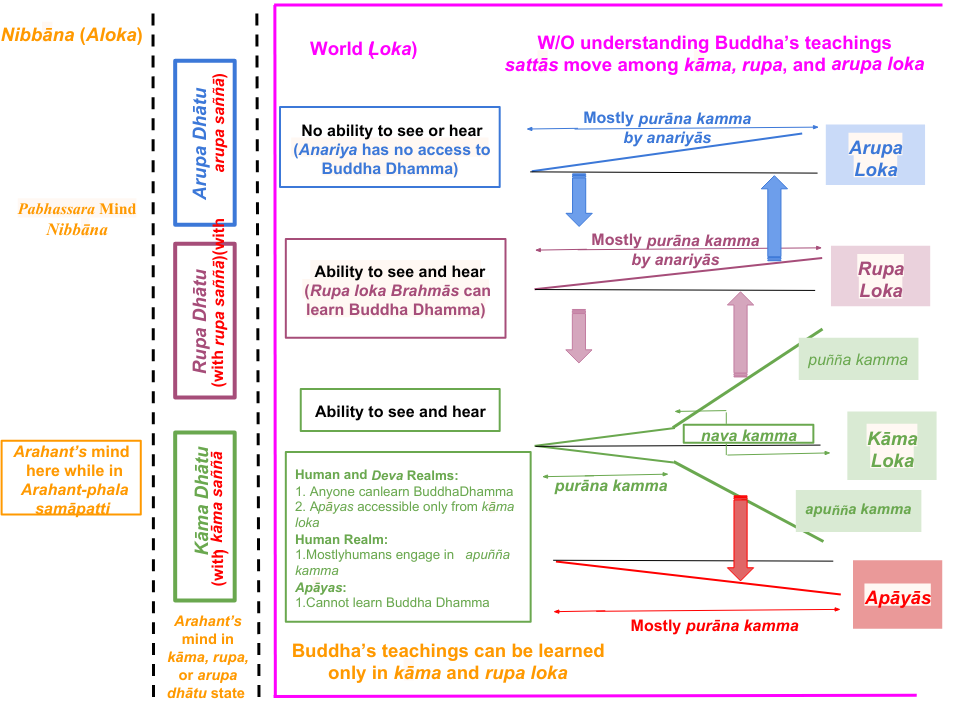
- A simple representation of the world and Nibbāna (removed from the world) is shown in the above chart. Let us discuss the necessary features. Of course, one must get rid of uccheda and sassata diṭṭhi first, as discussed in the previous post, “Path to Nibbāna – The Necessary Background.”
Một biểu diễn đơn giản về thế giới và Nibbāna (tách khỏi thế giới) được thể hiện trong sơ đồ trên. Hãy cùng thảo luận các đặc điểm cần thiết. Tất nhiên, trước hết cần loại bỏ uccheda diṭṭhi và sassata diṭṭhi, như đã thảo luận trong bài trước, “Path to Nibbāna – The Necessary Background.”
- One must learn Buddha’s teachings from a Buddha or a disciple who has attained a magga phala, i.e., at least the Sotāpanna stage. We have two sense faculties used for learning: listening and reading. Either or both can be used.
Một người phải học giáo pháp của Đức Phật từ chính Đức Phật hoặc từ một đệ tử đã đạt magga phala, tức là ít nhất ở giai đoạn Sotāpanna. Chúng ta có hai căn dùng để học: nghe và đọc. Có thể dùng một hoặc cả hai.
- Both those sense faculties are absent in arūpa loka (those Brahmās have only the mind). Thus, unless they had attained at least the Sotāpanna stage in a previous life, they cannot learn anything about Buddha’s teachings.
Cả hai căn này đều không có trong arūpa loka (các Brahmā ở đó chỉ có tâm). Do đó, trừ khi họ đã đạt ít nhất bậc Sotāpanna trong đời trước, họ không thể học bất cứ điều gì về giáo pháp của Đức Phật.
- Those in the four lowest realms (apāyās) also cannot learn Buddha Dhamma because their minds don’t generate “ñāṇa sampayutta citta” per Abhidhamma, i.e., they don’t have the wisdom to grasp the teachings.
Những chúng sinh ở bốn cõi thấp (apāyā) cũng không thể học Dhamma của Đức Phật vì tâm của họ không sinh ra “ñāṇa sampayutta citta” theo Abhidhamma, tức là họ không có trí tuệ để hiểu giáo pháp.
- Therefore, only those in the human, Deva, and rūpa loka realms can learn Buddha Dhamma and attain a magga phala.
Do đó, chỉ những chúng sinh ở cõi người, cõi Deva và cõi rūpa loka mới có thể học Dhamma của Đức Phật và đạt magga phala.
- A given sattā (any living being with no magga phala; a “puthujjana” if in the human realm) moves up and down among the realms endlessly (most time spent in the apāyās) until grasping Buddha Dhamma and attaining Nibbāna.
Một sattā (bất kỳ chúng sinh nào chưa đạt magga phala; gọi là “puthujjana” nếu ở cõi người) di chuyển lên xuống giữa các cõi vô tận (phần lớn thời gian ở các apāyā) cho đến khi nắm bắt được Dhamma của Đức Phật và đạt Nibbāna.
- Suffering does not end until one is fully separated from the world (on the right side) and moves to the leftmost region. That happens for the first time at the Arahant-phala moment. Then, until the death of the physical body, Arahant’s mind is mostly in the middle region; see below. Until the death of the physical body of an Arahant, a mind must be in one of the three regions in the above chart; at the death of the physical body of an Arahant, the mind will disappear from the chart; that is the end of suffering.
Khổ không chấm dứt cho đến khi một người hoàn toàn tách khỏi thế giới (ở phía bên phải) và chuyển sang vùng ngoài cùng bên trái. Điều đó xảy ra lần đầu tại khoảnh khắc Arahant-phala. Sau đó, cho đến khi thân vật lý chết đi, tâm của Arahant chủ yếu ở vùng giữa; xem bên dưới. Cho đến khi thân vật lý của Arahant chấm dứt, tâm phải nằm trong một trong ba vùng trên sơ đồ; khi thân vật lý của Arahant chết đi, tâm sẽ biến mất khỏi sơ đồ; đó là sự chấm dứt khổ.
A Mind Must be in One of the Three Regions
Tâm Phải Ở Trong Một Trong Ba vùng
- Attaining the highest magga phala (Arahanthood) means separation from the world of 31 realms in the three lokās: kāma, rūpa, and arūpa loka. See “Loka and Nibbāna (Āloka) – Complete Overview.”
Đạt magga phala cao nhất (quả vị Arahant) nghĩa là tách khỏi thế giới 31 cõi trong ba lokā: kāma, rūpa và arūpa loka. Xem “Loka and Nibbāna (Āloka) – Complete Overview.”
- However, an Arahant must live in this world until the physical body’s death. Upon death, he/she will not be reborn in any of the 31 realms within the three lokās.
Tuy nhiên, một Arahant vẫn phải sống trong thế giới này cho đến khi thân vật lý chết đi. Khi chết, vị ấy sẽ không tái sinh vào bất kỳ cõi nào trong 31 cõi thuộc ba lokā.
- Yet, the mind of a living Arahant will never get inside the “world boundary” marked by the “pink box” in the above chart. (Any mind anywhere within the “pink box” or the “world” inevitably generates thoughts of rāga, dosa, or at least moha.)
Tuy vậy, tâm của một Arahant còn sống sẽ không bao giờ đi vào “ranh giới thế giới” được đánh dấu bằng “khung màu hồng” trong sơ đồ trên. (Bất kỳ tâm nào nằm trong “khung màu hồng” hay “thế giới” đều tất yếu sinh ra các ý nghĩ với rāga, dosa hoặc ít nhất là moha.)
- Until death, the mind of an Arahant stays in one of three “dhātu” states (“here, dhātu means the “landing state” for any thought). During normal daily life it is the “kāma dhātu” for an Arahant born in kāma loka. If the Arahant can get into a jhāna (mindset of rūpa loka Brahmās), their minds will be in rūpa dhātu. If the Arahant can get into an arūpa samāpatti (the mindset of arūpa loka Brahmās), their minds will be in arūpa dhātu.
Cho đến khi chết, tâm của Arahant ở trong một trong ba trạng thái “dhātu” (ở đây dhātu nghĩa là “trạng thái đặt tâm” của mỗi tư tưởng). Trong đời sống thường ngày, đó là “kāma dhātu” đối với Arahant sinh trong kāma loka. Nếu Arahant nhập jhāna (trạng thái tâm của Brahmā ở rūpa loka), tâm sẽ ở trong rūpa dhātu. Nếu Arahant nhập arūpa samāpatti (trạng thái tâm của Brahmā ở arūpa loka), tâm sẽ ở trong arūpa dhātu.
- The mind of a sattā also lands first in a dhātu stage (for example, the mind of a puthujjana lands in “kāma dhātu” and that of an anāriya rūpa loka Brhama lands in the “kāma dhātu”), but immediately transitions to inside of the “pink box” or the “world.” Thus, a sattā’s mind will ALWAYS be inside the “pink box.”
Tâm của một sattā cũng đặt vào trạng thái dhātu trước (ví dụ, tâm của puthujjana đặt vào “kāma dhātu” và tâm của Brahmā anāriya ở rūpa loka cũng đặt vào “kāma dhātu”), nhưng ngay lập tức chuyển vào bên trong “khung màu hồng” hay “thế giới”. Do đó, tâm của một sattā LUÔN nằm trong “khung màu hồng”.
Difference Between the Two Regions on the Left in the Chart
Sự Khác Biệt Giữa Hai Vùng Bên Trái Trong Sơ Đồ
- As we have discussed, any mind in a dhātu stage would have the corresponding “distorted saññā”: “kāma saññā” in kāma loka, “rūpa (jhāna) saññā” in rūpa loka, and “arūpa (samāpatti) saññā” in arūpa loka. A puthujjana’s (or a sattā’s) mind will also start at a dhātu stage but immediately move to the “purāṇa kamma” state in one of the three lokās.
Như đã thảo luận, bất kỳ tâm nào ở trạng thái dhātu đều có “saññā bị méo mó” tương ứng: “kāma saññā” trong kāma loka, “rūpa (jhāna) saññā” trong rūpa loka và “arūpa (samāpatti) saññā” trong arūpa loka. Tâm của một puthujjana (hay một sattā) cũng bắt đầu ở trạng thái dhātu nhưng ngay lập tức chuyển sang trạng thái “purāṇa kamma” trong một trong ba lokā.
- Some Arahants can experience thoughts free of even the “distorted saññā” by getting into “Arahant-phala samāpatti.” Here, their cittās would not have the distorted saññā associated with any loka/realm; they will only be aware that they are still living and will not experience any sense event.
Một số Arahant có thể trải nghiệm các trạng thái tâm không có cả “saññā bị méo mó” bằng cách nhập “Arahant-phala samāpatti”. Khi đó, các cittā của họ không mang saññā bị méo mó liên quan đến bất kỳ loka/cõi nào; họ chỉ nhận biết rằng mình vẫn đang sống và không trải nghiệm bất kỳ đối tượng cảm giác nào.
- Thus, any given mind must be in one of the three regions separated by the dotted lines. A puthujjana’s mind is ALWAYS in the right region (“pink box”), and an Arahant’s mind could be in one of the other two regions on the left.
Do đó, bất kỳ tâm nào cũng phải nằm trong một trong ba vùng được phân tách bởi các đường chấm. Tâm của puthujjana LUÔN ở vùng bên phải (“khung màu hồng”), còn tâm của Arahant có thể ở một trong hai vùng bên trái.
A Sattā Moves Among the Three Lokas Endlessly
Một Sattā Di Chuyển Giữa Ba Loka Một Cách Vô Tận
- Therefore, until a Buddha shows how to separate from the world delineated by the “pink box,” a sattā (without magga phala) is trapped in the endless rebirth process.
Do đó, cho đến khi một vị Phật chỉ ra cách tách khỏi thế giới được giới hạn bởi “khung màu hồng”, một sattā (chưa đạt magga phala) sẽ bị mắc kẹt trong vòng tái sinh vô tận.
- The “nava kamma” stage is where a human puthujjana accumulates kammic energies for future rebirths. The high upward-sloping line indicates the accumulation of “good kamma,” and the downward-sloping line suggests the accumulation of “bad kamma.”
Giai đoạn “nava kamma” là nơi một puthujjana ở cõi người tích lũy năng lượng kamma cho các lần tái sinh trong tương lai. Đường dốc lên cao biểu thị sự tích lũy “kamma thiện”, còn đường dốc xuống biểu thị sự tích lũy “kamma bất thiện”.
- By cultivating puñña kamma, a human can move up to the Deva realms above. By cultivating jhāna/arūpa samāpatti, they can move up to Brahma realms. That is the most ancient yogis (like Āḷāra Kālāma and Uddaka Rāmaputta) could do. The discovery of the “purāṇa kamma” stage by our Bodhisatta led to his Enlightenment.
Bằng cách tu tập puñña kamma, con người có thể đi lên các cõi Deva. Bằng cách tu tập jhāna/arūpa samāpatti, họ có thể đi lên các cõi Brahma. Đó là điều các yogi cổ xưa (như Āḷāra Kālāma và Uddaka Rāmaputta) có thể làm. Việc Bồ-tát của chúng ta khám phá ra giai đoạn “purāṇa kamma” đã dẫn đến sự giác ngộ của Ngài.
- On the other hand, by cultivating apuñña kamma, they will move down to the apāyās. The bad news is that a sattā spends most of the rebirth process in the apāyās.
Ngược lại, bằng cách tạo apuñña kamma, họ sẽ đi xuống các apāyā. Tin xấu là một sattā dành phần lớn thời gian trong vòng tái sinh ở các apāyā.
- The truth of that statement can be seen by comparing the population in the human realm with that in the only apāya we can see, the animal realm. We have only about eight billion humans on Earth, but many animal species have trillions in each realm!
Sự thật của điều này có thể thấy khi so sánh dân số cõi người với cõi apāya duy nhất mà chúng ta có thể thấy, đó là cõi động vật. Trái Đất chỉ có khoảng tám tỷ người, nhưng nhiều loài động vật có số lượng lên đến hàng nghìn tỷ trong mỗi loài!
- See, for example, “How the Buddha Described the Chance of Rebirth in the Human Realm.”
Xem, ví dụ, “How the Buddha Described the Chance of Rebirth in the Human Realm.”
Abstaining from Dasa Akusala Is Not Enough to Attain Nibbāna
Chỉ Tránh Mười Điều Bất Thiện Chưa Đủ Để Đạt Nibbāna
- Most people believe abstaining from immoral deeds is enough to avoid future suffering.
Hầu hết mọi người tin rằng chỉ cần tránh các hành vi bất thiện là đủ để tránh khổ trong tương lai.
- Some say, “I don’t hurt anyone or do immoral things, so I should be fine. What is the need to do things like striving for Nibbāna?”
Một số người nói: “Tôi không làm hại ai hay làm điều bất thiện, vậy là ổn rồi. Tại sao cần phải nỗ lực hướng đến Nibbāna?”
- They don’t understand the power of temptations. If the sansāric bonds (saṁyojana) remain intact, anyone could be tempted to do immoral deeds under tempting conditions. We have heard many “highly moral people” getting caught engaging in immoral deeds. If the temptation is strong enough, the mind of any puthujjana is capable of the worst crimes. Aṅgulimāla was an intelligent student until turning into a monster, killing almost a thousand people. Ven. Moggallāna, in a relatively recent previous life, had killed his two parents! There are many such accounts in the Tipiṭaka.
Họ không hiểu sức mạnh của cám dỗ. Nếu các ràng buộc luân hồi (saṁyojana) vẫn còn nguyên, bất kỳ ai cũng có thể bị cám dỗ làm điều bất thiện trong những hoàn cảnh hấp dẫn. Chúng ta đã nghe nhiều “người rất đạo đức” bị phát hiện làm điều sai trái. Nếu cám dỗ đủ mạnh, tâm của bất kỳ puthujjana nào cũng có thể thực hiện những tội ác tồi tệ nhất. Aṅgulimāla từng là một học sinh thông minh trước khi trở thành kẻ sát nhân, giết gần một nghìn người. Tôn giả Moggallāna, trong một đời trước không xa, đã giết cha mẹ mình! Có nhiều câu chuyện như vậy trong Tipiṭaka.
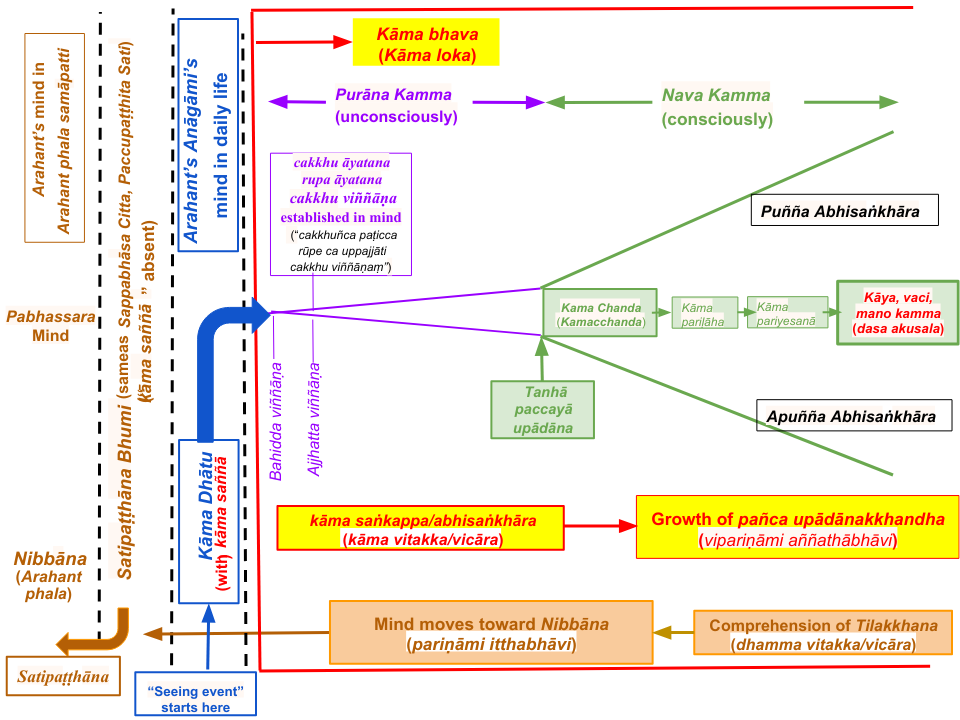
- The first step in understanding that forceful abstaining from dasa akusala in not enough to reach Nibbāna is to understand the following chart.
Bước đầu tiên để hiểu rằng việc cố gắng tránh mười điều bất thiện (dasa akusala) là chưa đủ để đạt Nibbāna là hiểu sơ đồ sau.
Path to Sotāpanna from Kāma Loka
Con đường đến Sotāpanna từ Kāma Loka
Download/Print: “WebLink: PDF File Download: Path to Sotāpanna from Kama Loka”
Tải xuống/In: “WebLink: PDF File Download: Path to Sotāpanna from Kama Loka”
- Before a Buddha comes to the world, no one can know of the “purāṇa kamma” state in the above chart. Morality is defined ONLY by whether one engages in puñña or apuñña kamma (in the “nava kamma” stage).
Trước khi một vị Phật xuất hiện trên thế gian, không ai có thể biết về trạng thái “purāṇa kamma” trong sơ đồ trên. Đạo đức chỉ được định nghĩa DUY NHẤT dựa trên việc một người thực hiện puñña hay apuñña kamma (trong giai đoạn “nava kamma”).
- Ancient yogis knew that engaging in apuñña (immoral) kamma led to rebirths in lower realms. They also knew that engaging in puñña (moral) deeds could bring rebirths in the Deva realms. Some (like Āḷāra Kālāma and Uddaka Rāmaputta) also knew that giving up sensual pleasures (kāma rāga) allows one to cultivate jhāna and have a rebirth in a Brahma realm.
Các yogi cổ xưa biết rằng thực hiện apuñña (kamma bất thiện) dẫn đến tái sinh vào các cõi thấp. Họ cũng biết rằng thực hiện puñña (hành động thiện) có thể dẫn đến tái sinh vào các cõi Deva. Một số (như Āḷāra Kālāma và Uddaka Rāmaputta) cũng biết rằng từ bỏ khoái lạc giác quan (kāma rāga) cho phép tu tập jhāna và tái sinh vào cõi Brahma.
- However, they did not know that attachment to any of the three lokās occurs well before a mind gets to engaging in puñña/apuñña kamma.
Tuy nhiên, họ không biết rằng sự dính mắc vào bất kỳ lokā nào trong ba lokā xảy ra từ rất sớm, trước khi tâm đi đến việc thực hiện puñña/apuñña kamma.
- The “bondage” to the world occurs at the “purāṇa kamma” stage, at the moment of experiencing a sensory event; one is not even aware that one has already attached. That is why details of this “purāṇa kamma” stage are essential to understand to become a sandiṭṭhiko (one who has “seen the Dhamma.”) See “Sandiṭṭhiko – What Does It Mean?.”
Sự “ràng buộc” với thế giới xảy ra ở giai đoạn “purāṇa kamma”, ngay tại khoảnh khắc trải nghiệm một đối tượng cảm giác; một người thậm chí không nhận ra rằng mình đã dính mắc. Đó là lý do tại sao việc hiểu chi tiết giai đoạn “purāṇa kamma” là rất quan trọng để trở thành sandiṭṭhiko (người “đã thấy Dhamma”). Xem “Sandiṭṭhiko – What Does It Mean?.”
Any Sense Event Takes a Mind Away from Nibbāna
Bất Kỳ Đối Tượng Cảm Giác Nào Cũng Đưa Tâm Rời Xa Nibbāna
- Any sense event takes the mind of a sattā (whose ten saṁyojana remain intact) away from Nibbāna, as seen in the above second chart. The mind of a a sattā ALWAYS transitions into the RIGHT to be inside the “loka/world” and AWAY from Nibbāna. Thus, without that understanding, a sattā cannot attain Nibbāna (which requires separating from the world).
Bất kỳ đối tượng cảm giác nào cũng đưa tâm của một sattā (còn đầy đủ mười saṁyojana) rời xa Nibbāna, như thể hiện trong sơ đồ thứ hai ở trên. Tâm của một sattā LUÔN chuyển sang PHÍA PHẢI để nằm trong “loka/thế giới” và RỜI XA Nibbāna. Do đó, nếu không hiểu điều này, một sattā không thể đạt Nibbāna (vì điều đó đòi hỏi phải tách khỏi thế giới).
- Attachment to the world (a mind moving to right in the chart) happens with every sense event. Most sensory events do not reach the “nava kamma” stage, where kammic energies that can bring rebirths are generated. Even if the mind does not get to the “nava kamma” stage, the mind is already attached to the world in the “purāṇa kamma” stage.
Sự dính mắc vào thế giới (tâm di chuyển sang bên phải trong sơ đồ) xảy ra với mỗi đối tượng cảm giác. Hầu hết các đối tượng cảm giác không đi đến giai đoạn “nava kamma”, nơi tạo ra năng lượng kamma dẫn đến tái sinh. Ngay cả khi tâm không đến giai đoạn “nava kamma”, thì nó đã dính mắc vào thế giới ngay từ giai đoạn “purāṇa kamma”.
- We have discussed the sequence of “attachment events” in many posts, but I have further clarified it in the second chart above. For anyone born in kāma loka, any sensory event starts at the “kāma dhātu” stage.
Chúng ta đã thảo luận trình tự các “sự kiện dính mắc” trong nhiều bài viết, nhưng tôi đã làm rõ hơn trong sơ đồ thứ hai ở trên. Đối với bất kỳ ai sinh trong kāma loka, mọi đối tượng cảm giác đều bắt đầu ở giai đoạn “kāma dhātu”.
- The mind of a puthujjana in the human realm will immediately transition to the kāma loka/bhava. For an Arahant (or an Anāgāmi who has removed the lower five saṁyojana, including kāma rāga), the mind will stay in the “kāma dhātu” stage.
Tâm của một puthujjana trong cõi người sẽ ngay lập tức chuyển sang kāma loka/bhava. Đối với Arahant (hoặc Anāgāmi đã đoạn trừ năm saṁyojana thấp, bao gồm kāma rāga), tâm sẽ ở lại trong giai đoạn “kāma dhātu”.
Key Steps in Mind Contamination Inside the “World”
Các Bước Chính Trong Sự Ô Nhiễm Của Tâm Trong “Thế Giới”
- Once in the kāma loka, a mind will rapidly become contaminated in many steps (see “Purāṇa and Nava Kamma – Sequence of Kamma Generation” and “Ārammaṇa (Sensory Input) Initiates Critical Processes”). Only the key steps are shown in the above second chart. A mind will go through the “purāṇa kamma” stage unconsciously, i.e., a puthujjana has no idea of these steps or that one has started experiencing a sense event. Only after the “taṇhā paccayā upādāna” step in Paṭicca Samuppāda that a mind starts generating javana citta that can generate kammic energies for future rebirths.
Khi đã ở trong kāma loka, tâm sẽ nhanh chóng bị ô nhiễm qua nhiều bước (xem “Purāṇa and Nava Kamma – Sequence of Kamma Generation” và “Ārammaṇa (Sensory Input) Initiates Critical Processes”). Chỉ các bước chính được thể hiện trong sơ đồ thứ hai ở trên. Tâm đi qua giai đoạn “purāṇa kamma” một cách vô thức, tức là puthujjana không biết về các bước này hay rằng mình đã bắt đầu trải nghiệm một đối tượng cảm giác. Chỉ sau bước “taṇhā paccayā upādāna” trong Paṭicca Samuppāda thì tâm mới bắt đầu sinh ra javana citta có thể tạo năng lượng kamma cho các lần tái sinh trong tương lai.
- Before the description of the “purāṇa kamma” stage by a Buddha, humans could only try to deal with the “nava kamma” stage, as discussed above.
Trước khi Đức Phật mô tả giai đoạn “purāṇa kamma”, con người chỉ có thể cố gắng xử lý giai đoạn “nava kamma”, như đã thảo luận ở trên.
- While those efforts can lead to rebirths in the “good realms” (human, Deva, and Brahma), they can NEVER end suffering. That is because once passing the “purāṇa kamma” stage, a mind would have already started moving away from Nibbāna; see the above charts.
Mặc dù những nỗ lực đó có thể dẫn đến tái sinh vào các “cõi tốt” (người, Deva và Brahma), chúng KHÔNG BAO GIỜ có thể chấm dứt khổ. Đó là vì ngay khi đã đi qua giai đoạn “purāṇa kamma”, tâm đã bắt đầu rời xa Nibbāna; xem các sơ đồ trên.
- That is why it is essential to understand how a mind transitions from the “kāma dhātu” stage to the “purāṇa kamma” stage. That is the “previously unheard teachings of a Buddha”!
Đó là lý do tại sao việc hiểu cách tâm chuyển từ giai đoạn “kāma dhātu” sang “purāṇa kamma” là rất quan trọng. Đây chính là “giáo pháp chưa từng được nghe trước đây của một vị Phật”!
Four Conditions to Attain the Sotāpanna Stage
Bốn Điều Kiện Để Đạt Bậc Sotāpanna
- From the above discussion, we can understand why four conditions (sotāpatti aṅga) must be satisfied for a puthujjana to reach the Sotāpanna stage. Those conditions are stated in many suttas but are in the short “WebLink: suttacentral: Aṅga Sutta (SN 55.50)”: “Sappurisasaṁsevo, saddhammassavanaṁ, yonisomanasikāro, dhammānudhammappaṭipatti.”
Từ phần thảo luận trên, chúng ta có thể hiểu tại sao bốn điều kiện (sotāpatti aṅga) phải được đáp ứng để một puthujjana đạt bậc Sotāpanna. Các điều kiện này được nêu trong nhiều sutta, nhưng được trình bày ngắn gọn trong “WebLink: suttacentral: Aṅga Sutta (SN 55.50)”: “Sappurisasaṁsevo, saddhammassavanaṁ, yonisomanasikāro, dhammānudhammappaṭipatti.”
- That worldview can be learned only from a sappurisa/Ariya (a Noble Person) who has understood it.
Thế giới quan đó chỉ có thể học được từ một sappurisa/Ariya (bậc Thánh) đã hiểu rõ nó.
- In the days of the Budhha, a puthujjana could learn it only by hearing it since written texts were unavailable. Thus, the second condition of saddhamma savana is to listen to such a person. However, that worldview can be learned these days by reading lengthy explanations such as these posts. Also, see #5 of “Four Conditions for Attaining Sotāpanna Magga/Phala.”
Thời Đức Phật, một puthujjana chỉ có thể học bằng cách nghe vì chưa có văn bản viết. Do đó, điều kiện thứ hai saddhamma savana là lắng nghe người đó. Tuy nhiên, ngày nay có thể học thế giới quan này bằng cách đọc các giải thích chi tiết như các bài viết này. Xem thêm mục #5 của “Four Conditions for Attaining Sotāpanna Magga/Phala.”
- Once explained, a puthujjana with sufficient wisdom and necessary background (“Path to Nibbāna – The Necessary Background”) can fulfill the third condition of yoniso manasikāra. The translation in that in the link is “rational application of mind.” However, yoniso manasikāra requires understanding Paṭicca Samuppāda. See “Yoniso Manasikāra and Paṭicca Samuppāda.”
Khi đã được giải thích, một puthujjana có đủ trí tuệ và nền tảng cần thiết (“Path to Nibbāna – The Necessary Background”) có thể đáp ứng điều kiện thứ ba là yoniso manasikāra. Bản dịch thường là “sự chú tâm hợp lý”. Tuy nhiên, yoniso manasikāra đòi hỏi phải hiểu Paṭicca Samuppāda. Xem “Yoniso Manasikāra and Paṭicca Samuppāda.”
- The fourth condition of dhammānudhamma paṭipatti mainly requires contemplating those concepts learned from the sappurisa. The Sotāpatti phala may be realized while listening/reading or contemplating what one learned. Again, see #5 of “Four Conditions for Attaining Sotāpanna Magga/Phala” for examples from the Tipiṭaka. This is also why it is incorrect to say that a Sotāpatti phala moment must happen while listening to a discourse.
Điều kiện thứ tư dhammānudhamma paṭipatti chủ yếu yêu cầu quán chiếu các khái niệm đã học từ sappurisa. Sotāpatti phala có thể được chứng ngộ khi đang nghe/đọc hoặc khi quán chiếu những gì đã học. Xem thêm mục #5 của “Four Conditions for Attaining Sotāpanna Magga/Phala” để biết ví dụ trong Tipiṭaka. Đây cũng là lý do tại sao nói rằng khoảnh khắc Sotāpatti phala phải xảy ra khi nghe pháp là không chính xác.
Diṭṭhi, Taṇhā, Māna – All Arise Due to “Distorted Saññā”
Diṭṭhi, Taṇhā, Māna – Tất Cả Đều Phát Sinh Do “Saññā Bị Méo Mó”
- Three types (diṭṭhi, taṇhā, māna) of sansāric bonds must be broken to attain Arahanthood or full Nibbāna:
Ba loại (diṭṭhi, taṇhā, māna) của các ràng buộc luân hồi phải được đoạn trừ để đạt quả vị Arahant hay Nibbāna hoàn toàn:
- Three types of “diṭṭhi-related saṁyojana”: sakkāya diṭṭhi, vicikicchā, sīlabbata parāmāsa (removed at the Sotāpanna stage.)
Ba loại “saṁyojana liên quan đến diṭṭhi”: sakkāya diṭṭhi, vicikicchā, sīlabbata parāmāsa (được đoạn trừ ở bậc Sotāpanna.)
- Four types of “taṇhā-related saṁyojana”: kāma rāga, paṭigha, rūpa rāga, arūpa rāga (removed at the Anāgāmi and Arahant stages.)
Bốn loại “saṁyojana liên quan đến taṇhā”: kāma rāga, paṭigha, rūpa rāga, arūpa rāga (được đoạn trừ ở giai đoạn Anāgāmi và Arahant.)
- Three types of “māna-related saṁyojana”: māna, uddhacca, avijjā (removed at the Arahant stage.)
Ba loại “saṁyojana liên quan đến māna”: māna, uddhacca, avijjā (được đoạn trừ ở giai đoạn Arahant.)
- In a future post, we will discuss how all three types have their origin in “distorted saññā” as pointed out in the highly condensed “Mūlapariyāya Sutta – The Root of All Things.”
Trong bài viết tiếp theo, chúng ta sẽ thảo luận cách cả ba loại này đều có nguồn gốc từ “saññā bị méo mó” như đã được chỉ ra trong “Mūlapariyāya Sutta – The Root of All Things.”