October 6, 2019; revised October 9, 2022; August 5, 2023; rewritten January 19, 2024; chart in #3 replaced July 7, 2024; chart in #3 replaced March 29, 2025
Ngày 06/10/2019; chỉnh sửa ngày 09/10/2022; ngày 05/08/2023; viết lại ngày 19/01/2024; biểu đồ ở mục #3 thay ngày 07/07/2024; biểu đồ ở mục #3 thay ngày 29/03/2025
Kāma guṇa refers to “false, mind-made characteristics” that an ignorant mind assigns to sensory inputs (visuals, sounds, odors, tastes, touches, and dhammā.) Because of kāma guṇa, we attach (taṇhā) to worldly things, thinking they can bring us happiness. Minds of Arahants do not generate kāma guṇa.
Kāma guṇa chỉ những “đặc tính giả tạo do tâm tạo ra” mà một tâm vô minh gán cho các đối tượng giác quan (hình ảnh, âm thanh, mùi, vị, xúc chạm và dhammā). Chính vì kāma guṇa, chúng ta dính mắc (taṇhā) vào các sự vật thế gian, nghĩ rằng chúng có thể mang lại hạnh phúc cho mình. Tâm của các vị Arahant không tạo ra kāma guṇa.
Most Vedanā Are Mind-Made
Phần lớn Vedanā là Do tâm tạo ra
- In the post, “Vipāka Vedanā and “Samphassa jā Vedanā” in a Sensory Event,” we first categorized vedanā into two types: vipāka vedanā (sukha, dukkha, and adukkhamasukha vedanā) and samphassa-jā-vedanā (somanassa and domanassa vedanā.) The latter category is mind-made and absent in Arahants.
Trong bài “Vipāka Vedanā and “Samphassa jā Vedanā” in a Sensory Event”, chúng ta đã phân loại vedanā thành hai loại: vipāka vedanā (sukha, dukkha và adukkhamasukha vedanā) và samphassa-jā-vedanā (somanassa và domanassa vedanā). Loại thứ hai là do tâm tạo ra và không có ở các vị Arahant.
- Sukha and dukkha vedanā are felt ONLY in the physical body; they are sārīrika vedanā (“sārīra” means “physical body.”) Sārīrika vedanā can also be “neutral” or adukkhamasukha vedanā. Anyone born with a physical body (including Arahants) experiences them; the following sutta specifically used sārīrika vedanā to describe the physical pain felt by the Buddha with an injury: “WebLink: suttacentral: Sakalika Sutta (SN 1.38).”
Sukha và dukkha vedanā chỉ được cảm nhận ở thân vật lý; chúng là sārīrika vedanā (“sārīra” nghĩa là “thân vật lý”). Sārīrika vedanā cũng có thể là trung tính hay adukkhamasukha vedanā. Bất kỳ ai sinh ra với một thân vật lý (kể cả các vị Arahant) đều trải nghiệm chúng; sutta sau đã dùng cụ thể sārīrika vedanā để mô tả cơn đau thân thể mà Đức Phật cảm nhận khi bị thương: “WebLink: suttacentral: Sakalika Sutta (SN 1.38).”
- All other sensory inputs of sights, sounds, tastes, smells, and memories (dhammā) only lead to adukkhamasukha vedanā.
Tất cả các đầu vào giác quan khác như hình ảnh, âm thanh, vị, mùi và ký ức (dhammā) chỉ dẫn đến adukkhamasukha vedanā.
- However, based on those three types of initial vedanā, a mind could generate “mind-made” samphassa-jā-vedanā.
Tuy nhiên, dựa trên ba loại vedanā ban đầu đó, tâm có thể tạo ra samphassa-jā-vedanā “do tâm tạo ra”.
- We recently identified the origin of such “mind-made” samphassa-jā-vedanā to be “distorted” saññā. Sensory inputs of sights, sounds, tastes, smells, and memories generate likable or repulsive “distorted” saññā, and a mind may attach to such saññā and generate samphassa-jā-vedanā.
Gần đây chúng ta đã xác định rằng nguồn gốc của samphassa-jā-vedanā “do tâm tạo ra” là saññā “bị bóp méo”. Các đầu vào giác quan như hình ảnh, âm thanh, vị, mùi và ký ức tạo ra saññā “bị bóp méo” mang tính dễ thích hoặc khó chịu, và tâm có thể dính mắc vào những saññā đó rồi tạo ra samphassa-jā-vedanā.
- For example, the “sweetness of sugar” and the “bad smell of feces” are “distorted saññā” and not vedanā. But they can lead to samphassa-jā-vedanā. Furthermore, sārīrika vedanā may also give rise to mind-made samphassa-jā-vedanā. For example, in the case of an injury, in addition to physical pain, there is usually “mental pain” when one worries about recovering from that injury.
Ví dụ, “vị ngọt của đường” và “mùi hôi của phân” là saññā “bị bóp méo”, chứ không phải vedanā. Nhưng chúng có thể dẫn đến samphassa-jā-vedanā. Hơn nữa, sārīrika vedanā cũng có thể làm phát sinh samphassa-jā-vedanā do tâm tạo ra. Ví dụ, khi bị thương, ngoài cơn đau thân thể còn thường có “nỗi đau tinh thần” khi người ta lo lắng về việc hồi phục sau chấn thương đó.
Samphassa-jā-Vedanā Have Their Origins in “Distorted Saññā”
Samphassa-jā-Vedanā Có nguồn gốc từ Saññā “Bị bóp méo”
- The concept of “distorted saññā” is discussed in detail in “Sotāpanna Stage via Understanding Perception (Saññā).” There, it was shown that sensations like “sweetness of sugar, attractiveness of a person, the smell of a rose, etc.” are not sukha or dukkha vedanā. They are “distorted saññā.”
Khái niệm saññā “bị bóp méo” được thảo luận chi tiết trong bài “Sotāpanna Stage via Understanding Perception (Saññā).” Ở đó đã chỉ ra rằng các cảm nhận như “vị ngọt của đường, sự hấp dẫn của một người, mùi thơm của hoa hồng, v.v.” không phải là sukha hay dukkha vedanā. Chúng là saññā “bị bóp méo”.
- Anyone born in kāma loka automatically generates specific “kāma saññā” for a given sensory object. Thus, such “distorted saññā” arise in Arahants as well as in average humans (puthujjana).
Bất kỳ ai sinh ra trong kāma loka đều tự động tạo ra “kāma saññā” tương ứng với một đối tượng giác quan nhất định. Vì vậy, những saññā “bị bóp méo” này xuất hiện cả ở các vị Arahant lẫn ở người bình thường (puthujjana).
- However, while the mind of a puthujjana will automatically attach to such “distorted saññā,” the mind of an Arahant would not.
Tuy nhiên, trong khi tâm của puthujjana sẽ tự động dính mắc vào những saññā “bị bóp méo” đó, thì tâm của một vị Arahant sẽ không như vậy.
- When the mind of a puthujjana attaches to such “distorted saññā,” that is immediately followed by “mind-made vedanā” or samphassa-jā-vedanā.
Khi tâm của puthujjana dính mắc vào những saññā “bị bóp méo” đó, ngay sau đó sẽ xuất hiện vedanā “do tâm tạo ra”, tức samphassa-jā-vedanā.
- This sequential (and rapid) attachment process is discussed in detail in several posts, the last being “Purāṇa and Nava Kamma – Sequence of Kamma Generation.”
Quá trình dính mắc tuần tự (và rất nhanh) này được thảo luận chi tiết trong nhiều bài viết, bài gần nhất là “Purāṇa and Nava Kamma – Sequence of Kamma Generation.”
Steps in Kamma Accumulation
Các Bước Trong Sự Tích Lũy Kamma
- Attachment to an ārammaṇa does not happen in “one-shot.” For example, when looking at an external object, our eyes capture the image not in one shot (like with a camera) but in many shots, each providing only an incomplete picture. That process is described in “Vision Is a Series of “Snapshots” – Movie Analogy” and “Seeing Is a Series of ‘Snapshots.’”
Sự dính mắc vào một ārammaṇa không xảy ra trong “một lần duy nhất”. Ví dụ, khi nhìn vào một đối tượng bên ngoài, mắt chúng ta không ghi nhận hình ảnh chỉ trong một lần (như máy ảnh) mà qua nhiều lần ghi nhận, mỗi lần chỉ cung cấp một phần hình ảnh chưa đầy đủ. Quá trình đó được mô tả trong các bài “Vision Is a Series of ‘Snapshots’ – Movie Analogy” và “Seeing Is a Series of ‘Snapshots.’”
- However, it happens so fast that we feel like we see an object in “one-shot.” The Buddha analyzed that process on an even faster time scale. That is an “ultra-fast process” (occurring within a billionth of a second) and is discernible only to the mind of a Buddha. Let us first look at the time sequence described by the Buddha in several suttās and Abhidhamma. They provide a self-consistent picture compatible with recent scientific findings.
Tuy nhiên, quá trình này xảy ra nhanh đến mức chúng ta cảm thấy như mình nhìn thấy một đối tượng chỉ trong “một lần”. Đức Phật đã phân tích quá trình đó trên một thang thời gian còn nhanh hơn nữa. Đó là một “quá trình cực nhanh” (xảy ra trong vòng một phần tỷ giây) và chỉ có tâm của một vị Phật mới có thể nhận biết được. Trước hết hãy xem chuỗi thời gian mà Đức Phật mô tả trong nhiều sutta và trong Abhidhamma. Chúng tạo nên một bức tranh nhất quán phù hợp với các phát hiện khoa học gần đây.
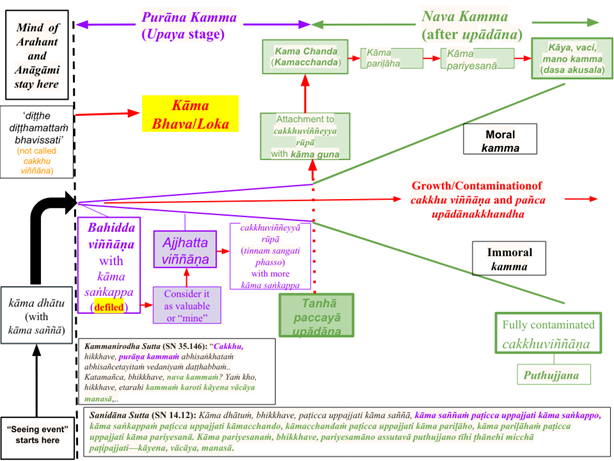
- The steps are as follows: Kāma dhātu TO kāma saññā TO kāma saṅkappa TO kāmacchanda TO kāma pariḷāha TO kāma pariyesanā, which leads to kamma accumulation via the mind, speech, and body, i.e., mano, vacī, and kāya kamma. These steps were briefly discussed using the chart below in the post “Purāṇa and Nava Kamma – Sequence of Kamma Generation.”
Các bước như sau: kāma dhātu → kāma saññā → kāma saṅkappa → kāmacchanda → kāma pariḷāha → kāma pariyesanā, dẫn đến sự tích lũy kamma qua tâm, lời nói và thân, tức mano, vacī và kāya kamma. Những bước này đã được thảo luận ngắn gọn bằng biểu đồ trong bài “Purāṇa and Nava Kamma – Sequence of Kamma Generation.”
Download/Print: “WebLink: PDF File Download: Purana and Nava Kamma -2-revision 2”
Tải xuống/In: “WebLink: PDF File Download: Purana and Nava Kamma -2-revision 2”
Steps in Kamma Accumulation Stops Automatically for Arahants
Các bước Tích lũy Kamma Tự động Dừng lại đối với các vị Arahant
- The chart shows that the mind starts at the “kāma dhātu” stage upon receiving an ārammaṇa (Note: I have revised the previous chart to indicate the difference in “viññāṇa expansion” for two types of ārammaṇa.) The sequence of kamma accumulation is in the “WebLink: suttacentral: Sanidāna Sutta (SN 14.12)” and was discussed in detail (especially the beginning steps) in the post “Upaya and Upādāna – Two Stages of Attachment.” I highly recommend reading it again. At the time of its posting, many people probably did not understand it. That sequence is:
Biểu đồ cho thấy rằng tâm bắt đầu ở giai đoạn “kāma dhātu” khi nhận một ārammaṇa (Lưu ý: tôi đã chỉnh sửa biểu đồ trước đó để chỉ ra sự khác biệt trong “sự mở rộng của viññāṇa” đối với hai loại ārammaṇa). Trình tự tích lũy kamma được nêu trong “WebLink: suttacentral: Sanidāna Sutta (SN 14.12)” và đã được thảo luận chi tiết (đặc biệt là các bước đầu) trong bài “Upaya and Upādāna – Two Stages of Attachment.” Tôi rất khuyến nghị đọc lại bài đó. Khi bài viết được đăng lần đầu, có lẽ nhiều người chưa hiểu rõ. Trình tự đó là:
- “Kāma dhātuṁ, bhikkhave, paṭicca uppajjati kāma saññā, kāma saññaṁ paṭicca uppajjati kāma saṅkappo, kāma saṅkappaṁ paṭicca uppajjati kāmacchando, kāmacchandaṁ paṭicca uppajjati kāma pariḷāho, kāma pariḷāhaṁ paṭicca uppajjati kāma pariyesanā.” OR “Attachment to kāma dhātu leads to kāma saññā, attachment to kāma saññā leads to kāma saṅkappa, attachment to kāma saṅkappa leads to kāmacchanda..and so on to kāma pariyesanā.”
“Kāma dhātuṁ, bhikkhave, paṭicca uppajjati kāma saññā, kāma saññaṁ paṭicca uppajjati kāma saṅkappo, kāma saṅkappaṁ paṭicca uppajjati kāmacchando, kāmacchandaṁ paṭicca uppajjati kāma pariḷāho, kāma pariḷāhaṁ paṭicca uppajjati kāma pariyesanā.” Tức là “Sự dính mắc vào kāma dhātu dẫn đến kāma saññā, sự dính mắc vào kāma saññā dẫn đến kāma saṅkappa, sự dính mắc vào kāma saṅkappa dẫn đến kāmacchanda… và tiếp tục cho đến kāma pariyesanā.”
- The critical point that needs to be pointed out is the following. “Kāma saṅkappa” starts arising only AFTER the “kāma saññā” step. As stated in the “WebLink: suttacentral: Nibbedhika Sutta (AN 6.63)” kāma rāga arises ONLY with kāma saṅkappa: “Saṅkappa rāgo purisassa kāmo” OR “kāma rāga is defined as kāma saṅkappa (mano saṅkhāra contaminated with rāga.)”
Điểm quan trọng cần nhấn mạnh là như sau. “Kāma saṅkappa” chỉ bắt đầu sinh khởi SAU bước “kāma saññā”. Như được nêu trong “WebLink: suttacentral: Nibbedhika Sutta (AN 6.63)”, kāma rāga chỉ sinh khởi cùng với kāma saṅkappa: “Saṅkappa rāgo purisassa kāmo”, tức “kāma rāga được định nghĩa là kāma saṅkappa (mano saṅkhāra bị ô nhiễm bởi rāga).”
- Such mano saṅkhāra arise within a billionth of a second without us realizing it. The arising of kāma rāga cannot be avoided if “kāma rāga anusaya/saṁyojana” is intact.
Những mano saṅkhāra như vậy sinh khởi trong vòng một phần tỷ giây mà chúng ta không nhận ra. Sự sinh khởi của kāma rāga không thể tránh khỏi nếu “kāma rāga anusaya/saṁyojana” vẫn còn tồn tại.
- Since Arahants and Anāgāmis have eliminated “kāma rāga anusaya/saṁyojana,” that second step DOES NOT occur for them. Thus, their minds DO NOT proceed beyond the kāma saññā The rest of the steps occur for only those below the Anāgāmi stage.
Vì các vị Arahant và Anāgāmi đã loại bỏ “kāma rāga anusaya/saṁyojana”, nên bước thứ hai đó KHÔNG xảy ra đối với họ. Do đó, tâm của họ KHÔNG đi xa hơn bước kāma saññā. Các bước còn lại chỉ xảy ra đối với những người dưới tầng Anāgāmi.
- The reason for Arahant’s mind not proceeding beyond the “kāma saññā” step was discussed using a different way in the post “Saññā – All Our Thoughts Arise With ‘Distorted Saññā’.” See #9 – #12 in that post. The following is a brief overview.
Lý do khiến tâm của một vị Arahant không tiến xa hơn bước “kāma saññā” đã được giải thích theo một cách khác trong bài “Saññā – All Our Thoughts Arise With ‘Distorted Saññā’.” Xem các mục #9 – #12 trong bài đó. Dưới đây là phần tóm lược ngắn gọn.
- The “WebLink: suttacentral: Upavāṇasandiṭṭhika Sutta (SN 35.70)” states, “Idha pana, upavāṇa, bhikkhu cakkhunā rūpaṁ disvā rūpappaṭisaṁvedī ca hoti rūparāgappaṭisaṁvedī ca” OR “Upavāna, take the case when a bhikkhu sees a sight with their eyes and also generates the desire for the sight.”
“WebLink: suttacentral: Upavāṇasandiṭṭhika Sutta (SN 35.70)” nói: “Idha pana, upavāṇa, bhikkhu cakkhunā rūpaṁ disvā rūpappaṭisaṁvedī ca hoti rūparāgappaṭisaṁvedī ca”, tức là “Upavāna, hãy xét trường hợp khi một vị bhikkhu nhìn thấy một cảnh bằng mắt và đồng thời sinh khởi sự ham muốn đối với cảnh đó.”
- In the verse “rūpappaṭisaṁvedī” means “rūpa paṭisaṁvedī” and “rūparāgappaṭisaṁvedī” means “rūpa rāga paṭisaṁvedī.” Just seeing (without attachment, but still with “distorted saññā”) happens with “rūpa paṭisaṁvedī,” and the attachment happens with “rūpa rāga paṭisaṁvedī.”
Trong câu này, “rūpappaṭisaṁvedī” nghĩa là “rūpa paṭisaṁvedī” và “rūparāgappaṭisaṁvedī” nghĩa là “rūpa rāga paṭisaṁvedī.” Việc chỉ đơn thuần nhìn thấy (không có dính mắc, nhưng vẫn với saññā “bị bóp méo”) xảy ra ở bước “rūpa paṭisaṁvedī”, còn sự dính mắc xảy ra ở bước “rūpa rāga paṭisaṁvedī.”
- Thus, an Arahant will only go through the “rūpa paṭisaṁvedī” but NOT the “rūpa rāga paṭisaṁvedī” step. A bhikkhu below the Arahant/Anāgāmi stages goes through both steps in the above verse. Note that “rūpa” here means all five types of rūpa present in the kāma loka and does NOT refer to “rūpa loka.”
Vì vậy, một vị Arahant chỉ trải qua bước “rūpa paṭisaṁvedī” mà KHÔNG trải qua bước “rūpa rāga paṭisaṁvedī.” Một vị bhikkhu dưới tầng Arahant/Anāgāmi sẽ trải qua cả hai bước trong câu trên. Lưu ý rằng “rūpa” ở đây có nghĩa là tất cả năm loại rūpa hiện diện trong kāma loka và KHÔNG chỉ “rūpa loka.”
Steps in Kamma Accumulation for a Puthujjana
Các Bước Tích Lũy Kamma Đối Với Puthujjana
- The first two steps in #3 and #4 take place simultaneously in the mind of a puthujjana upon receiving the sensory input, i.e., in the first citta vīthi. Thus, at the step “Kāma dhātuṁ, bhikkhave, paṭicca uppajjati kāma saññā” in the “WebLink: suttacentral: Sanidāna Sutta (SN 14.12)” BOTH “rūpa paṭisaṁvedī” and “rūpa rāga paṭisaṁvedī” occur for anyone with “kāma rāga anusaya/saṁyojana.”
Hai bước đầu trong #3 và #4 xảy ra đồng thời trong tâm của một puthujjana khi nhận đối tượng giác quan, tức trong citta vīthi đầu tiên. Vì vậy, ở bước “Kāma dhātuṁ, bhikkhave, paṭicca uppajjati kāma saññā” trong “WebLink: suttacentral: Sanidāna Sutta (SN 14.12)”, CẢ HAI bước “rūpa paṭisaṁvedī” và “rūpa rāga paṭisaṁvedī” đều xảy ra đối với bất kỳ ai còn “kāma rāga anusaya/saṁyojana.”
- Therefore, the two suttās (“WebLink: suttacentral: Sanidāna Sutta (SN 14.12)” and the “WebLink: suttacentral: Upavāṇasandiṭṭhika Sutta (SN 35.70)”) state the same thing but in different ways.
Do đó, hai sutta (“WebLink: suttacentral: Sanidāna Sutta (SN 14.12)” và “WebLink: suttacentral: Upavāṇasandiṭṭhika Sutta (SN 35.70)”) nói cùng một điều nhưng theo hai cách khác nhau.
- Let us now discuss the “expansion of viññāṇa” for a puthujjana in the subsequent steps, as shown in the chart above.
Bây giờ chúng ta hãy thảo luận về “sự mở rộng của viññāṇa” đối với puthujjana trong các bước tiếp theo, như được minh họa trong biểu đồ ở trên.
Two Stages of “Viññāṇa Expansion”
Hai Giai đoạn “Mở Rộng Viññāṇa”
- The increasing contamination of a mind (viññāṇa) with time is shown as two “expansions” (represented by two “cones” in the above chart):
Sự ô nhiễm ngày càng tăng của tâm (viññāṇa) theo thời gian được thể hiện như hai “sự mở rộng” (được biểu diễn bằng hai “hình nón” trong biểu đồ ở trên):
- In the “purāṇa kamma” stage, contamination happens slowly, and we are not even aware of the sensory input yet.
Trong giai đoạn “purāṇa kamma”, sự ô nhiễm xảy ra chậm và chúng ta thậm chí chưa nhận thức được đầu vào giác quan.
- The contamination is stronger in the “nava kamma” stage, where kamma accumulation happens consciously (with javana citta.)
Sự ô nhiễm mạnh hơn trong giai đoạn “nava kamma”, nơi sự tích lũy kamma xảy ra một cách có ý thức (với javana citta).
- That second stage of expansion occurs ONLY IF we consciously attach to the ārammaṇa with the mindset that it can provide us with happiness. That is where “kāma guṇa” comes into play.
Giai đoạn mở rộng thứ hai chỉ xảy ra NẾU chúng ta có ý thức dính mắc vào ārammaṇa với suy nghĩ rằng nó có thể mang lại hạnh phúc cho mình. Đó là lúc “kāma guṇa” xuất hiện.
- First, let us clarify the arising of “bahiddha viññāṇa” and “ajjhatta viññāṇa” in the “purāṇa kamma” stage using the above chart.
Trước hết, hãy làm rõ sự sinh khởi của “bahiddha viññāṇa” và “ajjhatta viññāṇa” trong giai đoạn “purāṇa kamma” bằng cách sử dụng biểu đồ trên.
Arising of “Bahiddha Viññāṇa” and “Ajjhatta Viññāṇa”
Sự sinh khởi của “Bahiddha Viññāṇa” và “Ajjhatta Viññāṇa”
- As we noted above, the mind of a puthujjana gets attached to ANY sensory input (ārammaṇa) in kāma loka at the very first instance. At the outset of that process, a “defiled viññāṇa” arises as “bahiddha viññāṇa” and strengthens to “ajjhatta viññāṇa” via only “kāma saṅkappa” which are “mano kamma.” No javana cittā arise at these steps.
Như đã lưu ý ở trên, tâm của một puthujjana dính mắc vào BẤT KỲ đầu vào giác quan (ārammaṇa) nào trong kāma loka ngay từ khoảnh khắc đầu tiên. Khi bắt đầu quá trình đó, một viññāṇa bị ô nhiễm sinh khởi dưới dạng “bahiddha viññāṇa” và mạnh dần lên thành “ajjhatta viññāṇa” chỉ thông qua “kāma saṅkappa”, tức các mano kamma. Không có javana cittā sinh khởi ở các bước này.
- The first instance of “weak attachment” is said to occur with “bahiddha viññāṇa.”
Khoảnh khắc đầu tiên của “sự dính mắc yếu” được nói là xảy ra với “bahiddha viññāṇa.”
- In the next step of “kāma saññaṁ paṭicca uppajjati kāma saṅkappo” that viññāṇa gets a bit stronger at the “ajjhatta viññāṇa” stage; see the chart above.
Ở bước tiếp theo “kāma saññaṁ paṭicca uppajjati kāma saṅkappo”, viññāṇa đó trở nên mạnh hơn một chút ở giai đoạn “ajjhatta viññāṇa”; xem biểu đồ ở trên.
- Right after the “ajjhatta viññāṇa” stage, the mind starts attaching to “its version of the external rūpa” (“cakkhuviññeyyā rūpa” means a “rūpa prepared by cakkhuviññāṇa.”)
Ngay sau giai đoạn “ajjhatta viññāṇa”, tâm bắt đầu dính mắc vào “phiên bản của rūpa bên ngoài do nó tạo ra” (“cakkhuviññeyyā rūpa” nghĩa là một “rūpa được cakkhuviññāṇa chuẩn bị.”)
Transition to the “Nava Kamma” Stage with Kāma Guṇa
Sự chuyển sang Giai đoạn “Nava Kamma” với Kāma Guṇa
- If that “cakkhuviññeyyā rūpa” is tempting to the mind, it will examine whether that “mind-made rūpa” has enough “kāma guṇa,”e., whether it is “enticing enough.” Note that “kāma guṇa” is NOT in the external object.
Nếu “cakkhuviññeyyā rūpa” đó hấp dẫn đối với tâm, tâm sẽ xem xét liệu “rūpa do tâm tạo” đó có đủ “kāma guṇa” hay không, tức là nó có “đủ sức lôi cuốn” hay không. Lưu ý rằng “kāma guṇa” KHÔNG nằm trong đối tượng bên ngoài.
- The “WebLink: suttacentral: Kāmaguṇa Sutta (AN 9.65)” states: “Pañcime, bhikkhave, kāmaguṇā.” It is misleading to translate that as “There are five kāma guṇā.”
“WebLink: suttacentral: Kāmaguṇa Sutta (AN 9.65)” nói: “Pañcime, bhikkhave, kāmaguṇā.” Việc dịch câu này là “Có năm kāma guṇā” là gây hiểu lầm.
- Here, “pañca kāma guṇa” does not mean “five types of guṇa.” The five refers to the five types of kāma (sensual pleasures with five physical senses [eye, ear, nose, tongue, and body]) available in kāma loka. There are six types of “guṇa.”
Ở đây, “pañca kāma guṇa” không có nghĩa là “năm loại guṇa.” Con số năm chỉ năm loại kāma (các khoái lạc giác quan qua năm giác quan vật lý: mắt, tai, mũi, lưỡi và thân) có trong kāma loka. Thực ra có sáu loại “guṇa.”
- Those six types are: “iṭṭhā, kantā, manāpā, piyarūpā, kāmūpasaṁhitā, and rajanīyā.”
Sáu loại đó là: “iṭṭhā, kantā, manāpā, piyarūpā, kāmūpasaṁhitā và rajanīyā.”
- The concept of kāma guṇā and the six types are discussed in #10 through #13 in the post “Kāma Rāga Dominates Rūpa Rāga and Arūpa Rāga.” and quoted below.
Khái niệm kāma guṇā và sáu loại này được thảo luận trong các mục #10 đến #13 của bài “Kāma Rāga Dominates Rūpa Rāga and Arūpa Rāga.” và được trích dẫn dưới đây.
- The first one, iṭṭhā means “promise of fulfillment,” which goes with our perceived “nicca nature of this world.” However, the world is of anicca nature, and thus, this “iṭṭhā characteristic” is based on the ignorance of the real nature.
Loại thứ nhất, iṭṭhā, nghĩa là “lời hứa về sự thỏa mãn”, gắn liền với nhận thức của chúng ta về “bản chất nicca của thế giới.” Tuy nhiên, thế giới có bản chất anicca, và vì vậy đặc tính “iṭṭhā” này dựa trên sự vô minh về bản chất thật.
- The three characteristics kantā, manāpā, and piyarūpā express similar meanings: desirable, agreeable, and pleasant (and emphasize the iṭṭhā) The fifth, “kāmūpasaṁhitā,” means “induce sensuality.” The last one, “rajanīyā,” means “generating defilements” and thus can make one do immoral things to fulfill one’s desires.
Ba đặc tính kantā, manāpā và piyarūpā diễn tả những ý nghĩa tương tự: đáng mong muốn, dễ chịu và hấp dẫn (và nhấn mạnh đặc tính iṭṭhā). Đặc tính thứ năm, “kāmūpasaṁhitā”, nghĩa là “khơi dậy dục lạc”. Đặc tính cuối cùng, “rajanīyā”, nghĩa là “tạo ra ô nhiễm”, và do đó có thể khiến người ta làm những hành động bất thiện để thỏa mãn ham muốn của mình.
- The last two clarify that “kāma guṇa” refers mainly to the kāma loka.
Hai đặc tính cuối làm rõ rằng “kāma guṇa” chủ yếu liên quan đến kāma loka.
Kāma Guṇa Come Into Play After “Ajjhatta Viññāṇa”
Kāma Guṇa xuất hiện sau giai đoạn “Ajjhatta Viññāṇa”
- At the “ajjhatta viññāṇa” stage, a specific person’s “gati” comes into play. “Ajjhatta” means “one’s own.”
Ở giai đoạn “ajjhatta viññāṇa”, “gati” của từng người bắt đầu đóng vai trò. “Ajjhatta” nghĩa là “của chính mình”.
- While the “bahiddha viññāṇa” is triggered with kāma rāga anusaya/saṁyojana, the “ajjhatta viññāṇa” also depends on one’s gati at that time.
Trong khi “bahiddha viññāṇa” được kích hoạt bởi kāma rāga anusaya/saṁyojana, thì “ajjhatta viññāṇa” còn phụ thuộc vào gati của mỗi người tại thời điểm đó.
- Furthermore, even for the same person, “kāma gati” will manifest at different levels depending on the conditions. While watching an erotic movie, “kāma gati” will be strengthened, but while listening/reading Dhamma, it will be non-existent.
Hơn nữa, ngay cả với cùng một người, “kāma gati” sẽ biểu hiện ở các mức độ khác nhau tùy theo điều kiện. Khi xem một bộ phim khiêu dâm, “kāma gati” sẽ mạnh lên, nhưng khi nghe hoặc đọc Dhamma của Đức Phật, nó sẽ không xuất hiện.
- Depending on the strength of the “kāma guṇa” generated for that sensory input (ārammaṇa), it leads to further contamination of the viññāṇa. This is where the “second cone” starts in the chart above, signifying the “nava kamma” stage.
Tùy theo mức độ mạnh yếu của “kāma guṇa” được tạo ra cho đầu vào giác quan (ārammaṇa), viññāṇa sẽ bị ô nhiễm thêm. Đây là nơi “hình nón thứ hai” bắt đầu trong biểu đồ trên, biểu thị giai đoạn “nava kamma.”
Mind Starts Consciously Accumulating Kamma in the “Nava Kamma” Stage
Tâm Bắt Đầu Tích Lũy Kamma Một Cách Có Ý Thức Trong Giai Đoạn “Nava Kamma”
- As shown in the chart, attachment to the “mind-made rūpa” strengthens with “kāma guṇa” and “kāmacchanda” (or kāma chanda) arising in the mind.
Như được thể hiện trong biểu đồ, sự dính mắc vào “rūpa do tâm tạo ra” trở nên mạnh hơn khi “kāma guṇa” và “kāmacchanda” (hay kāma chanda) sinh khởi trong tâm.
- That means one is strongly attached, and now the mind is in a “state of agitation” (“kāma pariḷāha”) until its desire to enjoy “more of it” is satisfied. Thus, it starts investigating ways to fulfill that desire, i.e., one engages in “kāma pariyesanā.”
Điều đó có nghĩa là sự dính mắc đã trở nên mạnh, và lúc này tâm ở trong “trạng thái kích động” (“kāma pariḷāha”) cho đến khi mong muốn được hưởng thụ “nhiều hơn nữa” được thỏa mãn. Vì vậy, tâm bắt đầu tìm cách thực hiện mong muốn đó, tức là tham gia vào “kāma pariyesanā.”
- That is when one starts doing kamma with speech and actions, i.e., now, one is fully engaged with mano, vacī, and kāya kamma.
Đó là lúc một người bắt đầu tạo kamma bằng lời nói và hành động, tức là lúc này người đó đã hoàn toàn tham gia vào mano, vacī và kāya kamma.
An Example
Một Ví dụ
- For example, consider person X going to a meal at a friend’s house. X is offered a dish he has not tasted before and finds it quite tasty.
Ví dụ, hãy xét trường hợp người X đến dùng bữa tại nhà một người bạn. X được mời một món ăn mà trước đây chưa từng nếm và thấy nó khá ngon.
- The taste of the food was the “kāma saññā” (in this case, “rasa saññā”) that triggered kāma saṅkappa automatically (the first step generating “bahiddha viññāṇa.”) As more kāma saṅkappa arise, his “jivhā indriya” becomes “jivhā āyatana” at the second of “ajjhatta viññāṇa.” See the above chart.
Vị của món ăn chính là “kāma saññā” (trong trường hợp này là “rasa saññā”) đã tự động kích hoạt kāma saṅkappa (bước đầu tiên tạo ra “bahiddha viññāṇa”). Khi nhiều kāma saṅkappa sinh khởi hơn, “jivhā indriya” của anh ta trở thành “jivhā āyatana” ở bước thứ hai của “ajjhatta viññāṇa”. Xem biểu đồ ở trên.
- If the dish is enticing (i.e., if it triggers strong “kāma guṇa”), X’s mind will attach to the “rasa rūpa” created in his mind by the “tasty dish.” That is the “kāma chanda” stage in the chart.
Nếu món ăn hấp dẫn (tức là nếu nó kích hoạt mạnh “kāma guṇa”), tâm của X sẽ dính mắc vào “rasa rūpa” được tạo ra trong tâm bởi “món ăn ngon.” Đó là giai đoạn “kāma chanda” trong biểu đồ.
- Now, X wants to know more about the dish and starts asking the friend how to make it or where to buy it. Those involve the rest of the steps leading to kāya, vacī, and mano kamma.
Lúc này X muốn biết thêm về món ăn và bắt đầu hỏi người bạn cách nấu hoặc nơi mua nó. Những điều này liên quan đến các bước tiếp theo dẫn đến kāya, vacī và mano kamma.
- If X got really attached to that meal, he may tell others about it the next day and even try to make it himself. All those involve vacī and kāya saṅkhāra. If that is the case, the “viññāṇa” (expectation of enjoying the meal again) that arose in his mind was strong.
Nếu X thực sự dính mắc vào bữa ăn đó, anh ta có thể kể cho người khác nghe vào ngày hôm sau và thậm chí thử tự nấu món đó. Tất cả những điều đó liên quan đến vacī và kāya saṅkhāra. Trong trường hợp đó, “viññāṇa” (sự mong đợi được thưởng thức món ăn đó lần nữa) sinh khởi trong tâm anh ta là mạnh.
Kāma Rāga Means Getting Attached to “Mind-Made Vedanā”
Kāma Rāga Nghĩa là Dính mắc vào Vedanā Do tâm tạo ra
- The human world has abundant enticing sights, sounds, tastes, odors, and bodily comforts. Those are not kāma. They are kāma guṇa that we had created by being born with this physical body; this birth occurred only because we had craved such a body in the past. Comprehending that requires understanding how the “bhava paccayā jāti” step in Paṭicca Samuppāda led to the birth of the present physical body. That is vipassanā!
Thế giới loài người có vô số cảnh tượng, âm thanh, hương vị, mùi và sự dễ chịu của thân thể đầy hấp dẫn. Những thứ đó không phải là kāma. Chúng là kāma guṇa mà chúng ta đã tạo ra do được sinh ra với thân thể vật lý này; sự sinh ra này chỉ xảy ra vì trước đây chúng ta đã khao khát một thân thể như vậy. Hiểu được điều đó đòi hỏi phải hiểu cách bước “bhava paccayā jāti” trong Paṭicca Samuppāda dẫn đến sự sinh ra của thân thể hiện tại. Đó chính là vipassanā!
- This physical body is created by kammic energy to provide that “distorted saññā.” That is why even an Arahant will taste the “sweetness of a tasty meal.” But his mind has fully comprehended how that “distorted saññā” arises and that it is a “mirage” or a “magic show.” The Buddha called saññā a mirage and viññāṇa magician in the “WebLink: suttacentral: Pheṇapiṇḍūpama Sutta (SN 22.95),” and we discussed that in the post, “Sotāpanna Stage and Distorted Saññā.”
Thân thể vật lý này được tạo ra bởi năng lượng kamma để tạo ra “saññā bị méo mó” đó. Vì vậy ngay cả một Arahant cũng sẽ cảm nhận “vị ngọt của một món ăn ngon.” Nhưng tâm của vị ấy đã hoàn toàn hiểu cách “saññā bị méo mó” đó sinh khởi và rằng nó chỉ là một “ảo ảnh” hay một “màn ảo thuật.” Đức Phật đã gọi saññā là ảo ảnh và viññāṇa là nhà ảo thuật trong “WebLink: suttacentral: Pheṇapiṇḍūpama Sutta (SN 22.95)”, và chúng ta đã bàn về điều đó trong bài “Sotāpanna Stage and Distorted Saññā.”
- Therefore, the next step of generating kāma saṅkappa and getting to the “ajjhatta viññāṇa” stage does not occur for an Arahant.
Vì vậy, bước tiếp theo là sinh khởi kāma saṅkappa và tiến đến giai đoạn “ajjhatta viññāṇa” sẽ không xảy ra đối với một Arahant.
- Anyone not released from the kāma loka will get to the first steps of generating “bahiddha viññāṇa” and the “ajjhatta viññāṇa” stages, i.e., will go through the “purāṇa kamma” stage.
Bất kỳ ai chưa thoát khỏi kāma loka sẽ đi đến các bước đầu tiên của việc tạo ra “bahiddha viññāṇa” và giai đoạn “ajjhatta viññāṇa”, tức là sẽ trải qua giai đoạn “purāṇa kamma.”
- But the second stage of “nava kamma” will be initiated only if the ārammaṇa is strong enough to trigger the conscious attachment (taṇhā) to that “mind-made rūpa.” If that happens, then the “standard Paṭicca Samuppāda” process will kick in at the “taṇhā paccayā upādāna” step, leading to a “rapid and strong expansion of viññāṇa”; see the chart above.
Nhưng giai đoạn thứ hai của “nava kamma” chỉ bắt đầu nếu ārammaṇa đủ mạnh để kích hoạt sự dính mắc có ý thức (taṇhā) vào “rūpa do tâm tạo ra.” Nếu điều đó xảy ra, thì tiến trình “Paṭicca Samuppāda” tiêu chuẩn sẽ khởi động tại bước “taṇhā paccayā upādāna”, dẫn đến sự “mở rộng nhanh và mạnh của viññāṇa”; xem biểu đồ ở trên.
First Step for Removing Kāma Rāga Is To Remove Kāma Guṇa
Bước Đầu Tiên Để Loại Bỏ Kāma Rāga Là Loại Bỏ Kāma Guṇa
- First, one must stop the “nava kamma” stage from starting. That requires getting rid of kāma guṇa by losing one’s attachment to “sensual sensory events” or mind-pleasing ārammaṇa.
Trước hết, cần phải ngăn không cho giai đoạn “nava kamma” bắt đầu. Điều đó đòi hỏi phải loại bỏ kāma guṇa bằng cách từ bỏ sự dính mắc vào “các trải nghiệm giác quan mang tính dục lạc” hoặc các ārammaṇa làm tâm thích thú.
- The “WebLink: suttacentral: Yogakkhemi Sutta (SN 35.104)” states that the Buddha has cut-off kāma guṇa at their roots. Of course, that is true for Arahants and Anāgāmis
“WebLink: suttacentral: Yogakkhemi Sutta (SN 35.104)” nói rằng Đức Phật đã cắt đứt kāma guṇa tận gốc rễ. Dĩ nhiên điều này cũng đúng đối với các Arahant và Anāgāmi.
- That becomes easier when one realizes that all mind-pleasing ārammaṇa are “fake” or a “magic show” as explained in #15.
Điều đó trở nên dễ dàng hơn khi người ta nhận ra rằng mọi ārammaṇa làm tâm thích thú đều là “giả tạo” hay chỉ là một “màn ảo thuật” như đã giải thích ở mục #15.
Related Posts
Các bài Liên quan
- All related posts in “Sotāpanna Stage via Understanding Perception (Saññā).”
Tất cả các bài liên quan trong mục “Sotāpanna Stage via Understanding Perceptio (Saññā).”
- The first post provides links to posts with the required background: “Sotāpanna Stage and Distorted Saññā.”
Bài đầu tiên cung cấp các liên kết đến những bài viết có nền tảng cần thiết: “Sotāpanna Stage and Distorted Saññā.”